
Expletive Deleted

On the 9th August 1974 president Richard Nixon resigned from office in the face of almost certain impeachment. As president he broke a number of political, constitutional and moral norms.

He attempted to use Departments of state to “get dirt” on his opponents; he had a list of “enemies”; he hated the press; he expected loyalty to himself not the Constitution; he instigated the Saturday night massacre, his Attorney General and Deputy Attorney General resigning in succession when he ordered them to fire Archibald Cox the Special Prosecutor investigating the Watergate affair. He was a bad man. And he swore a lot.

Not since then has the US faced such a norm challenging president. Someone who threatens not just to do a bad job or make awful policy decisions but who actively undermines the foundations of the democratic system of government.

The parallels between Nixon and Trump are many and close however in the pantheon of awfulness Trump stands head and shoulders above even Nixon. He has been a far greater threat to US democracy and liberal democracy worldwide than Nixon ever was. There are two reasons for this.

Firstly, the character of the person. Neither Nixon or Trump could be said to be overly worried about questions of conscience or moral scruple. The difference is Nixon knew there was an issue, Trump doesn’t understand the question.

The second difference, is the the moral character of those about them. Nixon had loyal supporters, some of whom went to jail for him. However within the Republican Party and within Departments of State, most importantly Justice, individuals knew there were lines that must not be crossed.

They knew when partisan political focus strayed into an obsessive demand for control at the expense of Constitutional government. Not only did they know when something was wrong they did something about it. His political colleagues in the Republican party withdrew support from the president making the success of impeachment certain, lifetime public servants resigned rather than implement the actions of an increasingly irrational leader.

The threads connecting Nixon who was enraged by what he saw as the radical trends of the 1960’s in relation to issues like race, gender, youth, and Trump who has many of the same prejudices are fascinating.

Part of the Nixon legacy may be his support for a counter revolution taken up by libertarian oligarchs determined to overturn what they saw as a strengthening progressive agenda. The investment of hundreds of millions of dollars to change the intellectual landscape and build an alternative neoliberal agenda as promoted by groups like the Mont Pelerin Society.

An agenda of small government and privatisation, unregulated free markets, low taxation, a Washington consensus about the benefits of free trade Their activities contributed to a period where market-determined price became the measure of worth of all things to the exclusion of value. Government was portrayed as the problem, supply side economics with its tax cuts and de-regulation the norm with a Washington consensus about trickle down wealth distribution.

Over the years what may arguably have been a reasonable recognition of the importance of entrepreneurial dynamism became an ossified dogma incapable of addressing the problems of an increasingly integrated world with a dramatically different economic structure.

A weightless world of digital goods and instant communications facilitating global supply chains supporting just-in-time assembly processes. A world where offshoring, and mechanisation was destroying some jobs and shifting others to the other side of the world.

The impact of all this on, initially, non-graduate labour but as countries expanded their higher education, graduate labour was remorseless. Further, the deregulation agenda meant the ability of labour to defend itself was diminished if not removed.

The outcome in terms of growing inequality, an uncertain “gig”economy, loss of employment rights and benefits, and in the States the loss of health insurance created a sense of despair. Despair which had devastating consequence for the health and well being of many as described by Anne Case and Angus Deaton in their work “Deaths of Despair”.

These trends have meant the majority of the populations of many western democracies have seen their standard of living stagnate or decline. The political elites of these nations have seen this decline as an unfortunate consequence of economic progress.

Labour and Conservative, Democrat and Republican have argued, more or less forcefully the market economy is a self regulating machine which human interference can only damage. Ultimately it will make things better. Ultimately of course we are all dead. For those living, and possibly dying, through the transition, ultimately better days are of little consolation.

It is this context in which Donald Trump came to power. For Millions of Americans, no one was listening to them. It is a sign of the level of desperation they felt that a billionaire, foul mouthed, misogynist, racist could be seen as someone able to address their concerns.

What Trump did do was articulate their fears. He gave them a voice. He took the crisis of identity which unemployment, underemployment and marginal employment foster and gave it a series of targets which he claimed would “Make America Great Again”.

After four years the Trump record on the issues he said were his priorities is clear. He “loves” coal but coal production is lower as he leaves office than when he arrived, the balance of trade with China (ignoring the question of whether a deficit is necessarily a bad thing) in 2016 was negative $346bn in 2019 it was negative $345bn. (It is much lower in 2020 but there are reasons for that.) The $1bn reduction in the deficit has come at significant cost to the US economy. The New York Federal reserve has estimated that the trade war has wiped $1.7tn off the value of US companies.

In January 2016 US unemployment was at 4.9%. This was after six straight years of decline from a high of 10% in October 2009. In October 2020 the rate is 6.9%. The wall with Mexico remains to be built and Mexico have made clear their views on paying for it. Worst of all, close to a quarter of a million US citizens have died from Covid-19. A significant proportion of those would still be alive if the president had chosen to address the issue.

President Trump’s record is disastrous in his own terms which in the main are wrong anyway. This is before you address the issues of nepotism, self dealing, global security, national standing. I could go on.

However, the issues which created the space for a Trump presidency have not gone away. A radical agenda of change is needed and those that Hilary Clinton dismissed as in the “basket of deplorables” need to be reached out to and tangible support provided.

A president Biden has a massive task ahead. Despite appearances to the opposite winning the presidency is the easy bit. Crafting a consensus which secures real change in the balance of economic power to ensure areas like the rustbelt experience economic transition as benefit not just pain will be a massive challenge.

The agenda and the process of reconciliation is more than a one term exercise.and will mean hitting the ground running. There are those that doubt whether Joe Biden is up to the job. We will see, however, whatever his failings he is infinitely better than his predecessor. Democracy has rescued itself as it has done before. The political elites of all democratic parties must learn the lesson of how fragile it is and stand up for it against all who attempt to undermine it whichever side of the aisle they stand.

When he was forced to release the transcripts of the tapes of the conversations in the Oval office President Nixon insisted that the obscenities be deleted. This led to a huge number of text replacements with the term “expletive deleted”. Democracy has just ensured that an expletive has been deleted from the White House. It is a massive triumph for democracy.

On Tyranny. “…it could never happen here?”

This is a book you can read in a morning and is well worth the time. First published in 2017 it is shot through with real concern and a sense of urgency following early experiences of the Trump campaign and presidency.

The book, written by Timothy Snyder, Housum Professor of History at Yale, looks at the tyrannies of the 20th Century, particularly Hitlers Fascism and Stalin’s soviet communism. It identifies a set of behaviours to be avoided or adopted to oppose tyrants. These are set in a theory of history which see it as being made as much through the voluntary actions of the many as what appear to be the irresistible impositions of a few. And a theory of democracy which sees it as something to be tended and nurtured regularly. A key part citizenship is a responsibility to actively engage in that process.

His concerns about the behaviours of Trump which parallel those of tyrants of the 20th and 21st century have only become clearer in the period since the book was written. The attacks on the judiciary and the media; the rejection of truth; the characterisation of political opponents as extremists or enemies of the people; the use of the state apparatus to persecute critics; the demands for personal loyalty over professional integrity. The parallels with nazi Germany, the Soviet union and more recent political strongmen are truly frightening.

The book is a demand we learn from history and as citizens identify ways in which individually and collectively, in our day to day behaviour and in organised actions, we can oppose the threat which Trump is seen as posing.

The strategies include things which stated alone seem blindingly obvious, like “believe in truth”; “defend institutions”; “remember professional ethics”. Five years ago, as advice to a mature democracy, they would have appeared as simplistic truisms. It is interesting how, with four years of a Trump presidency, they take on a much more powerful relevance.

A key message of the book is that, as Professor Snyder puts it, “Most of the power of authoritarianism is freely given.” He warns against “anticipatory obedience”. This is where an aspirant tyrant starts to fly policy kites and waits to see if people start to adopt behaviours ahead of any specific action. If this occurs the tyrant is emboldened to go further.

The book outlines how this type of behaviour sealed the fate of Austrian Jews. How Hitler only had to threaten annexation of Austria to secure violent discrimination against Jews by Austrian nazis. This experience of anticipatory obedience taught the nazi leadership a lesson which added confidence to their organising of Kristallnacht.

On Tyranny provides a challenging frame to assess the Trump presidency. The author’s passion is clearly driven by his deep understanding of the holocaust. Particularly the recognition that the acts of omission by the many contributed to the horror as well as the acts of commission by the minority. In addition to the passion and urgency a real sense of fear pervades the writing.

At the time it was written I think the fear was well founded. As we approach the 2020 election I now have more hope. Although the awfulness of Trump was apparent his incompetence was still being revealed. An incompetence which extends not just to the governance of the nation but to his own affairs and long term best interest.

Two years down the track and it is clear he does not just lie to others he lies to himself. What is more, the self deception only gets worse as the reality and his mental picture of reality diverge. Whilst there is still significant risk with voter suppression; calls to his solid base of armed supporters to go poll watching; attempts to discredit the result and refusal to confirm he will accept it; packing the Supreme and federal court system to facilitate future legal challenge, there is a growing sense that American democracy is going to fight back.

The polls show not just a Biden lead but the potential for a blue wave to crash across the capitol taking both houses of Congress. It is no less than the pliant Republican poodles deserve. They are up to their necks in the outrageous behaviour of their president, whatever distance they are now trying to put between themselves hand him.

One institution, more than any other provides comfort that a Trump coup is unlikely to succeed. If you want to lead a coup make sure the armed forces are on your side. Two hundred and fifty years of civilian government has embedded a culture of military compliance with civilian authority. Further, you do not gain the support of people that risk their lives for their country by denigrating their sacrifice.

Professor Snyder’s worries about tyranny, may not come to fruition in the person of Donald Trump. Democracy may consign him to an ignoble chapter in the history of US presidents. However, no one should underestimate the stress US democracy has experienced over the past four years or its impact on the body politic.

Even if President Trump is voted out America has much to do to repair and strengthen its democratic systems and procedures but most important its democratic values. It remains to be seen whether Joe Biden is up to the job.

On Tyranny provides something of a yard stick to measure the damage that has been done. What it shows, across all parts of US governmental institutions, is that what was unthinkable 5 years ago has become commonplace. It would be a brave person, following the Trump presidency who could say “it could never happen here.” It is up to the American people to make sure it never does.

On Tyranny. Prof. Timothy Snyder.The Bodley Head. 2017

Why Joe Biden Will not win the US Election

Political prediction is almost always a hope of the heart propelled by a wishful intellect. However…

I hardly dare say it but it does look as if the wheels are finally coming off the clown car which is the Trump administration. Naturally at this point in any predictive article it is important to put the Wilsonian disclaimer in that “a week is a long time in politics” and we are a good four months from 3 November when Americans go to the polls.

When they do go they will not just be judging the performance of their President they will also be voting for 35 seats in the Senate, where the Republicans currently have a six seat majority, and all 435 members of the House of Representatives where the Democrats have a 15 seat majority.

At the moment Mr Biden has a double digit poll lead. Even his closest supporters would be hard pressed to put this down to energetic, charismatic, high profile campaigning. 

What Mr Biden does have on his side is President Trump and an administration which increasingly lacks competence and credibility. An administration long on loyalty but short on ability. Better yet even the long position seems to be starting to crack.

A large number of Americans have been giving President Trump the benefit of the doubt. I have no doubt that, for a very tiny fraction of Americans, the spiteful and juvenile stream of tweets; the coarse behaviour and articulation of clearly racist and misogynist views were welcomed. For a much larger number however, I suspect there was a feeling this was a price worth paying to shake up the elite and drain the swamp. They had been ignored for so long that something radically different was needed. Well they certainly got that.

Having said this it became ever more difficult to understand why the President’s increasingly unconstitutional and bizarre behaviour seemed to come at no cost to his support. People appeared to be willing to accommodate ever more outrageous attacks on the very foundations of the US constitution. 

The separation of powers, the independence of the judiciary, the chain of command, respect for the law, threats to a free press, abuse of office for personal gain, nepotism. As they occurred individually and even as they accumulated they did not lead to the level of public outrage that many thought appropriate and inevitable. However, over the years they have built up a picture which people simply did not focus on when the economy was booming and unemployment was falling to record low levels.

But now, Covid-19 (C-19) has burst the bubble of the Trump narrative. His bluster and incompetence have been revealed for what they are.  

The shotgun the President took early on in his Administration to health care was always pointed at his foot. Having shot off one foot in the mid-terms he carefully took aim at this issue again on the other foot! 

His denial of C-19, his failure to act early, his stupid musings on how to cure it with disinfectant, his refusal to model appropriate social distancing practices, his rush to reopen the economy, prioritising re-election over American lives, all reveal the essence of the man. An incompetent narcissist, with the attention span of a goldfish and IQ to match.  Whilst this has been visible to some for a long time it is now being brought home to all Americans in the most cruel manner.

This awakening is set to lead to a re-evaluation of much of the past five years. The doubt is over. He really is what he appears to be. What is more that re-evaluation may not simply focus on the President. The Republican party and its members of the Senate and House; the cast of venal  incompetents, extreme loyalists and yes men that make up his cabinet, and the upper echelons of the Federal bureaucracy appointed by Trump may all feel the growing wrath of the American people. 

It is clear some of his “team” are beginning to see this. Members of his own party, startled by polling numbers, are starting to put their head above the parapet. Senator John Thune has urged the President to focus on an electoral strategy which, “deals with substance and policy…”  and is presented in a different “tone”. Good luck with that one Senator.

What 4 years have shown is the complete lack of ability of this President. The esteem of the nation in the eyes of its allies is lower than it has ever been. Its  foreign policy a combination of rhetorical triumphs with practical failure, see North Korea and the Middle East. A craven response to dictators, see Russia and its interest in Ukraine, and Turkey and its interests in Syria. A trade “policy” the theoretical idiocy of which is only exceeded by its incompetent implementation. A legislative record, the golden star of which was a tax cut focussed clearly on the 1%.

If the election was tomorrow it is very likely there would be a Democratic landslide. The Republicans must be praying for a miracle because there is nothing on the horizon set to help. The monumental mishandling of the virus means America is now sitting on an epidemic time bomb set to overwhelm the medical services of the richest country in the world. The graph below shows the surging infection numbers. This will eventually force an effective lockdown and an avoidable protraction of the damage to the economy. 

Covid-19 Confirmed Cases. Source: The New York Times


Even if the disease were to disappear tomorrow the impact has been devastating. The virus has already taken more American lives than the wars in  Korea and Vietnam combined (94k), and more than the First World War (116k).  If the current level of incompetence is not addressed quickly and radically it is not inconceivable the final death toll could compete with America’s previous worst, the 650k killed in the Civil War. Of course the Civil War lasted four years, C-19 has killed more than 125k in four months.

Whilst all of this grim reality provides hope President Trump will be gone in 7 months time it also generates fear. It is certain he will not go quietly. A totally compliant Attorney General who confuses his role with that of defence counsel to the President, provides a powerful tool for skewing the election process. Voter suppression is an industry in some Republican States and is set to go into overdrive. Legal attacks on Nixonian type “enemies” is more than a risk, and Joe Biden has already been in the crosshairs. 

Worse, some other form of domestic of foreign crisis may be manufactured. The difficulty with this, for Trump, is that the American people are increasingly  unlikely to be reassured any such crisis will best be handled with him as President.

Trump’s aggressive, vindictive nature is not going to be a pretty sight as it becomes more apparent he is going to lose. We are in for a very rough few months with the US constitution and nation strained to the absolute limit.

Mr Biden’s best efforts may not win the election but there is every chance Donald Trump will lose it and lose it spectacularly. Fingers crossed, for if he does not lose and lose clearly, the prospect for the States is definitely not United.


Why is Trump so popular?

Ok maybe his star is waning. Maybe he has crossed one norm that alienates him from the majority in the United States, commitment to the democratic process. However it cannot be denied that, for a bombastic, demagogue who has cornered the market on phobes, (Zeno, Homo, Islama etc.) and has all the charm of a lounge iguana, Trump has tapped into a genuine and substantial vein of discontent.

The 2016 election may well come to be seen as a portent of things to come. Two years ago the idea that an avowed socialist would give Mrs Clinton such a run for her money in the Democratic primaries would have been laughed at. Similarly, who thought Donald Trump could become the Republican nominee, and what is more, run Mrs Clinton a tight race despite a whole number of increasingly outrageous comments.

I suspect after the race if Trump loses there will be analysis to demonstrate that he was never going to win given the basic demographics of the States. Even if this is true there is no denying his popularity amongst a large swath of the American public. More, his radical agenda might have got even more traction, including amongst traditional Democratic supporters, if he were not such a bafoon.

Mrs Clinton made the mistake of consigning half Trumps supporters to the “basket of deplorables”. This was not just a tactical, PR mistake it was a theoretical error. Whilst I have every confidence some of his followers are thoroughly objectionable people, his popularity goes well beyond that small substratum of society. There is genuine depth to his support, a depth which has been generated by tectonic shifts in America’s political economy that have been happening over decades, perhaps half a century. Each year, a small, almost imperceptible, but definitely detrimental, change in the position of the American Middle Class, and specifically, blue-collar workers.

It is a process which Ryan Avent claims began sometime in the 1970’s and is not about the periodic cycle of economic boom and bust. It is a secular decline in the relative position of labour in the distribution of income and wealth. The post war era was a boom time for the vast bulk of the American population. Between 1947 and 1972 real wages in the US rose by between 2.5% and 3% per annum.

From the 1970’s however, the rate of increase of real pay declined to an average of less than 1%. Up to the 1970’s workers pay rose broadly in line with the increase in productivity. From the 1970’s onwards however productivity growth slowed. Pay however, faired even less well, between 2005 and 2014 productivity increased by about 1.4% per annum, about twice the rate of real pay increases.

Avent goes onto make the point that even the poor performance of mean average real wages does not capture the reality for many Americans. “Median wage growth, or growth in wages for the American in the middle of the distribution, did far worse. Indeed, since 2000 the real wage for the typical American has not risen at all. Looking further back does not much improve the picture either; since 1980 the median real wage is up by only about 4%. Not per year, but over the whole period. And if you then focus in just on the real wage of the median male worker, the duration of the stagnation extends back into the 1960’s”. (1)

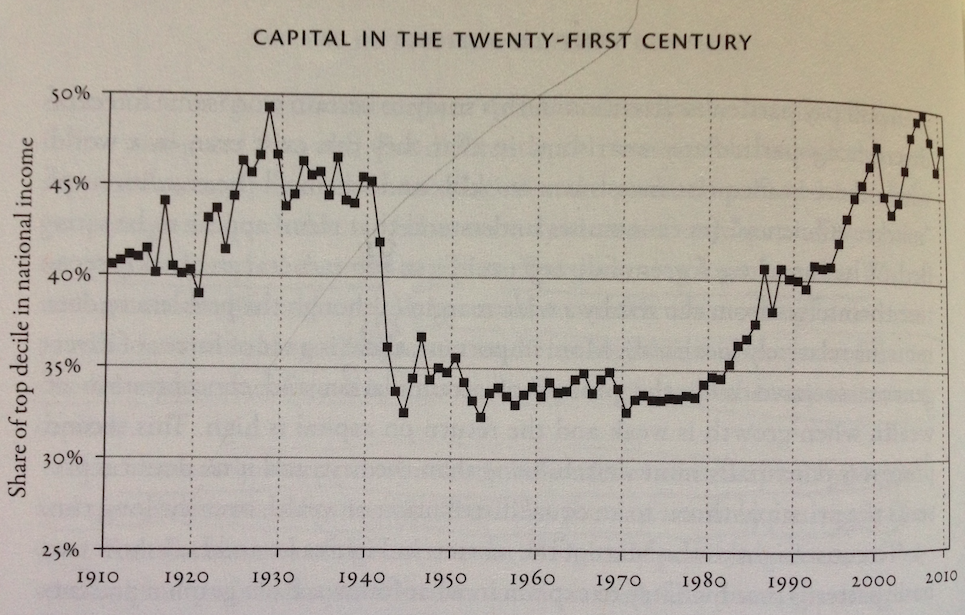
The picture painted by Avent of stagnating incomes for the majority of the population has been well documented in a range of book over the past few years. Robert Stiglitz(2) , Hacker and Pierson(3) and, of course, Thomas Picketty(4) have screen-shot-2016-10-23-at-14-58-44all pointed to this phenomenon and its role in increasing the levels of inequality in America. Typical is the “U” shaped graph showing Income inequality in the United States 1910 – 2010 in Thomas Picketty’s book Capital in the 21st Century. This charts the high levels of inequality in the first 40 years of the 20th Century followed by the dramatic reduction in inequality from the period after the second world war, then an accelerating growth in inequality since the 1970’s to levels not seen since the late 1920’s.

Given this gradual but enormous change in the position of middle class America it should be no surprise that people are frustrated and angry. The frustration arises out of the narrative that says this process is an inevitable result of progress. Opposing it is a luddite response to the course of history and in due course a whole load of new jobs will come along to take up the slack. The problem is the new jobs that have come so far are low skilled, low paid and very precarious.

At the same time people can see corporate and financial leaders taking enormous salaries, many multiples those of their predecessors at a time when GDP growth is lower than it used to be. Worse the people that take these enormous salaries seem to be able to secure them through location rather than performance. Whatever the results of the company the salaries of those in the C suite go up.

Worse yet when exceptionally highly paid people in the finance industry bring the economy to its knees, costing thousands of jobs and homes they are bailed out by the very people whose lives have been devastated, the tax payers. The people who arrange these bailouts as public officials later move on to work in the very institutions that have been saved. In these circumstances you can understand why the ordinary American is highly cynical about the ability of the existing political system to bring about change in their favour. This is why Mrs Clinton is struggling. She is perceived as too close to the traditional political machine and worse, Wall Street.

America may have averted a tragedy if they avoid the election of Donald Trump but they should not think they have avoided a crisis. It is not going to be politics as usual even if Mrs Clinton secures the White House. Radical change is needed in the States. There are a number of systemic problems that need to be addressed which would involve a real shift in the distribution of power. If Mrs Clinton can achieve this she will go down as one of the great US Presidents. If she cannot, and I am not optimistic, America, and therefore the rest of the world, are in for a very challenging time.


(1) Ryan Avent The Wealth of Humans: Work and its absence in the Twenty First Century. Penguin Random House 2016

(2) Joseph P Stiglitz The Price on Inequality Allen Lane 2012

(3) JacobS Hacker & Paul Pierson Winner Take All Politics Simon and Schuster Paperbacks 2011

(4) Thomas Piketty Capital in the 21st Century Harvard University Press 2014