
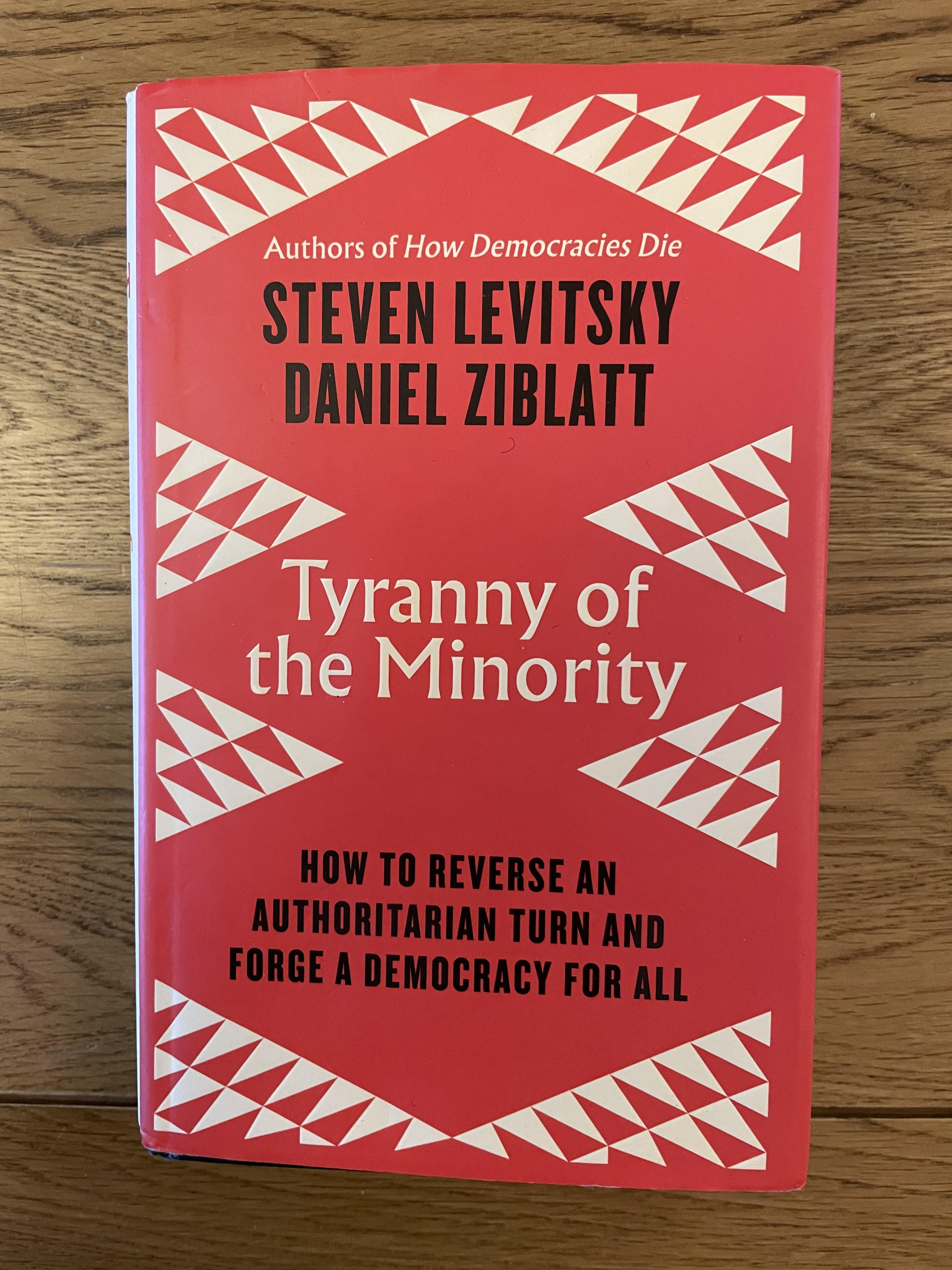
Given the current state of US politics this book is incredibly timely. It builds on and develops themes set out in their earlier work “How Democracies Die” published in 2018.
They begin by identifying the way in which “strongmen” leaders, once elected turn the institutions of democracy against itself. Creating laws which seem to be general but are actually aimed at undermining opposition. Playing “constitutional hardball” by manipulating the dead letter of the constitution to kill its living spirit.
Critically such leaders are facilitated by those who may previously have played by the democratic rules of the game, and indeed protest that is what they continue to do, whilst actually supporting actions which are the classic actions of wannabe dictators.
Undermining the independence of the judiciary is one of the key actions in the despot’s playbook. An example of this was the refusal of the Senate Republicans to allow Barack Obama to appoint a Supreme Court Judge in his last year in office. Whilst all done strictly legally it went against a 150 year old precedent that no Senate ever stopped an elected president from filling a Supreme Court vacancy.
In essence the Tyranny of the Minority is about the way the checks and balances established in the US Constitution, written in the 18th Century, have become all check and no balance. Worse the checks work in a partisan manner tipping the balance of institutions towards the Republican party. Shifting a constrained majority rule towards unconstrained minority rule.
They point out that the US Constitution is treated more like the Tablets of the Laws handed down by an omnipotent being rather than a political document forged in compromise at a time where the very existence of the nation was under direct threat. They compare it as the oldest written democratic constitution with that of Norway, the second oldest.
The US has been amended its constitution 27 times since its ratification in 1788. Of those amendments the first ten were ratified together in 1791 becoming known as the Bill of Rights. The last amendment was ratified in 1992. By way of contrast the Norwegian Constitution was amended 316 times between 1814 and 2014.
The limited amendments to the US Constitution was not through lack of effort. Since its adoption there have been 11,848 attempts to make amendments. Why the difference? Because the US Constitution is very difficult to amend. It requires a a two thirds majority in both the House and the Senate and then be ratified by three quarters of the States. In Norway a two thirds majority is required in two successive parliaments but that is it.
Does it matter? Well when the US Constitution was adopted America was a predominantly agricultural and rural society. Slavery was still in place and was reflected in the Constitutions “three fifths clause” which meant slaves counted for legislative apportionment despite their having no rights whatsoever. Whereas Norways Constitution has evolved to address a radically different social, economic and political environment, the American Constitution has not.
Checks which were baked into the constitution consciously to protect against tyranny by the majority have over time evolved into mechanisms which tend to support tyranny by the minority.
The credibility and legitimacy of any democracy depends on state authority being exercised by those that secure the majority of votes. Genuine checks and balances and the occasional change of administration of provide for a process where ruling parties respect the interests of those that did not vote for them. However, the system must be seen as a level playing field and when someone wins they must be allowed to govern.
Levitsky and Ziblatt see the current stalemate in American politics where effective government is impossible as caused by two key problems. First the manipulation of the electoral system which has now reached such proportions, with the collusion of a super-conservative Supreme Court, that it effectively disenfranchises significant numbers of people from specific groupings. Most notably black Americans.
The second issue is to update a number of Constitutionally embedded institutions to ensure that they produce a more democratic outcome than they do at the moment.
Amongst the change they propose a key one is a constitutional amendment establishing a right to vote for all citizens. Who knew this was not in the Constitution? This would be accompanied by the restoration of Federal level voting rights protection. In effect reinstating the 1965 Voting Rights Act which wqas eviscerated by the Supreme Court 2013.
They also propose that electoral administration should not be within partisan political control. Rather an independent electoral administration should be established with non partisan officials. In parallel with this there should. be the equivalent of our independent boundaries commission to prevent the often egregious examples of gerrymandering.
Other key institutional changes include abolition of the Electoral College. In a modern democracy those that get the majority of the popular vote should become leader. The Electoral College means this is often not the case.
Reform of the structure of the Senate which provides two senators per State irrespective of the size of the State. This builds in a rural and agricultural bias which is significantly out of line with and an urban industrial/post industrial nation. Something which more accurately reflect the size of the population of States.
Abolition of the Senate Filibuster. This mechanism which means that 40 out of 100 senators can prevent any proposed law getting on to the statute book however big a majority it received in the House of Representatives and however popular amongst voters.
Establishing term limits for Supreme Court Justices who currently serve for life. Appropriately structured this could ensure all presidents get to appoint the same number of Justices in their term in office. This woudl avoid the situation as now wher there is a super conservative majority in the Supreme Court which is manifestly out of touch with majority American opinion on many issues.
Finally, and possibly the most crucial proposal is that the method of amending the Constitution be made simpler by removing the requirement for any amendment to secure ratification by three quarters of the individual States. This would bring it into line with most modern democracies and provide for the Constitution to become living document growing with its people, reflecting more accurately the needs of a modern polity.
There are a range of other proposals put forward by Levitsky and Ziblatt but these give an indication of the depth of change they are proposing and also the difficulty such change might face. It is a really well argued case and given the recent experience of the Disunited States particularly between 2016 and 2020 it is an important one.
Political paralysis undermines belief in democracy with potentially extreme consequences. It is clear something has gone wrong when the almost certain Republican candidate for the presidency encourages Russia to attack treaty allies.
If I have a criticism it is that the analysis is very much focused at the institutional level.Whilst this is vitally important there is a socio-economic set of issues structured around inequality which need to be addressed. It could be argued that the current challenges to American democracy would have got very little traction had not civil society experienced a long period of growing inequality. Stagnation and even decline in real standards of living for many. Neglect of public services and reducing welfare provisions.
Having said this what Levitsky and Ziblatt do is illuminate critical weaknesses in the US polity which are putting its democratic future at risk. They make sensible proposals about how to address these problems. They do this with clarity and illustrate their arguments with examples from around the world and from history. It is a great book for understanding some of the structural forces underlying the current travails of the United States. The coming election probalbly makes it vital reading.
Tyranny of the Minority: How to Reverse an Authoritarian Turn and Forge a Democracy for All. S Levitsky, D Ziblatt. Penguin Viking 2023.
 northerncomment