Changing the Middle East

The mediaeval barbarism of 7 October 2023 was cruelly twisted to secure maximum terroristic effect by having its atrocities filmed and then made available to the world, and thus despicably, to the victim’s relatives. Horror shows of murder, mutilation and abduction displaying a disregard for human life and revealing a visceral loathing for Jews.

It is not surprising that this action would instil fear in a nation built to protect its Jewish citizens from precisely this kind of merciless and violent persecution. Something Jews have experienced over the centuries culminating in Hitler’s effort to annihilate them in an industrial attempt at genocide.

Given all this, a strong, not to say fierce, response from the Israeli Government via the Israeli Defence Force (IDF) was inevitable. Actions to defend Israel and secure retribution against the perpetrators was and is justified. Securing some justice for the innocent victims and recovering the hostages was and remains a justifiable goal. However, the scale and the nature of the response has raised questions and concerns from the start which have only deepened and multiplied over time.

Following the attack, Prime Minister Netanyahu announced that Israel was at war with Hamas and it would not end until the group was completely eliminated from Gaza and the safety of Israel was secured.

The United States quickly got behind this goal followed by the UK and a range of other Western nations. This was seen as a war against a terrorist organisation which had carried out a 9/11 type outrage and was thus legitimate.

In addition to this specific if ambitious target, Prime Minister Netanyahu also spoke about how Israel’s response would “change the Middle East”. A much more ambiguous goal but, as the campaign has progressed, an increasingly ominous one.

An ever-mounting civilian toll has eaten away at the unwavering support promised at the outset. The increasing unease of Israel’s allies has resulted in ever more complex circumlocutions about the support and its being tied to care to minimise civilian casualties. With good reason.

Given the atrocious actions of Hamas that triggered the current war, Israel could adopt the moral high ground and very quickly did. At every opportunity it has justified its actions as self-defence by graphic reference back to the bestiality of what Hamas did on 10/7. Everything that Israel has done since then and all the civilian casualties of the Israeli action has been placed at the door of Hamas.

To be clear the actions of Hamas are inexcusable. They are war crimes that need to be brought to justice. However, that does not make them inexplicable. The actions were not irrational, motiveless violence. They have causes in a 70-year confrontation between Arabs and Jews in Palestine. If this history is ignored it is unlikely a viable way forward will be found.

Not only are they not inexplicable but neither do they justify the level of sustained and indiscriminate bombing of civilian Palestinians.

The IDF claims it is only targeting Hamas. However, when one looks at the level of destruction wrought across the North, Central and finally Southern Gazza one can only conclude that the IDF are awfully bad shots. In truth the claim is not credible. In an area which is one of the most densely populated on earth it was inevitable that the scale of the bombing carried out would have a massive civilian toll.

The IDF blames this on the fact that Hamas adopted the morally despicable act of using their own citizens as human shields. However, the efficacy of human shields depends on the humanitarian values of those they are used against. The immoral act of using defenceless civilians as a shield is morally matched, not opposed, by the act of shooting through them.

The moral high ground is a slippery place and the actions of the Netanyahu government from the very start of the offensive indicated very unsure footing. Actions that included the closing of the borders, stopping food and medical supplies, the turning off of power and water to 2.3m people, ordering c1.m residents of Gaza City to move South within 24 hours.

The claims of moral authority because residents were warned to leave and go South ring hollow when those that do are bombed on their journey and again when they arrive in the “safe” South. They are then told to go West, toward the sea. The 2.3m population of Gaza appears to be being herded into a smaller and smaller fraction of the small pocket of the territory they live in.

All of this in order to prosecute a war against c40-60k Hamas fighters is difficult to see as proportionate or in accordance with international humanitarian law.

The treatment of prisoners of war further undermines the moral position of Prime Minister Netanyahu’s government and the IDF. Palestinian men stripped to their shorts and filmed in a grossly choreographed display of walking forward with hands above their heads to place weapons on the ground. The weapons, carefully ringed by the IDF to ensure they are not missed. What do they think this demonstrates?

The claim is they had to be stripped to ensure they did not have suicide vests on or hidden weapons. Who do they think believes they could not be searched and have their clothes handed back to them. This was not about security, it was about humiliation. Humiliation filmed and broadcast to the world.

When one looks at what Prime Minister Netanyahu’s forces do it looks like the aim to “change the Middle East” is primary.

What Prime Minister Netanyahu’s war has done is displace pretty much the whole of the population of Gaza making them refugees in the territory they have been confined as refugees in over the past 70 years. He has destroyed Gaza’s economic infrastructure, its health facilities, its educational infrastructure, and many of its religious and cultural buildings. He has humiliated its men and starved its women and children. Worst of all he has achieved this by killing c 33k of its citizens, many of whom are women and children.

This through a campaign of bombing which, at the beginning of December, had inflicted a higher level of damage to buildings than the allies achieved in Dresden and Cologne in World War 2. According to the same source in the Financial Times “Gaza will go down as a place name denoting one of history’s heaviest conventional bombing campaigns.”

Set aside whether you can win any conflict against groups like Hamas with bombs you certainly cannot do it without massive collateral damage. The sustained and comprehensive nature of the bombing seems precisely judged to do just that.

The whole of the population of Gaza has been traumatised unable to find the so-called safe areas they are directed to by the IDF. Desperate to secure food and water for their families they are forced to fight and scramble for any relief that gets through.

What can they look forward to? Suppose the IDF managed to kill all the members of Hamas tomorrow, then what? No homes, no jobs, no functioning health, education, security or other state service. Continued dependence on international relief.

There are three possible responses. First, resign yourself to the fate of a refugee in the largest open prison in the world. Second, seek to escape to somewhere else where you might be able to create a life for yourself. Third, create Hamas 2.0. Someone once said, if a person has nothing to live for they will soon find something to die for.

The West, but more specifically the United States and the UK, have stood shoulder to shoulder with their ally Prime Minister Netanyahu. They have believed his assurances about minimising the harm to the civilian population. As the death toll has mounted and the level of physical destruction become more and more apparent the allies have become increasingly uneasy.

The gap between what PM Netanyahu says he will do and what he does has become so wide that not even the most faithful ally can ignore it. Further, his adamant rejection of advice from his allies has prompted irritation amongst Western leaders which had begun to boil over.

When the killing stops the true numbers of those killed, injured and displaced will be far higher than anything that has been seen in the Middle East since the Six Day War in 1967. Arab losses in that war were roughly 20,000.

The level of physical destruction will be way beyond what might be justified by the doctrine of proportionate defence. The treatment of prisoners of war discussed above. The shooting of Israeli hostages, stripped to the waist waving white flags and shouting in Hebrew, by the IDF does not instil confidence that the IDF rules of engagement will have protected many Palestinian civilians.

In the end what this may look like is what a UN Commission defined as ethnic cleansing “… a purposeful policy designed by one ethnic or religious group to remove by violent and terror-inspiring means the civilian population of another ethnic or religious group from certain geographic areas.

It is almost certain it will be perceived as that by Palestinian and Arab citizens across the Middle East, which should be a matter of concern to Israel. But what should perhaps be of more concern is the potential spread of this perception to a wider, developing nation cohort across the world and indeed to many citizens in developed nations watching the carnage on their screens.

The strategy of containment which has been pursued towards the Palestinians in recent years is clearly over. The events of 10/7 demonstrate it does not work even on its own terms. What appears to have replaced it is one of making Gazza unviable as a place to live. This is not new. Back in 2015 a UN Report set out the manifold ways in which the Palestinian territories viability was constantly undermined by Israel’s actions.

When this military campaign ends what happens?

Firstly, there will be a global focus on the area greater than there has been in many decades. Unless the civilian death toll is pure Hamas propaganda and the pictures of bombing devastation are deep fakes Israel will be perceived as having committed a whole host of crimes against international humanitarian law. These will be the focus of years of litigation and argument and will undermine the moral authority of Israel.

When it ends, someone will have to administer Gazza. If Israel takes on responsibility or they hand it to the Palestinian Authority the legitimacy of its governance will likely be zero, particularly if there is no prospect of a two-state solution.

If the Israeli blockade and economic strangle hold is maintained it will be a running sore and one which has much greater visibility than it has had in the past. Since its establishment in 1948 Israel has proved pretty much impervious to “international opinion” and has continued that position throughout the current war. Its ability to do this has been because its closest ally has been the richest and most powerful force on the earth.

Israel seems to take the support of the US for granted and abuses that position with apparent scant concern for the risk it might change. This is a mistake.

If Israel does not engage in good faith in a two-state solution what is the future? The plight of the Palestinian people will provide an excuse for new or re-established terrorist organisations to carry out atrocities against civilians in a country increasingly dominated by security. Provoking further state violence against civilians in territories with no security.

Global powers will seek to use the conflict to promote their own interests with merely rhetorical regard for the interests of the Palestinians, but also perhaps increasingly for the state of Israel.

The tit for tat ratchet between Israel and Iran has now been engaged. This may well achieve PM Netanyahu’s goal of changing the Middle East. But, as the saying goes, “be careful what you wish for”. The change might be one which brings continuing misery for the Palestinians but also growing insecurity and isolation for the State of Israel. No one can want eikther of these things.

The distance between the Prime Minister and the President

So the PM, the Health Secretary and the Chief Medical officer are confined to quarters. We do not know whether they practiced what they preached when off-screen, however,  what this does demonstrate is that if you continue working the chance of avoiding infection is low. The multiple infections are perhaps not surprising amongst a group of people who have had to work intensively and closely together for some time however it is unfortunate in terms of the governments messaging.

To date I think I would give the Prime Minister 7 out of 10 for his handling of the Covid-19 crisis. Due account has to be given to the sheer scale and multi-dimensional nature of the problem and the speed at which it has evolved. It is one thing to hear descriptions of the spread and see graphs it is another to live it. On the positive side, he has taken the issue seriously and, has deferred to the science or at the very least taken serious account of it. He has “pivoted” when necessary, albeit a touch abruptly.

Overall I think, from the distance of the North, he has done as good or bad a job as many of the other West European leaders have. The leaders of countries in the East, like South Korea and Japan have had much more recent experience of what a national epidemic can do and might have been expected to be better prepared both logistically and mentally to respond with more appropriate alacrity and concern.

There are of course questions to be asked. The timing of lockdown looked more a like a response to mounting political and external scientific pressure than the next step in a carefully crafted, strategic timeline. It would be interesting to see what mortality rates were attached to the herd immunity strategy which was disavowed as soon as the Imperial College Report was in the public domain.

Communication has been and continues to be a problem. The daily press briefing, meant to reassure the public by demonstrating a transparent approach to keeping the nation informed, was a good idea. Its very existence communicated a sense of urgency. The professional and business like way they were conducted and the presence of subject experts transmitted seriousness but also reassuring competence. Unfortunately the message was not clear enough.

This may have been that the strategy was evolving from mitigation to suppression however the social distancing message was just not strong enough. Details about what it involved keeping 2 meters apart, staying at home etc. was undermined by a failure to communicate the need for rigid adherence. The Prime Minister talking about continuing to shake hands and hoping to visit his mother on mothers day weakening and confusing the message.

As the potentially catastrophic consequences of the disease began to sink in, driven it would seem by the Imperial College Report the Prime Minister stiill appeared to be struggling with either his libertarian instincts, his concern for the economic consequences or fear that stricter controls would be ignored. He started out by “asking”,  then moved to “telling”, but then in very short order he moved to  “instructing” as emergency legislation was put in place. It may be argued that the language followed the legislation or that it was part of a strategy to take the population on a journey, however, a pandemic is not a time to be “nudging” people. It is a time for decisiveness and clear, consistent, simple messages. Days mattered.

Unfortunately as time has gone by the communication strategy has become more problematic. If you start out claiming you want to be transparent and that you are following the science you set yourself up to fail if you start to obfuscate. As the media have asked increasingly specific questions about, how many ITU bed spaces are available – now, how many ventilators the NHS have – now, and where the PEP is – now, the vagueness of the answers has become a source of concern and, for front line staff, anger.

Nadhim Zahawi, Minister for Business and Industry, was writhing like a fish on a line when being pushed to provide detailed figures on this and dates when more of all of these items would be available. It looked as if at one point he would crack and shout out, “You can’t handle the truth.” He would have been wrong. People prefer truth, however unpalatable, to obviously untrue platitudes about “ramping up”.

It is obvious to all that the requirement for rigid social distancing is absolutely critical and that anything less will mean the NHS is overwhelmed. It does not have the equipment or staff it would need to address anything other than a limited spread of the virus. False reassurance will come back to bite when reality tragically contradicts it as the infection rate accelerates and peaks.

Having said all this, I still hold to my 7 out of 10 for the Prime Minister. He may not have acted as decisively and early as he should  to implement rigid social distancing and he may not have been clear enough in the initial messaging, however, he appears to be someone doing the best he can in a fast moving crisis. He remains courteous to the media, even in the face of difficult questioning, he respects the views of the scientific advisors and at least seems to understand what it is, and he is trying to communicate that medical advice to the public.

By comparison,… a picture is worth a thousand words, and here are two.

However effectively implemented by the PM and his team there is a real attempt to communicate the social distancing message.

If you watch the two briefings the contrast could not be greater. In the US version, depicted here, three advisors stood like lemons on the stage of the press briefing  room waiting for the President. There was an awkward, nay embarrassing silence. Eventually, presumably when the time had built up enough tension for a grand entrance, the President appeared.

There was then a rambling, incoherent presentation by the President, talking mainly about what a terrific job his administration and he personally was doing. His one strength is consistency, whenever he speaks he is saying something which is either a lie or stupid or both. Firing on all four cylinders he managed the double on most of what he had to say.

His overriding concern to ensure re-election tempered his concerns for the thousands who may die from this virus. His view is that we must ensure the “cure is not worse than the disease”. He talked about the 50k people who die each year from flu and those involved in road traffic accidents to reassure the American people he had their welfare at heart.

He probably struggles with numbers (other than $ bills) but if the US do not get a grip on Covid-19 the fatalities could be in the hundreds of thousands not, the clearly more acceptable to the President, tens of thousands. From the start the President has treated Covid-19 as an annoying distraction from the main business of getting reelected for another four years of self aggrandisement and national corruption. Variously he has referred to Covid-19 as a “hoax”, the “Chinese virus”, only affecting 15 Americans, something where the “cure cannot be worse than the virus”, and which is likely to be pretty much over “by Easter”.

I had been thinking a suitable sobriquet for President Trump might be, “The President that Broke America.” Sadly, if the individual States don’t save him and their citizens I think a more appropriate one may be, “The President that Killed America.” At least the distance between him and the Prime Minister is reassuringly large.

That Fight is Ours Too…

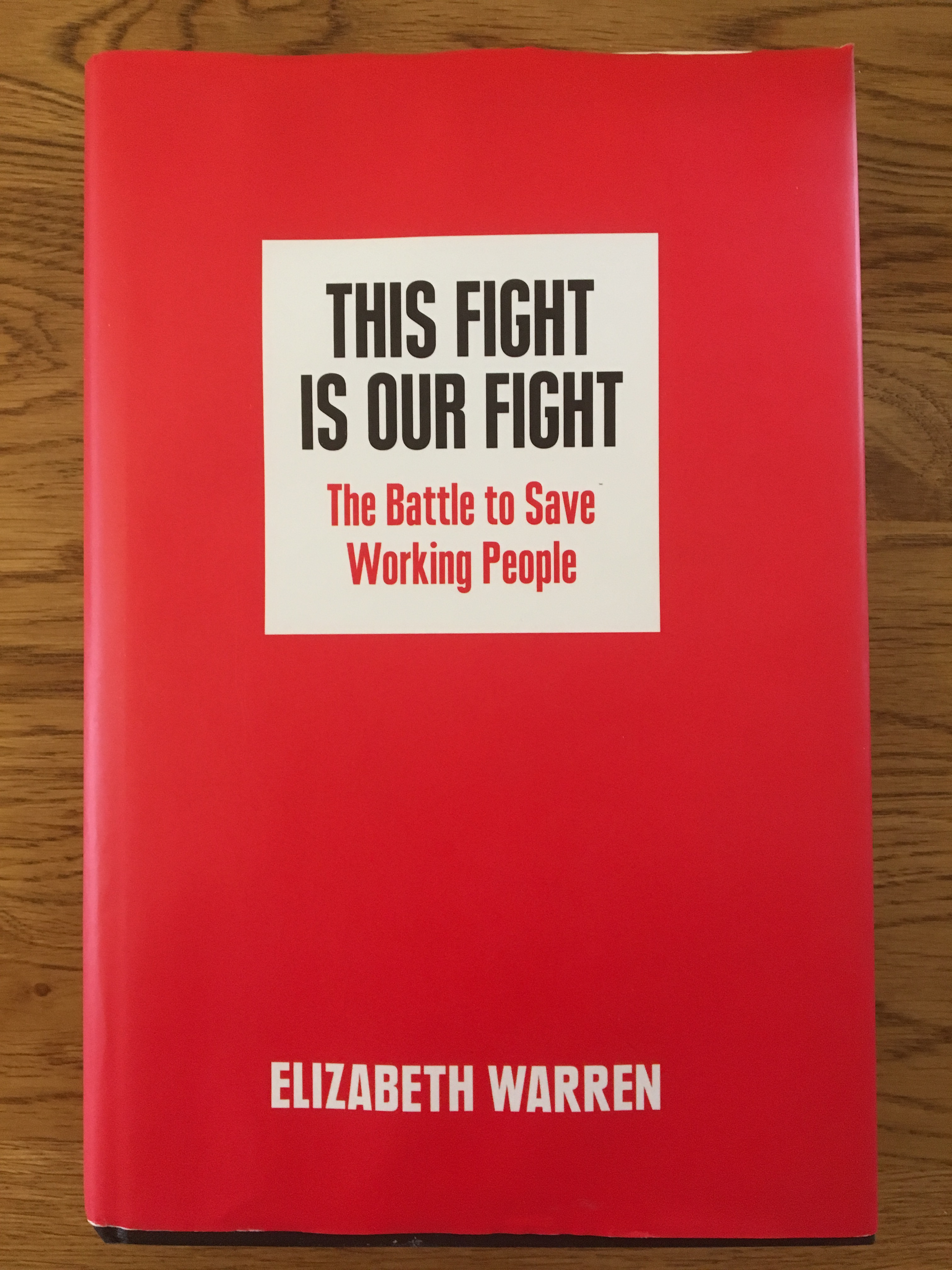
Politics in the United States is not the obvious place to look for inspiration at the moment however Senator Elizabeth Warren’s book “This Fight is Our Fight: The Battle to Save Working People” is like a shaft of light in  a dark cave. Ms Warren is the senior US senator for Massachusetts and a Democrat. Her book provides an analysis of how the US has been transformed over the past four decades from a nation characterised by a stable and growing middle class optimistic about its future to a society riven with insecurity and fear.

She is a genuine patriot, particularly proud of the amazing growth of the middle class in the states following the Great Depression driven by FD Roosevelt’s government which took on the multi-millionaires of the time. Promoting trade unions, breaking monopolistic practices, regulating competition, investing in education for all and creating a nascent welfare state.

Warren BookAll of this meant that over the period from 1935 to 1980 some 70% of all the income growth went to the bottom 90% of the population and 30% went to the top 10%. It meant that an enormous middle class was created whose experience was of steady employment, with good pensions to look forward to and a faith their children would be able to build on the foundations they had laid and gain a better future through education and their own efforts.

Do not think Ms Warren looks back through rose tinted spectacles however, at “the good old days”. Her personal experience as a child of how precarious existence could be when her father had a heart attack and could not work prevents that. When her mother became the only breadwinner in the house and got a minimum wage job at Sears things were tight, however, in the mid 1960’s, that one minimum wage kept a family of three afloat paying the mortgage and keeping food on the table.

It is not that everything back then was perfect, it was just that there was a sense the arc of history was bending in the right direction. Since then however the arc of history has been pushed in a different direction. Whilst the cost of living has increased significantly the value of the minimum wage has plummeted in real terms and the idea that a single minimum wage, could keep a family of three afloat is laughable. The current Federal minimum being $7.25 although in many states higher rates are paid up to $15 (£9) per hour. Worse, median wages have stagnated so that over a thirty year period working Americans have seen virtually no real increase in their pay. Why is this?

One of the reasons is that in the period since 1980 to 2015 the income growth of the country mentioned above got shared out differently. The amount received by the bottom 90% was a large round number – zero. And for those who struggle with maths this means the top 10% have taken 100% of the growth. How could that happen?

Well not by accident. Back in those crazy communist days of the 1960’s the 10% started to become discontent with the mere 30% of the wealth they received. This discontent was channelled in 1971 by a confidential memo written by a corporate lawyer named Lewis Powell which was essentially a call to the rich to transform themselves in to the rich and powerful.

To do this they were encouraged to invest their wealth in gaining control of the political agenda. Whilst this included funding supportive politicians in increasingly costly election campaigns it was more insidiously about capturing the realm of ideas. To do this they should fund research, think tanks, media shows, anything which promoted their ideas. Ideas which could be boiled down to low taxes for the rich and an ever reduced role for the state in the provision of services, regulation and, worst of all, transfer payments.

Ms Warren draws on her own experience and that of a number of individuals to illustrate what that process has done to people and their life chances. She talks about Gina, the woman whose family income has halved over the past 20 years from $70k to $35k. “No crisis. No Accident. No tale of woe. Juts the grinding wear and tear of an economy that doesn’t work for families like Gina’s”

She talks about Kai a young woman who worked hard through school and wanted to work in design. She paid to go to a private University but after the first year could not afford the fees so decided to return to her home state and complete her degree there only to find the credits from the Private University were not recognised so had to repeat a year. The upshot is she now has $90k of the $1.4 trillion US student loan debt and is repaying it out of her job as a waitress.

Finally, Michael who worked hard at his job at DHL for 16 years securing a house with  a mortgage and what he though was a solid middle class life ahead. Then 2008, DHL eliminated 14,900 jobs including Michael’s. He then got a call asking if he wanted his old job back. Not his full time job with benefits though, a part time job with no guaranteed hours and no benefits. He had to take on two jobs but even then he could not pay the penalous mortgage he had been mis-sold so lost his home.

Even then he did not give up but just kept on eking out jobs here and there until he got work in a Nabisco factory putting the cream in Oreos. Just when he thought he was getting back on his feet the factory was closed and production relocated to Mexico.

The real life stories of individuals trying to live up to the myth that hard work is all that is needed to secure a reasonable living are heartbreaking. They translate debates about trade deals, de-regulation and labour rights into a increasingly depressing reality for millions of American. As “the economy” and Wall Street does well and the stock market booms the 90% get left further and further behind.

Ms Warren is under no illusion about the implications for working people of a Trump presidency backed by a Republican Congress. However she draws strength from the millions of Americans who want to stand up against bigotry, for a fairer economy and most of all for Democracy. Her battle for Democracy has implications far beyond the States. Democracy there has been infected most by the “greenback virus” but it is happening in many other places including the UK where election expense rules are starting to be challenged by being ignored. We have a common interest in Ms Warrens fight.

If this book is a kite being flown to test support for a 2020 campaign run it gets my vote. Ms Warren comes across as intelligent, incisive, authentic but most of all humane. If voters want a choice of opposites in the 2020 election she would provide it.


Elizabeth Warren. This Fight is Our Fight: The Battle to Save Working People. Harper Collins. 2017.

Dark Money

Dark Money by Jane Mayer covers a period from the early 1970’s to the run up to the Trump election. It documents in meticulous detail the amount of money spent over the period by super rich Americans, not just to secure the election of politicians  supportive of their radical libertarian views but more insidiously to shift the terms of political debate to the right.

DMThe process begins in the late 1960’s early 70’s when a number of very wealthy Americans began to fear the US was about to succumb to socialism. It may seem unbelievable now but looking back it was a time of radical foment, the rights of black Americans were being fought for, a nascent women’s rights movement was emerging, young people’s opposition to the Vietnam war resulted in 4 students being shot and killed in a protest at Kent State University.

Whilst all this protest were real worries to many on the right there were other issues about the role of the state that were of perhaps of more profound concern. The Democratic President Lyndon Baines Johnson had initiated a War on Poverty. Worse however was a proposal by Republican President Richard Milhous Nixon to create a modest basic income, an idea about which there is currently renewed interest.

In 1970 the Family Assistance Plan passed through Congress with a healthy majority but was lost in the Senate to Democratic opposition that it was not radical enough. At the time it was said “This bill represents the most extensive, expensive and expansive welfare legislation ever handled.” Not only was their bipartisan support for this proposed legislation, but it was supported by 90% of the press and popular in the country.

For some, all of this represented an unwarranted intervention by the state in the operation of the market economy. An intervention that would expand the role of the state, require increased taxation and thus impact directly on the fortunes of the very wealthy. Some decided it was time time to act.

Ms Mayer’s book focuses primarily on the brothers Charles and David Koch. The brothers engaged in active politics in the 1970’s providing financial support to the Libertarian Party. In 1980 David Koch ran as the running mate to the party’s Presidential candidate, Ed Clark who was challenging Ronald Reagan, from the right. They got 1% of the vote. From this point on the Koch’s receded from public view and over the next three decades according to Ms Mayer gave well in excess of $100m “…to dozens of seemingly independent organisations aimed at advancing their radical ideas.”

The book charts how the brothers “weaponised philanthropy”, maximising the tax benefits of establishing charitable trusts, thus avoiding inheritance tax, and then using the money from the trusts to support a series of educational and social welfare groups to promote their libertarian viewpoint. Over the years a variety of think tanks were established or supported all with the aim of ensuring that conservative ideas were made respectable.

Over time the thinking evolved and there was a recognition that in order to change opinions the elite educational institutions of the US had to be “penetrated”. This led to the “beach head” theory which was about establishing conservative beach heads at “…the most influential schools in order to gain maximum leverage.” By 2015 the Charles Koch Foundation was “subsidising pro-business, anti-regulatory and anti-tax programmes in 307 different institutions of higher education in America.” Interestingly the book reports a comment about the Golden Rule of philanthropic giving – those with the gold, rule. This was taken to a higher level when a donation of $965,000 to West Virginia University by the Charles Koch foundation came with strings. The foundation was to have a say over the professors it funded, fundamentally undermining academic independence.

The Koch’s were not alone in this enterprise but they did, and continue, to play a major co-ordinating role such that at one point the sprawling breadth of their influence in right wing political promotion was described as Kochtopussy. Ms Mayer’s book makes clear that this was not the outcome of a series of more or less random individual initiatives. Rather it was an evolving, but very conscious, political strategy to move the political goal posts. It responded to a very clear cri de coeur set out in a memo by Lewis Powell in the late 1970’s urging American capitalists to wage “guerrilla warfare” against those he saw as trying to insidiously undermine them. Ms Mayer claims his call to arms inspired some of the super rich, “to weaponise their philanthropic giving in order to fight a multi-front war of influence over American political thought.”

You may wonder whether these people were driven by a bizarre but genuine belief in radical libertarianism, where the state, taxes and regulation were perceived as demeaning constraints on the freedom of the individual. In truth their idealism was always tempered by a strong regard for their personal advantage. When congress was considering the Troubled Assets Relief Progamme (TARP) the Koch’s and their radical caucus were opposed to the massive package of  state support. This changed however when the stock market started to tank. Suddenly their wealth was at risk and opposition to the TARP was dropped.

Another fascinating insight into the motivation of the Koch brothers comes from a post mortem conducted into the right’s failure to prevent a second Obama term at one of their annual seminars. Arthur Brooks, President of the American Enterprise Institute funded generously by the Koch brothers, made the point that if the 1% want to win control of America, “… they needed to rebrand themselves as champions of the other 99%”. This theme was built on in 2014 in a paper that Richard Fink, Charles Koch’s “grand strategist”, gave to a meeting of one of their annual seminars of the libertarian super rich. The paper was entitled “The Long Term Strategy: Engaging the Middle Third”. In a perfectly candid way Fink asked the question, “We want to decrease regulations. Why?” he then answered his own question, “It’s because we can make more profit, okay?.”

One third of the electorate who were perceived as solidly on the side of the libertarians, another third never would be. This mean the battleground was about gaining the trust of the middle third. To do this it would be necessary to convince the them that libertarian intent was virtuous. “We’ve got to convince these people we mean well and that we are good people.”

Following a Supreme Court decision in 2010 known as Citizens United it was found that corporations had the same rights to freedom of speech as individuals. This overturned a century of restrictions banning corporations and unions from spending all they wanted on the election of candidates. This opened the floodgates to political spending to support congressmen and senators and the Koch Brothers took maximum advantage building a real power base which was in but not of the Republican Party.

In 2014 the Koch network invested $100m into House and Senate races for the GOP plus almost twice as much into other kinds of activism. The result was they won full control of both. Their aim was to spend $889m in the 2016 presidential race. Whilst they could not legislate for the Trump wildcard the first attempt to replace Obamacare was such a shambles because of the intransigence of the right wing caucus within the Republican Party largely made up of Koch supported Congressmen and Senators who thought the Trump proposal was too generous!

Dark Money is a sobering work which casts an unflinching light on the very private world of the super rich in America and specifically on the brothers David and Charles Koch estimated to be worth $41.6bn each. It raises all kinds of issue about the role of multi-billionaires in undermining democracy in America and reinforcing a process which is concentrating ever more power and wealth in the hands of a smaller and smaller group of super rich plutocrats.

The influence of the Koch brothers, and many others of the same ilk, is not confined to the States however. They have played a part in shifting the terms of political debate across the whole of the developed world, dragging the centre of politics so far to the right that people like Richard Nixon look like lefty softies. If one thinks about how a proposal to increase taxes on the rich in Britain today would be greeted it is a testament to how far the super rich have captured common sense and shaped it to their benefit.

This is a book that should be read widely. It’s scale will probably prevent this which is a real shame. It is a tremendous summary of a long and sustained process of the exercise of soft power through the expenditure of vast amounts of private money. If the process is not stopped it will ultimately undermine democracy.

Dark Money. Jane Mayer. Scribe Publications 2016