
The Prime Minister believes there is nothing wrong with labelling the Benn Act, which prevents him from leaving the EU without a deal, the Surrender Act. His colleagues have suggested it is a legitimate part of robust political discourse. It is equivalent to the Labour Party’s labelling the removal of the “spare room subsidy” as the “bedroom tax”. This is however a false equivalence.
In the case of the bedroom tax there was a dispute over the change to a welfare benefit which penalised households deemed to have chosen to live in accommodation which had a bedroom they did not need. The Government attacked the Opposition for tax and spend profligacy and a failure to recognise the seriousness of the deficit. The Opposition attacked the Government for a heartless attack on some of the most vulnerable members of society. The debate about this was passionate some might say vitriolic.
However, whilst the terms were strongly contested the disputants were always arguing about who was right and who was wrong. However much they disagreed about who was right and who was wrong they accepted the legitimacy of the other side putting their case. On the bedroom tax, critically, the Government thought the opposition was wrong, but not the enemy.
Using terms like surrender and other rhetoric that has its origins in military discourse and war time challenges the legitimacy of the other sides right to argue a case. The patriotic integrity of the other side is brought into question. They are no longer people who have a very different view of the world they are the “enemies of the people”.
The distinction between this kind of language and the the dispute over the bedroom tax is fundamental, and profoundly important. It takes public debate into very dangerous territory. At best the PM’s hubris is clouding his common sense. I don’t like to think about the worst.
Recently, I looked at how President Trump compared against a number of tests set out by Levitsky and Ziblatt. in their book How Democracies Die. He did not fare well, which is a real worry for democracy in the US. Sadly, looking at the actions of Mr Johnson we also have cause for concern.
Before I go any further however, let me make clear I do not think Boris Johnson is equivalent to President Trump. Mr Trump is in a category of his own for venality, banality and an absolute stranger to the meaning of right and wrong, truth and lies. By contrast Boris is a pale imitation. But imitation he is.
In their book Levitsky and Ziblatt look at how how populist leaders gain democratic support and then proceed to corrode the democratic system from within. Typically they argue the system is frustrating the “will of the people”. Initially they may well be implementing popular policies but over time their view of the “will of the people” becomes less consistent with what most people think and they transition into increasingly authoritarian systems of government.
This transition is not always the result of a conscious strategy. They did not set out to be an authoritarian. They started out shortcutting the democratic system because it was too bureaucratic, or complex. The shortcuts outrage the opposition who push back and a tit for tat process spirals out of control and can lead to the establishment of a genuinely authoritarian government.
Levitsky and Ziblatt recognise that many people in long established democracies think “it could never happen here”. Their research, however, is a wake up call as in a number of the examples they consider similar views were present before it did, in fact, happen. Their aim is to provide warning signs of the kind of behaviour that precedes a drift to increasing authoritarianism. They identify 4 key indicators and for each indicator they give examples of more or less egregious behaviour which evidence a move towards it. Thankfully, as yet in Britain, there is evidence of only the first two indicators and indeed the behavioural evidence is at the lower end of the spectrum.
The first key indicator is “Rejection of (or weak commitment to) democratic rules of the game” evidenced by whether they “… they reject the constitution or express a willing ness to violate it.” The Supreme Court seemed to think, eleven / nil, that the Prime Minister’s behaviour did evidence this. Choosing which laws to obey probably falls into this category also.
The second indicator and the one most relevant to the question in hand is the “Denial of the legitimacy of political opponents” evidenced by whether “… they describe their rivals as subversive, or opposed to the existing constitutional order?” Talk of “surrender”, “traitors” and “betrayal” clearly attack the legitimacy of those opposed to a no-deal Brexit.
Boris Johnson is not a “dictator” and he has not staged a “coup”. He is, however, playing with fire. Talk about a people versus Parliament election ignores that 48% of “the people” wanted to remain. Reinforcing and promoting the divisions in a country should not be the aim of a of a democratic leader. It may not work in achieving the leaders goal but even if it does it could well be a case of an operation which was a great success but sadly the patient ended up dead.
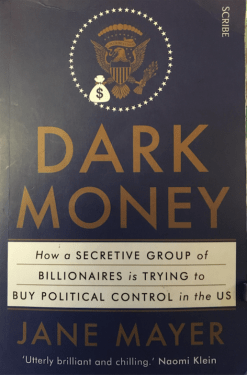 The process begins in the late 1960’s early 70’s when a number of very wealthy Americans began to fear the US was about to succumb to socialism. It may seem unbelievable now but looking back it was a time of radical foment, the rights of black Americans were being fought for, a nascent women’s rights movement was emerging, young people’s opposition to the Vietnam war resulted in 4 students being shot and killed in a protest at Kent State University.
 northerncomment