Will the Republican Senate Support Impeachment?

Based on Impeachment 0.1 one would think support in the Senate would not be forthcoming. Clearly there are still many within the Senate who support the President, whether out of misplaced loyalty or misplaced fear is unclear.

That loyalty is misplaced is obvious if it is anticipated that it will be reciprocated. Time and again President Trump has been happy to throw the most loyal of colleagues under the bus if it suited his purpose or indeed whim. But is fear misplaced?

That depends on the extent to which you feel Trump’s actions in the transition have accelerated what would inevitably have been a rapid diminution of power as he leaves office. His baseless claims of election fraud and incompetent insurrection have significantly reduced his stature and support. Members of the GOP need to consider how far this has impacted regular Republican voters. It is almost certain Trump could become the leader of a devoted and substantial group of supporters. But probably not an election winning, following.

If the deep state is anyone who fails to support unquestioningly Donald Trump it now includes Lindsey Graham, Mike Pence and the PGA of America! At this rate their will be more in the deep state than in the… er shallow state! The more that are moved into that category, surely, the less credibility it has for conspiracy theorists.

For four years the GOP has sustained president Trump in office despite him being a clear and present danger to the constitution of the United States. His egregious behaviour will only be properly evaluated with the fullness of a historical perspective but I am willing to bet he and those that supported him will not be looked on favourably.

The incompetent insurrection and the berating of Lindsey Graham as he passed through the airport are tastes of what it is like when you put your faith in a demagogue. You conjure up forces which it is not so easy to hold in check. Fortunately, Trump’s capacity for harm is mitigated to some extent by his self assured incompetence.

The GOP have much to answer for and certain members ought to be held personally responsible for their role in the events of 6 January. In the full knowledge of what their flat earth complaints about the election had triggered they continued to raise objections they knew full well to be baseless. Sadly, I fear their guilt will be lost as the page of history is quickly turned.

But if they could muster enough Senators with some semblance of patriotic commitment the GOP leadership must wonder whether it would make sense to take Trump out of the equation for the 2024 election once and for all. If he runs it is more than likely he will split the Republican vote and give the White House back to Joe Biden.

On the other hand they may feel that Trump will self destruct if left to himself. Let’s hope so. It is almost certain citizen Donald Trump will continue to be Joe Biden’s best recruiting sergeant and quite likely secure the 2014 election for him.

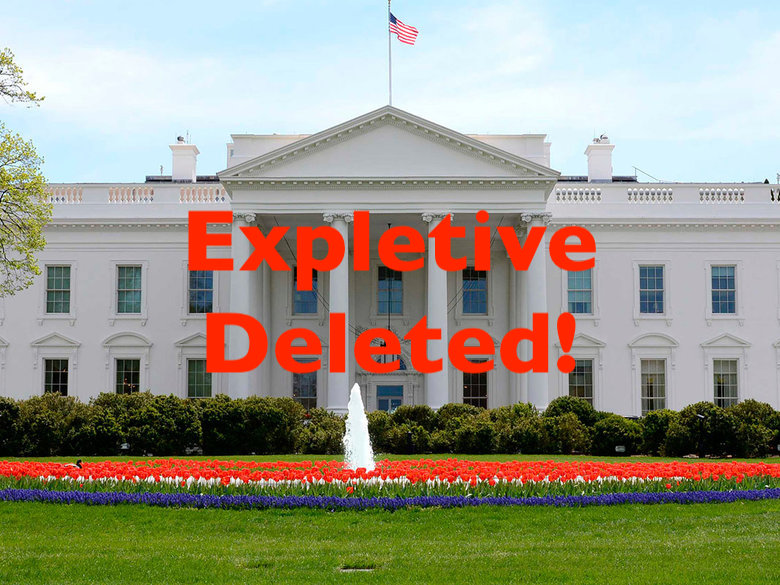
Expletive Deleted

On the 9th August 1974 president Richard Nixon resigned from office in the face of almost certain impeachment. As president he broke a number of political, constitutional and moral norms.

He attempted to use Departments of state to “get dirt” on his opponents; he had a list of “enemies”; he hated the press; he expected loyalty to himself not the Constitution; he instigated the Saturday night massacre, his Attorney General and Deputy Attorney General resigning in succession when he ordered them to fire Archibald Cox the Special Prosecutor investigating the Watergate affair. He was a bad man. And he swore a lot.

Not since then has the US faced such a norm challenging president. Someone who threatens not just to do a bad job or make awful policy decisions but who actively undermines the foundations of the democratic system of government.

The parallels between Nixon and Trump are many and close however in the pantheon of awfulness Trump stands head and shoulders above even Nixon. He has been a far greater threat to US democracy and liberal democracy worldwide than Nixon ever was. There are two reasons for this.

Firstly, the character of the person. Neither Nixon or Trump could be said to be overly worried about questions of conscience or moral scruple. The difference is Nixon knew there was an issue, Trump doesn’t understand the question.

The second difference, is the the moral character of those about them. Nixon had loyal supporters, some of whom went to jail for him. However within the Republican Party and within Departments of State, most importantly Justice, individuals knew there were lines that must not be crossed.

They knew when partisan political focus strayed into an obsessive demand for control at the expense of Constitutional government. Not only did they know when something was wrong they did something about it. His political colleagues in the Republican party withdrew support from the president making the success of impeachment certain, lifetime public servants resigned rather than implement the actions of an increasingly irrational leader.

The threads connecting Nixon who was enraged by what he saw as the radical trends of the 1960’s in relation to issues like race, gender, youth, and Trump who has many of the same prejudices are fascinating.

Part of the Nixon legacy may be his support for a counter revolution taken up by libertarian oligarchs determined to overturn what they saw as a strengthening progressive agenda. The investment of hundreds of millions of dollars to change the intellectual landscape and build an alternative neoliberal agenda as promoted by groups like the Mont Pelerin Society.

An agenda of small government and privatisation, unregulated free markets, low taxation, a Washington consensus about the benefits of free trade Their activities contributed to a period where market-determined price became the measure of worth of all things to the exclusion of value. Government was portrayed as the problem, supply side economics with its tax cuts and de-regulation the norm with a Washington consensus about trickle down wealth distribution.

Over the years what may arguably have been a reasonable recognition of the importance of entrepreneurial dynamism became an ossified dogma incapable of addressing the problems of an increasingly integrated world with a dramatically different economic structure.

A weightless world of digital goods and instant communications facilitating global supply chains supporting just-in-time assembly processes. A world where offshoring, and mechanisation was destroying some jobs and shifting others to the other side of the world.

The impact of all this on, initially, non-graduate labour but as countries expanded their higher education, graduate labour was remorseless. Further, the deregulation agenda meant the ability of labour to defend itself was diminished if not removed.

The outcome in terms of growing inequality, an uncertain “gig”economy, loss of employment rights and benefits, and in the States the loss of health insurance created a sense of despair. Despair which had devastating consequence for the health and well being of many as described by Anne Case and Angus Deaton in their work “Deaths of Despair”.

These trends have meant the majority of the populations of many western democracies have seen their standard of living stagnate or decline. The political elites of these nations have seen this decline as an unfortunate consequence of economic progress.

Labour and Conservative, Democrat and Republican have argued, more or less forcefully the market economy is a self regulating machine which human interference can only damage. Ultimately it will make things better. Ultimately of course we are all dead. For those living, and possibly dying, through the transition, ultimately better days are of little consolation.

It is this context in which Donald Trump came to power. For Millions of Americans, no one was listening to them. It is a sign of the level of desperation they felt that a billionaire, foul mouthed, misogynist, racist could be seen as someone able to address their concerns.

What Trump did do was articulate their fears. He gave them a voice. He took the crisis of identity which unemployment, underemployment and marginal employment foster and gave it a series of targets which he claimed would “Make America Great Again”.

After four years the Trump record on the issues he said were his priorities is clear. He “loves” coal but coal production is lower as he leaves office than when he arrived, the balance of trade with China (ignoring the question of whether a deficit is necessarily a bad thing) in 2016 was negative $346bn in 2019 it was negative $345bn. (It is much lower in 2020 but there are reasons for that.) The $1bn reduction in the deficit has come at significant cost to the US economy. The New York Federal reserve has estimated that the trade war has wiped $1.7tn off the value of US companies.

In January 2016 US unemployment was at 4.9%. This was after six straight years of decline from a high of 10% in October 2009. In October 2020 the rate is 6.9%. The wall with Mexico remains to be built and Mexico have made clear their views on paying for it. Worst of all, close to a quarter of a million US citizens have died from Covid-19. A significant proportion of those would still be alive if the president had chosen to address the issue.

President Trump’s record is disastrous in his own terms which in the main are wrong anyway. This is before you address the issues of nepotism, self dealing, global security, national standing. I could go on.

However, the issues which created the space for a Trump presidency have not gone away. A radical agenda of change is needed and those that Hilary Clinton dismissed as in the “basket of deplorables” need to be reached out to and tangible support provided.

A president Biden has a massive task ahead. Despite appearances to the opposite winning the presidency is the easy bit. Crafting a consensus which secures real change in the balance of economic power to ensure areas like the rustbelt experience economic transition as benefit not just pain will be a massive challenge.

The agenda and the process of reconciliation is more than a one term exercise.and will mean hitting the ground running. There are those that doubt whether Joe Biden is up to the job. We will see, however, whatever his failings he is infinitely better than his predecessor. Democracy has rescued itself as it has done before. The political elites of all democratic parties must learn the lesson of how fragile it is and stand up for it against all who attempt to undermine it whichever side of the aisle they stand.

When he was forced to release the transcripts of the tapes of the conversations in the Oval office President Nixon insisted that the obscenities be deleted. This led to a huge number of text replacements with the term “expletive deleted”. Democracy has just ensured that an expletive has been deleted from the White House. It is a massive triumph for democracy.

Fear and Rage – The Trump Presidency

Bob Woodward is an exceptional journalist who began his career with the crescendo that was Watergate. Together with his colleague Carl Bernstein and meticulous reporting he contributed to the fall of President Nixon.

His coverage of US politics and presidents is marked by meticulous attention to detail and rigorous fact checking. To date he has written two books on the Presidency of Donald Trump. The first, “Fear” dealt with the first two years of the Trump White House. It involved both, on the record, and deep background interviews, with serving and former members of the administration.

It provides a detailed insight into the day to day decision making of President Trump. What makes it stand out from the myriad of other books about the President is that it does not start from an assumption that President Trump is self evidently neither suitable for nor capable of the job.

He reports the conversations between Trump and members of his administration as close to how they happened as possible. How the president appointed senior members of his cabinet and what he saw as their strengths. How he discussed key policy issue such as trade with China, North Korea, NATO, The Middle East and also more directly concerning issues such as the Mueller Inquiry.

Occasionally, in comment, Woodward will sympathetically point out that some of the issues Trump is criticised for are intractable issues which previous incumbents have failed to resolve and made similar policy mistakes about. In a very partisan environment, the fact that he does not leap on every policy error as proof positive that Donald Trump is a narcissistic imbecile is actually refreshing.

Mr Woodward has been criticised for producing books full of facts but little analysis. It is certainly the case that both “Fear” and his latest book “Rage” are fact full. Comment is confined to occasional small paragraphs which mainly involve a fact check.

Having said this assessing the Trump Presidency requires little more than listening. What comes out of the mouth of the President is so self condemning that to point out it is untrue and or stupid would seem to be an unnecessary statement of the bleedin’ obvious.

Reading, “Fear” is like reading a succession of comments which range from the completely inappropriate, to the laugh out loud stupid ( see page 273 when he wants to launch an investigation into China without mentioning that it is into China!) to the treasonously criminal.

Fear ends with the resignation of Trump’s personal lawyer, a man called John Dowd. Mr Dowd had been appointed specifically to defend Trump in the Mueller Inquiry.

Mueller wanted the President to testify to his Inquiry under oath. Dowd told Trump he could not do this. In Dowd’s view it was a perjury trap. Trump disagreed, he wanted to testify to clear it all up. Unable to act for a client who would not take his advice, Dowd resigned.

As Bernstein puts it in the last sentence of the book, “…Trump had one overriding problem that Dowd knew but could not bring himself to say to the President: “Your a fucking liar”.”

“Rage” is not just based on interviews with his staff and colleagues, but its principal source is the President himself and comprises some 18 taped interviews. Given the conclusion of the previous book one might wonder about the benefit of this.

However, the final comment on his veracity, or lack thereof, might have included the word stupid. Trump lies when there are multiple sources including his own recorded testimony that contradicts what he says. He lies when he does not even have to. The reality of life in the States screams against his words for most Americans.

The very way in which these interviews are organised provides insight. Some have a degree of formality in the Whitehouse with other staff present who might be able to shield some of the more off-beat answers. Others, come out of a phone call from the president at any random time. There appears to have been no advance notification of the questions so that the President could bone up on them.

On one occasion Mr Woodward phoned the president, when he got through to him the President said he could not talk because he had half the National Intelligence Committee waiting for him for a meeting downstairs. He then proceeded to talk for 15 minutes.

Lack of discipline, lack of focus, lack of concentration, lack of strategy all shine out of the words coming out of the presidents own mouth.

The president provided Bernstein with the correspondence between himself and Kim Jong Un. A more toe curling example of brazen flattery from Kim is difficult to imagine. But it seemed to work. He got his meetings, destabilised the relationship between Soul and Washington and kept his weapons. Having said this war was avoided, but it is difficult to see how, after all the bally hoo, things differ now from how they were when President Obama walked out of the White House.

One thing that strikes you as you read Rage is how sympathetic you become to individuals who, you might expect to have little in common with, politically, socially or morally. Dan Coats a devout Christian and former Republican Senator from Indiana. James “Mad Dog” Mattis, a Marine General who had overseen the wars in Iraq and Afghanistan. Rex Tillerson ex CEO of ExxonMobil one of the largest fossil fuel companies in the world.

The recruitment of these individuals to the offices of Director of National Intelligence, Secretary of Defence and Secretary of State respectively is described as is their subsequent careers. A pattern emerges of patriots trying to make policy and sense out of Tweets, TV interview statements and incoherent meetings lacking any sense of purpose. They all loyally attempt to make steam of consciousness seem like coherent policy.

After, diligently and loyally working for the President, each one of them found their position increasingly untenable. The President cancelling joint military exercises with South Korea without any reference or forewarning to his Secretary of Defence. His dismissal of National Intelligence reports about Russia’s interference in the 2016 election on the strength of a robust denial by… Vladimir Putin.

Eventually all were sacked, even those that resigned. As Mattis put it, he quit when “…I was basically directed to do something that I thought went beyond stupid to felony stupid, strategically jeopardising our place in the world and everything else,…”

The book also changes ones perception of others in Trump World from that which has been built in the partisan media. Rod Rosenstein, the Deputy Attorney General who took over the supervision of the Mueller Inquiry when Jeff Sessions recused himself, came across as a beleaguered defender of Mueller. He was that but it seems independently he kept Mueller on a very short leash of his own design,

Republican Senator Lyndsey Graham has been a robust defender of Trump in public and has drawn the ire of the liberal media for that. Unquestioning public defence has made Graham look either stupid or blinded by partisan prejudice. Behind the scenes however he seems to have been someone consistently willing to challenge the president and give him sound advice.

Lynsey confided that he had never been, “…more worried than I am right now” when Trump had Lafeyette Square violently cleared of peaceful protestors so he could wave a bible in front of St John’s Church. Graham proposed to Trump he appoint a commission to look into policing and race before he started getting tough on protestors. He was ignored.

Whether from the outset or from experience Graham clearly saw the weaknesses of his man and the risks these represented. In relation to Covid-19 the president’s failure to properly engage was a matter of real concern. At one point, perhaps prophetically, he says of Trump, “His biggest political threat is is for people to go without a pay check for weeks and get disgruntled, and he overreacts and tries to open up the economy too soon. That will be the end of him, because you will have another round of the virus.” Prophetic words.

Like a toddler Trump only paints in primary colours. There are loyal friends who are very smart or there are treacherous enemies who are dumb and stupid. There is no shade or tone. Bernstein overcomes this and provides a much more nuanced picture of those around the president and indeed he genuinely seems to try to let the president present a more nuanced picture of himself.

He lets the president speak for himself. He does not try to catch him out, indeed he often points out how Trumps actions and words might be perceived negatively by those outside of his bubble. Even with such an even handed approach Trump clearly emerges as a what-you-see-is-what-you-get person. There is no hidden, deep strategic direction for the nation. His administration’s strategy has all the clarity of a set of random fridge magnets that have dropped on the floor.

Metropolitan, elite disdain for Trump is easy. That he is nasty, self centred, stupid but laced with flashes of evil genius is apparent from his public persona. It is a testament to the depths of despair with the pre-existing political elites that a substantial number of people were willing to try him and indeed for some to stick with him despite all the evidence.

However, it is too easy to dismiss Trump as a buffoon. He is not a harmless clown. There are real areas of concern, the born again christian supporter and Director of National Intelligence Dan Coats never overcame a concern about the relationship between Trump and Putin, for him it was never all witch hunt.

The isolation of the States from its natural allies, the cavalier approach to diplomacy with an unpredictable leader with nuclear weapons, a science ignoring approach to the worst pandemic in 100 years costing 210k lives and counting. These are direct outcomes of Trumps unprocessed impressions and random style of leadership and direction.

Since the start of his presidency there have been those who have tried to suggest behind all the u-turns and sharp shifts in key there is an underlying logic. That his style is to secure his ultimate goals by keeping his opponents, his friends and his staff guessing. It sounds stupid. There is a reason. It is stupid.

Trump’s view of the presidency is of a sinecure for personal aggrandisement. Notoriety is seen as a positive achievement and the venal pursuit of personal gain the lodestar of all his actions.

Despite his best endeavours this is what emerges from Woodward’s book , and while his analysis and commentary is spare it is ultimately damning. He concludes the book as follows: “When his performance as president is taken in its entirety, I can only reach one conclusion: Trump is the wrong man for the job.”

Rage. Bob Woodward. Simon and Shuster 2020.