
The government’s pivot from a strategy of mitigation to a strategy of suppression this week was caused by the work of the MRC Centre for Global Infectious Diseases analysis led by Prof Neil Ferguson. The report in question is the Centre’s 9th report on Covid-19. Twenty pages long there is some very impressive statistical analysis but the argument and the conclusions are clear for any lay reader.
It considers the pros and cons of both mitigation and suppression strategies for dealing with Covid-19. Spoiler alert, it comes down very much on the side of suppression given the likely level of deaths of the mitigation strategy, 250k. In essence this is mainly due to the health system being overwhelmed before any benefits of herd immunity begin to appear.
I recommend anyone not yet convinced of the need to take seriously the advice of the government on radical social distancing to read the report. Specifically I suggest you contemplate Figure 3 from the report shown below. 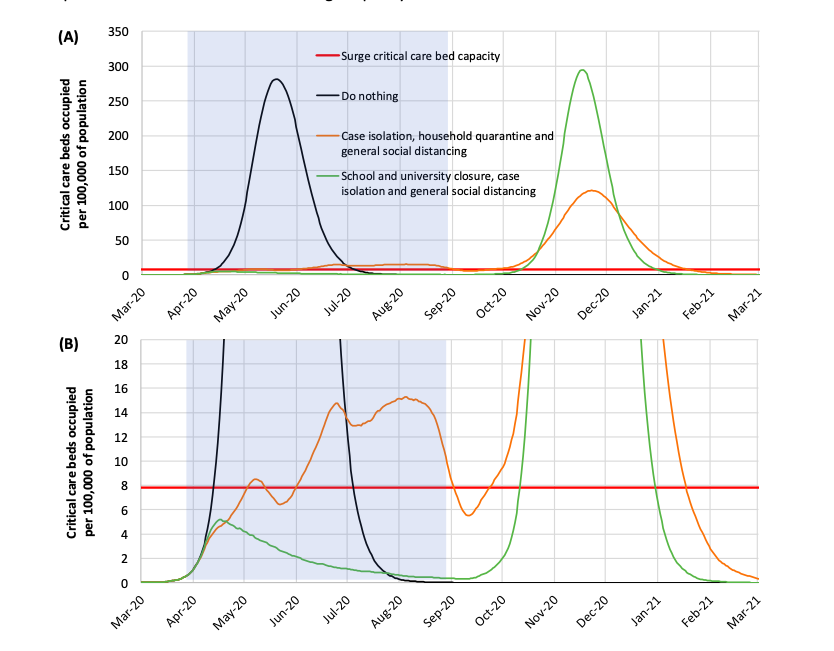
The key thing to look at here is the red line at the bottom of graph (A), as expanded in the lower graph (B). This is the critical care bed capacity in the system. The black, green and orange lines are what happens given different social distancing responses. Black is that colour for a reason. If we do nothing then the NHS will be overwhelmed with cases and have nowhere near the capacity to meet demand. This will therefore mean some 250k+ Corona virus patient deaths. I am not sure whether this addresses collateral damage ie. those patients that ordinarily need a critical care bed but will not be able to get one because they are full of Covid-19 patients.
The orange and green lines show differing levels of social distancing. We have moved from being “advised” to being “told” by the PM that we should move to what the green line requires. I suspect the next step will be “instruction” backed with sanctions.
The aggressive suppression strategy clearly manages to keep the cases of corona virus requiring critical care within the capability of the system. However, it does assume the social distancing measures last until September, a touch longer than the PM’s optimistic timeframe.
The down side of the suppression strategy is that it slows/prevents herd immunity and thus when the measures are relaxed the virus takes off again. Does, therefore, suppression simply delay the inevitable? No. Critically what suppression does is buy us precious time. Time to build critical care capacity: beds; staff; PPE; ventilators etc. Time to build testing capacity both in terms of scale but also the ability to test for those that have had the virus and are well. Finally, time to identify a vaccine, although this is clearly many months away at best.
The strategy seems to be the “Hammer and Dance” one set out by Tomas Pueyo’s in his article, referenced in my last post. This involves Hammering the virus with aggressive social distancing. The aim being to get the infection rate from something like 2.4 persons to 1 or below. In other words the number of people an infected person passes the virus on to falls from 2.4 to 1.
Then infections will start to reduce and the Dance begins as critical care facilities gain capacity social distancing restrictions can be relaxed. As soon as the rate of infections start to build again the restrictions need to be reapplied, however, by then it may be possible to target them more effectively through the use of much more wide spread testing. A touch of 2 steps forward and one back. Or perhaps more like like the fair ground game “Whack a Mole” where moles pop up in random places and you have to whack them back down.
If you want to get a reasonably good picture of the likely evolution of the disease and the key factors driving its spread the Imperial College Report is well worth a read.
Stay safe
 northerncomment