
Why Sue Grey’s Report is Irrelevant

Why are Conservative MP’s waiting for Sue Greys report? We are told it will establish the facts. But in reality the facts are no longer in question. Were there breaches of the law in relation to Covid? Did the PM attend where the breaches occurred? Yes to both as admitted by the PM at the dispatch box.

The question is, did the PM lie to Parliament and the country when he admitted the actions but claimed they were unintentional and the fault of the advice of others.

His ministers are running around trying to see if they can get a defence to fly with the country. Jacob Rees Mogg has tried them all. Blaming the civil servants for arranging the breaches; the complexity of his diary; advisors telling him the events were within the rules; a PM focused on his big job and not the meeting he was taken to.

All of these are attempts to demonstrate there was no intention to break, or knowledge he had broken, any laws.

If this does not work there is the defence about how good the PM has been on the “big calls” he has made. How, all this obsession with Partygate, driven by the media and opposition, is distracting the PM from dealing with a vast in-box of issues not least the attempt by President Putin to invade even more of the Ukraine. Mr Rees Mogg even had a go at trying to undermine the severity of the breach by talking about how excessive the rules were.

However well delivered in the meliflous tones of the upper class, however remorseless the politeness and however supported by classical references, Mr Rees Mogg’s arguments for the defence remain bunkum.

In essence the PM’s own argument seems to be the age old defence of the nursery. “He told me to do it.” To which over the years parents and primary school teachers have responded, “So if he told you to jump in the river would you?”

Despite what some people may call him the vast bulk of the population do not think the PM is stupid. And certainly not so mind numbingly stupid as not being able to distinguish, for himself, when he is engaged in breaking a law he has designed.

The country has decided he has lied. He has a track record of this which many people discounted when he was lancing the noxious boil of Brexit, which had petrified UK politics for years after the referendum. Lying about breaches of the Covid laws, however, are lies about something intensely personal for many people. His lies were about behaviour which was in direct contrast to the behaviour of millions of law abiding citizens convinced of the sense of what they were doing to control a deadly disease.

But does Partygate matter? In one view it pales into insignificance when you look at what is happening in the world at the moment. The challenges and threats are significant and many imminent. Ukraine and Putin more generally, the rise of China and its threats toward Taiwan, global Covid, the humanitarian crisis in Afghanistan, the threat of nuclear proliferation in Iran and the ticking time bomb of the existential climate crisis.

There is another view however which is about the challenge to democracy which is growing around the world. That challenge comes from “strong leaders” who certainly do not want to be held accountable for their kleptocratic behaviour by anything so awkward as democracy.

But it also comes from those within democracies who play fast and loose with the truth. Lying at the heart of government is corrosive. It involves more and more members of the government trying to defend the indefensible. Bending the truth, manipulating the facts, prevaricating to buy time. All the while undermining public confidence in the democratic system. It seems impossible to hold those who break the rules to account if they are rich and or powerful.

President Putin tells lies. He lies about state sponsored assassinations, little green men in Crimea, and the defensive purpose of a build up of 100k troops on the border with Ukraine.

It may be argued lying about breaking minor laws cannot be compared with the egregious life and death falsehoods of President Putin. But that would be a mistake. One of the fundamental pillars of democracy is trust in political leaders and this requires they speak the truth. If people do not feel trust in democracy they may be much less willing to defend it. Indeed they may be happy to try something different.

The PM behaved in a way which he knew would be totally unacceptable to the British public. He decided to try to pretend he had been misled into this behaviour. It does not wash. When you start telling lies to hold on to office you pave the way to ever more audacious falsehoods. Eventually, you do not lead by consent secured by convincing people with rational arguments you lead by force and state enforced “truth” which becomes whatever you want it to be.

The PM and President Putin may be at very different points on the spectrum in relation to lying. However, it is not a spectrum any leader should be on. People will forgive mistakes, they will even forgive some lies, but they will not forgive being taken for mugs. I am pretty sure the Tory party knows this and the PM’s days are numbered.
Boris the Hedgehog

In the early 1950’s Isiah Berlin, a highly respected Oxford don, wrote an essay on Tolstoy’s theory of history as revealed in War and Peace. As a way of analysing this he referred to a fragment from Archilochus, an ancient Greek poet, which says: “The fox knows many things, but the hedgehog knows one big thing.” The analysis he developed from this was seen as highly revealing about the thinking of Tolstoy but was picked up and used much more widely to categorise writers, artists, statesmen and indeed humanity in general into hedgehogs and foxes.

Hedgehogs, see the world through the prism of one central and blinding truth. Indeed they make sense of the world and interpret it by referring back to that single organising principle, the force which underpins and drives the manifest reality we experience. So in Berlin’s view; Marx’s economic determinism; Plato’s ideal forms; and Hegel’s Geist or cosmic spirit are all examples of the hedgehog perspective where some force structures and determines reality.

Foxes on the other hand see reality emerging from the interaction of many things with the outcome being contingent and far from determined. They seek understanding by knowing many, often contradictory things and seeking to understand those many things in depth respecting their uniqueness. Not trying to fit them into some pre-existing model. Berlin refers to Aristotle’s taxonomy, Herodotus’s historiography, and Joyce’s stream of consciousness as typical of the foxes approach focusing on the individual and contingent as opposed to the universal and determined.

Berlin does not see this distinction as anything more than, “… a point of view from which to look and compare, a starting point for genuine investigation.”

What has all this got to do with Boris? Bare with… a little longer.

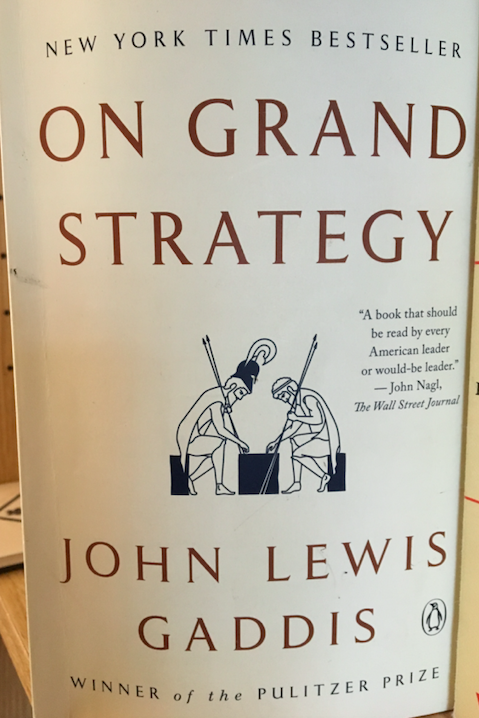
This “starting point for genuine investigation” was recently taken up by John Lewis Gaddis, a lecturer at Yale University on Studies in Grand Strategy, in his recent book “On Grand Strategy”. The work considers the histories of great leaders of the distant and recent past and anaylses their strengths and weaknesses in terms of Berlin’s distinction. In essence he believes successful leaders manage to combine the guiding compass of the hedgehog with the pragmatic adaptability of the fox. Indeed the mark of the truly great leader is their ability to hold two contradictory thoughts in their minds at one time and still be capable of operating effectively.

The benchmark of great leadership Gaddis sees as having been exemplified by Abraham Lincoln whose moral compass was set on the abolition of slavery, who however, recognised that when the direction pointed into a swamp it was necessary to tack and change direction to get around the swamp, but never losing sight however of his ultimate goal. For Lincoln that tacking involved: a lot of smoke filled rooms; the suspension of habeas corpus and defying the Supreme Court in time of war; retaining the allegiance of states where slavery was legal, as he is reputed to have said he “…wanted God on his side, but he must have Kentucky”. The trick was in holding the contradictory requirements of ultimate ends and immanent means in dynamic balance and always tending in the direction aimed for.

Someone, who failed to hold this balance according to Gaddis was Xerxes, Persia’s King of Kings in his invasion of Greece. He was a full-on hedgehog. On the Asian bank of the Hellespont he considers the 360 boats that have been lashed together to create a bridge for his invading army. He seeks the advice of his uncle and advisor Artabanus, an out-and-out fox, who recites all the problems the King may encounter and things which may go wrong. Xerxes listens but concludes if you considered all the risks in the world you would never get out of bed, so sends his uncle home and proceeds to cross the Hellespont.

Xerxes had a mighty army and a plan with a single goal, the capture of Athens. Nothing was to stand in the way of that. In order to demonstrate his resolve, when Pythius the Lydian provided him with all the troops and treasure he asked for, save the service of his eldest son, Xerxes had the son bisected and ordered his army to march between the two halves of the unfortunate young mans body.

Now, withdrawing the Whip from 21 loyal conservatives might not be anywhere near as brutal and bloody however it might be seen as equally gratuitous and spiteful. Certainly not judged to secure the affection and support of those who might have been seen as natural allies.

Like Boris Xerxes took ambition for capacity and expected to crush all before him to ultimate victory. His mistake was to fail to consider what things might undermine his vision. For example, geography could not always be simply overcome with initiatives such as pontoon bridge. The narrow pass at Thermopylae provided a bottle neck where the Spartan 300 held up the advancing force. Giving their lives to shake the vision of an invincible foe and delay their progress.

Furthermore, the other side did not act as they were supposed to. Just as Jeremy Corbyn refused to fight on the ground dictated by Boris, i.e. a snap general election, Themistocles refused to fight on the ground Xerxes expected. He evacuated Athens leaving Xerxes with a pyrrhich victory and approaching bad weather. His response was to stamp his feet and set fire to the Acropolis anticipating this would undermine the morale of the Athenian navy off shore. On the contrary he then watched as the Greek triremes battered his navy and slaughtered his sailors.

Xerxes retreat was ignominious and costly. His error in the eyes of Gaddis was his failure to calibrate his ends with his means. Ends arise in the mind of the leader. They are projections of what might be, and free of consideration of the messy realty of means can be infinite. First Athens then the world will be ours. First out of Europe and then the world will be ours.

When you are King of Kings it is easy to start to believe your own publicity and capacity to make things happen. The world however is an intractable place and there are others with different agendas. You may feel able to bulldoze through the opposition and at times that may be necessary. However, you need to know when those time are, and then, whether you have the resources and ability to do it.

Boris started out mistaking a “can do” attitude with a strategy. He has supplemented this with a call for “optimism” and “positivity” which are just as vacuous. His closest advisors, for all their classical eduction, are a nest of hedgehogs focused exclusively on Brexit at any cost. If their strategy is going according to plan it is a very cunning plan, cunning to the point of incomprehensible.

The very purity of their hedgehog vision may be their downfall as they ignore the legal and constitutional terrain they must fight across. “Can do” as hubris may yet trip them up. We can only hope. However we should not assume this will be the case. Their willingness to trample over conventions, figuratively bisect their opponents and only touch base with truth when it suits them means they could get to what is their increasingly clear goal – no ifs, no buts, no Deal.

Sadly, if they do, it is the vast majority of the population of the UK who will bear the pyrrich nature of their victory, not them.