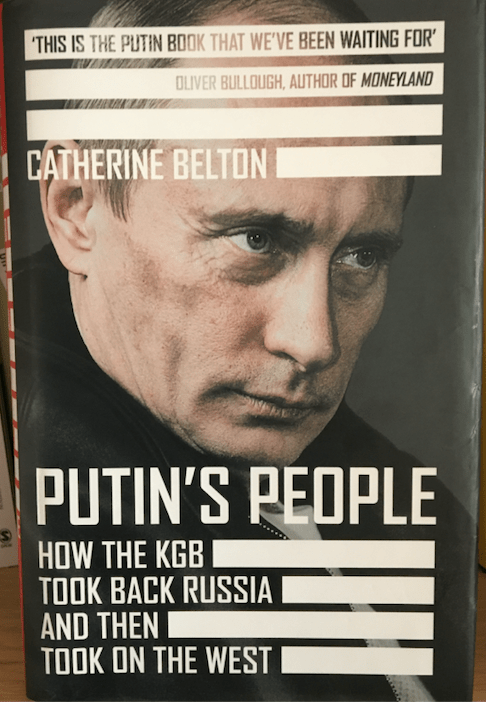
Former FT Moscow correspondent Catherine Belton’s recent Book “Putin’s People” chronicles the rise to power of Russia’s President. It provides a fascinating insight to the form of State Capitalism put in place by Putin and his former KGB colleagues over the past 20 years.
Central to this process has been the transformation of Russia’s legal system into a pliant arm of the Kremlin. For long it had been subject to local corruption due to the very low pay of Russian judges. However, what Putin has done is incorporate the judiciary into the state, no longer providing an independent assessment of facts and guilt versus innocence but rather a step back to Soviet era “telephone law”. In practice the whole of the legal system is at the behest of the political elite and more specifically Putin.
The key shift to this was the trial of Mikhail Khordorkovsky, at one point the richest man in Russia, a beneficiary of the first moves to a market economy under Boris Yeltsin. The trial lasted 11 months and, according to Belton, “…created a precedent for the country’s judiciary to be turned into an extension of the long arm of Putin’s siloviki.”*
The three female judges were accommodated by the Kremlin in a sanatorium 50 kilometers outside of Moscow, all expenses paid, while they wrote their verdict. When one of the judges refused to go the sanatorium under police guard Vladimir Kalanda, a deputy in the presidential administration spoke to the chairwoman of the Moscow City Court to make sure her subordinate complied. The official reason for this was to ensure they would not be bribed by representative of Khordorkovsky.
Surprisingly, the judgement was almost an exact summary of the prosecution. In truth it involved the retrospective and partial implementation of laws to ensure conviction and resulted in a sentence of 10 years hard labour. An appeal was submitted and after a number of delays was heard in a single day due to concerns that the statute of limitation might apply to some of the counts against Khordorkovsky. It took the judges a matter of minutes to reject the appeal.
Oddly enough, following this Russian oligarchs were very careful to ensure they did not upset Putin and indeed when asked to jump for him only asked how high. And he did ask them to jump or rather treated their wealth as an extension of the states available for him to direct as he thought fit.
In short Putin converted a nascent independent judiciary into a shield and sword to overwhelm any opposition, appropriating assets and incarcerating oponents at his pleasure.
Of course he has a different take on the matter and argues that the courts act according to law and he cannot interfere in their independent prosecution of those he falls out with. In short, he lies.
Belton’s book provides plenty of evidence to support this degradation of the rule of law into rulers law. Whatever the limitations of the British legal system and whatever bias to wealth and power it contains, the situation is categorically different to one where the Executive becomes, rather like Humpty Dumpty, able to say the law “…means just what I chose it to mean – neither more or less.”
All this is truly frightening and undermines two foundational principles of democratic societies. First the rule of law and its application without fear or favour to all citizens equally. No one is above the law. The second principle, is the separation of powers and the independence of a professional judiciary. One which stands separate from the Executive and indeed can hold it to account if it breaks the law.
Obviously, there has not been a long tradition of any of this in Russia. Neither before the 1917 Revolution nor after in the Soviet Union. On the collapse of the latter there was a brief period when these principles seemed to be gaining ground. However, they were under challenge from the moment Putin came to power in 2000. The judiciary came under increasing pressure and after the trial of Khordorkovsky in 2005 it was really game over.
In the west of course we believe the two principles mentioned above are well and truly secured in democracies such as the United States. Or we did. From the very start of his term in office President Trump took his Twitter scythe to undermine the judiciary by attacking judges and courts for rulings he disagreed with and used his powers of appointment to attempt to take control of it from within.
His track record on Attorneys General illustrates a restless search for someone that will meet his exacting requirements. Most Presidents seem to have around three Attorneys General. FD Roosevelt managed with four in his exceptional twelve year 3 term presidency. George W Bush had the most with 3 acting and 3 full Attorneys General. That of course was in his 8 years in office.
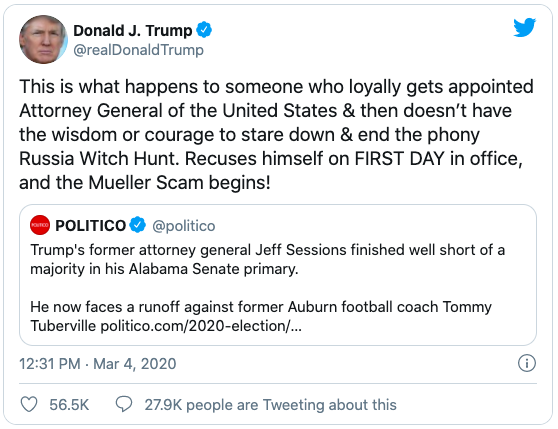
President Trump had gone through three acting and one full Attorney General in just over two years before settling on William Barr in February 2019. His first full appointment was Jeff Sessions who made the school boy error of recusing himself from the inquiry into Russian involvement in the 2016 Presidential election campaign of Donald Trump. From that moment on he was a dead man walking, openly ridiculed and berated by the President in public.
After he had left office the President made clear what he saw as his shortcomings. In essence these were his failure to Protect Trump by closing down the Mueller Inquiry or the “Russia Witch Hunt” as he called it.
With William Barr he seems to have discovered an Attorney General that does understand the legal immunity which attaches to the office of President. Mr Barr has assiduously attempted to ensure the President is protected from the distracting attentions of Federal Prosecutors.
As soon as he took office Mr Barr inserted himself into the Stormy Daniels investigation of campaign fund violations. Ms Daniels was paid $130k for her silence about an alledged affair with candidate Trump in the run up to the 2016 election. His personal lawyer Michael Cohen was jailed for 3 years for making the payment on behalf of “Individual One”, President Trump.
Following Mr Barrs review of matters the Federal case investigating the liability of “Individual One” drifted for months and then was wound up with Federal Prosecutors confirming no further action on this matter would be taken against any other individuals.
Mr Barr also insisted that any other cases in any Federal Prosecutors Office relating to the President needed to be reviewed by a hand picked team in his office.
When the Mueller Inquiry finally reported to Mr Barr he initially tried to prevent its release to the public providing a letter to Congress with his own rather contentious summary of what he believed it concluded. It attempted to set the tone about exonerating the campaign and the President.
Mr Barr holds the radical view that whilst in office not only can the President not be charged with any breaches of the law but that neither does he have to respond to investigations into such breaches. According to him the President does not have to provide congress with documents even if they are supported by a subpoena.
Not only has Mr Barr used the law to shield his boss but he has also used it as a sword, setting up criminal inquiries into the actions of law offices in relation to the establishment of the investigation into Russian attempts to support Trump in the 2016 election.
His latest moves have been to replace the US Attorneys in Washington DC and both the Southern and Eastern Districts of New York. What all these Districts have in common are ongoing investigations into President Trump and the Trump organisation. Geoffrey Berman, Attorney for the Southern District, denied he had resigned when Mr Barr announced this one Friday evening. This forced Mr Barr get the President to remove Mr Berman.
No doubt the estimable Ms Kayleigh McEnany, the Presidents indefatigable press Secretary, can confirm that all this is perfectly normal and there is nothing to see here. But there is. Incredibly what we see is a process undermining the independence of the judiciary with frightening parallels with what has happened in Russia.
Fortunately there are signs of push back. Last week the President lost two cases in the Supreme Court which struck down definitively and in terms the notion that the President is above the law.
In the Southern District of New York the State prosecutors office have picked up the case dropped by the Federal Prosecutors office into the Stormy Daniels hush payments which they believe breach a range of State campaign finance laws. The State Prosecutors do not answer to Mr Barr and importantly State laws are not subject to Presidential pardon.
There is hope the attack on the rule of law in the States will be overcome. However no one should underestimate the strength of that attack or the risks it creates if even partially successful. By far the most effective way to defeat this is by the US public rejecting candidate Trump at the polls in November. Experience to date, however, indicates President Trump will do all he can to transform The Rule of Law into The Rulers’ Law to secure victory. The 2020 US election is not for the Presidency, it is for democracy.
*Siloviki = Putin’s inner circle of ex KGB colleagues.

 northerncomment