Constitutional Crises

Two of the foundational democracies in the Western world, both ironically containing united in their name, the United States of America and the United Kingdom are in the midst of constitutional crises. Here, where we famously have an unwritten constitution, the Supreme Court has declared the Prime Ministers prorogation of Parliament void. In the US, the country with probably the most famous written constitution in the world, the House of Representatives has begun impeachment proceedings against the President. In truth they are both responses to a similar issue.

In both countries there are leaders in power who are happy to override or ignore constitutional conventions and practices in the interests of getting things done i.e. delivering Brexit, or getting my way building a wall.

Boris Johnson has decided the country has expressed a clear view it wants to leave the European Union and therefore he is justified to do “whatever it takes” to secure this. More than three years on from the referendum, one indecisive election, two Prime Ministerial resignations, one year of unedifying Parliamentary manoeuvring, including three unsuccessful votes on a withdrawal deal, it is not surprising Mr Johnson can tap into a national mood of frustration.

A decisive strategy for dealing with the impasse must surely be welcome. The problem is Mr Johnson has been more decisive than strategic.

Mr Johnson has not attempted to build a consensus, or even a majority, in either his own party or Parliament, or thought of attempting to lance the boil with another referendum. He has in effect said the Parliamentary system is not working and so I will circumvent it. I will ignore Parliamentary sovereignty in order to return sovereignty to Parliament. Taking at face value what Mr Johnson says about his earnest desire to avoid a no deal Brexit, whatever was in his mind, proroguing Parliament and removing the whip from 21 tory members who voted against him looked like a concerted attempt to circumvent the democratic process. The Supreme Court seems to have viewed the latter in that light. So far so bad

However, when the news of the Supreme Court’s decision provides a cheap opening laugh in a speech to Business leaders in NewYork and the PM uses the opportunity to say how profoundly he disagrees with the Judges decision you have to be worried it is not just hubris that’s the problem. This concern is reinforced when there is talk of a “Constitutional Coup” and Number 10 start briefing about an election fought on a “people against the establishment” ticket. An establishment composed of the members of the Supreme Court and Jeremy Corbyn. You only have to say it out loud!

Across the Atlantic, after two years of continuous challenge the Democratic majority in the House of Representatives has eventually moved to impeach the President. The straw that broke the resistance of the Democratic leadership arose out of a whistleblowers complaint which has still to be provided to the Chairman of House Intelligence Committee.

Despite its not having been provided there seems to be a clear picture emerging the issue revolves around a conversation between President Trump and the Leader of the Ukraine, Volodymyr Zelensky. It is alleged Mr Trump tried to pressure Mr Zalensky into providing political dirt on Joe Biden (current frontrunner in the Democratic primaries) and of his son. It is further alleged that military aid, approved by Congress, was used as a bargaining chip.

In truth, it is difficult to keep up with the “high crimes and misdemeanours” of the current President of the United States. Appointing a secret foreign agent to the post of National Security Advisor; using his office to secure financial advantage for himself and his family; lying about his business dealings in Russia; paying $280k in hush money to women he had affairs with; refusing to release his tax returns; lying daily about everything from the economy to the weather; denigrating the free press and the judiciary. This is just a brief list of some of his deplorable actions. They contain a mix of offences against the the constitution, the constitutional  separation of powers, the conventions of political behaviour, and black letter State and Federal laws.

Whether the impeachment action is successful will depend on whether the current whistleblowing issue gains traction with the public. If not the President could likely shoot someone on 5th Avenue and the Republican Senate would still back him.

Whatever the outcome of Brexit or impeachment, on both sides of the Atlantic we have leaders surrounded by small groups  of ideologues determined to get their way whatever the cost. They don’t just challenge those who disagree with them, whether press, politicians or judiciary, they denigrate them as anti-democratic traitors.  In doing this they are undermining the foundations of constitutional practices within which democracy has operated for over 100 years.

Whilst it is important leaders project confidence it is always a worry when they claim certainty. Here the Prime Minister claims he knows what the British people want based upon a referendum held three years ago. The President has a view that when he was elected he became boss of US Ltd. He thinks his authority runs across all arms of government including the judiciary and  legislature. They should accept what he says and do as they are told. That includes locking up his opponents e.g. “crooked Hilary”.

What is happening on either side of the Atlantic is similar and profoundly dangerous. When you mess with precedents as a politician your self interest might tell you what goes around comes around. If the precedents don’t constrain you then they may not constrain the opposition when they move into power, as they will at some point. But worse if you undermine conventions and ignore precedents you strike at the credibility of the rules of the game. If this undermines public faith you may create a wholly different scale of problem.

The Supreme Court has blown the referees whistle and cried fowl. A sensible leader in a democracy would treat this seriously and temper their behaviour. Politics with rules is very demanding, difficult and frustrating, without them it’s war.
“We the people…”

The Constitution of the United States of America has been called one of the hinges of history. For all its imperfections and the compromises over slavery it was a revolutionary document articulating the belief that sovereignty lies with those who are governed and not with those who govern.

The UK took a different path but arrived at a similar recognition of the location of sovereignty. Whilst there are written sources on process, eg Erskine May, there is, however, no definitive written statement of the British Constitution. It is a set of conventions and practices which politicians have more or less adhered to over time.

No one would argue that either constitutional model is perfect but perfection is not a yard stick with much use in the world of politics. Democratic politics is about satisficing, about how the clash of ideas and interests are resolved characteristically by compromise and a willingness to accept outcomes which you have opposed. It may not always get the best answer but will more often than not avoid the worst and critically provide for accountability by the governed of those that govern.

However, crucially, it can only function if there is an overall commitment to, acceptance of and and trust in, the system for securing governments and process of aggregating political ideas and interests. There needs to be an acceptance that the written or unwritten constitution provides a reliable, equable and fair skeleton holding the body politic together. Prime Ministers and Presidents may come and go and the style of governance may ebb and flow but the rules of the game sustain through time, creating continuity and trust in the process if not always happiness with every outcome.

In recent years, on both sides of the Atlantic, weaknesses in this model have come to light. Conventions and indeed laws are only as strong as the willingness of the political elite to follow them. Both here and in America politicians of all persuasions have been engaged in an escalating process of the weaponisation of their respective constitutional norms. This is a very dangerous path. It goes to the integrity of the skeleton without which trust in the process is undermined and commitment to compromise destroyed.

There is no doubt the process is more brazen and ubiquitous in the States, for the time being. President Trump has no understanding of the notion of the separation of powers, the role of an independent judiciary, a free press, the location of sovereignty, or in truth much at all. He is a uniquely awful individual who brings to everything he does a combination of ignorance and prejudice which when combined with the power of his office is truly frightening.

Whilst he has brought a terrible destructive force to the rejection of accepted ways of behaving in truth he is accelerating and deepening a process which has been in chain for some time. Furthermore, culpability for what is happening now is not confined to President Trump. Mitch McConnell, the Republican leader of the Senate has, with the backing of most of the rest of the GOP, sustained and supported his President in a manner which, if there is any justice, history will judge very harshly.

Back here in the UK it is the case that both sides in the Brexit debate have sailed close to the wind in terms of bending and stretching constitutional norms. However, the prorogation of Parliament for 5 weeks at a critical point in the Brexit process raises the the bar to a whole new level. It is a typical populist ploy to claim there needs to be progress and Parliamentarians are getting in the way of firm and clear government. It is also typical of despotic double speak that one claims to be bringing sovereignty back to Parliament by closing it.

If precedents are manipulated to do something they were not intended to they start to lose legitimacy. They then come to mean whatever the government of the day thinks they mean. This completely undermines their function of constraining political battles within civilised bounds. If the rules of the game don’t apply to one side they don’t apply to any. Political debate becomes ever more acrimonious. Effective government ceases, in the United States this has literally involved the shutdown of government 10 times in recent years. The spectacle of all this undermines the faith of the governed in the very process of democratic government and they seek assurance and stability elsewhere. And there is always someone willing to provide that stability, even if the assurance is short lived.

There is a complacency about the strength of democracy, which perhaps derives from the fact that most citizens in the US and UK have experienced nothing other. It may be this complacency has also infected our political elite. They feel they can manipulate the system and it will spring back. They can twist its arm tighter and tighter and it will never break. They need to be aware, however, that a broken convention will take a lot longer to repair than a broken arm, if it is repairable at all.

For a minority of Parliament Brexit is an idee fixe which must be achieved at all costs. They seem to have assessed the political, constitutional and economic cost they are risking as less than the benefits from a country free from Europe. If they get their way we must hope they are right, even if we are sure they are wrong, because if they are wrong they may have inflicted severe harm on democracy in the UK, which, given the current global context, may have implications around the world.


Trumps Presidential State Visit

That Trump came on a state visit is not the problem. The problem is he was invited.

Some have argued it is only right he should be invited given the importance of the “special relationship” between the US and the UK. It is interesting, however, this relationship did not need such a visit during the 1950’s, 60′, 70′, 80’s, or 90’s. The first state visit of an American President under Queen Elizabeth II was President GW Bush in 2003. The only other was President Obama in 2011.

Those arguing against the visit point to both President Trump’s personal characteristics and his political actions. An inveterate liar, narcissist, misogynist, racist, bombast and bully… I could go on. These may be true, however there are a number of state visitors over the years who would not pass the smell test on at least some of these criteria, and it is a moot point about which is worse, someone who is not even aware of his awfulness as against someone who dissembles.

The second argument is that Trump is, at heart, an enemy of democracy. His attacks on the judiciary via tweets about judges who don’t do as he thinks they should and the blatant appointment of people he thinks more biddable; attacks on a free media; disregard for the constitutional principle of the separation of powers; failure to distinguish his personal interests from those of the office he holds. Another strong set of arguments but again the Queen has held banquets with many whose interest in democracy has been at best passing or indeed openly hostile.

Whilst it is very uncomfortable to sup with the devil you can understand why the UK government attempts to secure positive relationships with countries to further its economic and geo-political interests however odious the regime may be.

The key economic interest put forward as the reason for the current visit is a possible trade deal with the US. One can see that post Brexit such a deal would be an urgent priority. President Trump has responded to this, talking of what a fantastic deal that could be done once we throw off the “shackles” of the EU.

It was Lord Palmerston who set out the real politic of diplomatic guidelines, “We have no eternal allies and no perpetual enemies. Our interests are eternal and perpetual, and those interests it is our duty to follow.” So we often have to treat with those we privately despise, and that includes using the soft power of pomp and royal access. So was Mrs May right to invite President Trump?

The answer is no. Not because of any liberal concern for his personal or political shortcomings. President Trump is unique.

Whatever the faults of the previous 110 heads of state they could be expected to act rationally even if that rationality was not in our interests. You could make sense of where they were coming from and going to, even if you did not like it. Further, they at least understood rational argument or had sufficient self awareness to listen to their advisors.

President Trump is special. All of his rationality is ex post facto. There is no point in trying to get close to him and secure a commitment. His commitments run nowhere near the length of his tie. There are a swath of staff in the White House whose job it is to make sense of ill informed tweets on major policy issues. In the middle of NAFTA trade negotiations President Trump, a la Homer Simpson, wakes up and tweets that he will be imposing tariffs on Mexican imports. Bemused advisors and spokes people try, with ever less success, to present this as part of a strategy of the President or as part of his instinctive deal making style. 

In two and a half years President Trump has normalised venal lunacy. There are a lot of very clever people trying to make what he does look like it is a radical shake up of a dated global order. Some have their own agenda and Trump is a useful battering ram for their alt right objectives. Some are no doubt patriotic Americans trying to limit the damage President Trump does to the nation’s reputation.

Mrs May’s proposal to the Queen was certainly embarrassing, but its ultimate sin is it was pointless. The only calculation President Trump will be making when the wheels of Air Force One leave the ground will be the impact pictures of him with the Queen will have on the 2020 election. Any thought of a trade deal will only be in the context of how such a prize may be used to expedite Brexit.

It is vital we do not lose sight of the base venality of the man. On his way back to the States he called off in Ireland for a meeting with the Taioseach, Leo Varadkar. The Irish government turned down the President’s proposal to meet at one of his golf complexes in Ireland! At the meeting in the VIP lounge at Shannon the President demonstrated his trademark depth of understanding and deft diplomatic sensitivity about borders and walls! Whilst you cannot help laughing at him this should not dilute a recognition of the danger he poses to democracy both in the States and around the world.

Mrs May’s invitation would have been valuable had it genuinely stood a chance of promoting the interests of the UK. It never did. It has only served to burnish the image of President Trump with his base and feed his voracious, narcissistic, self indulgence. The UK’s interests are best served by the departure of President Trump from the office he holds. Whilst the UK government should do nothing to actively promote this it is the hight of stupidity to do anything that might delay that happening.


Losing Earth

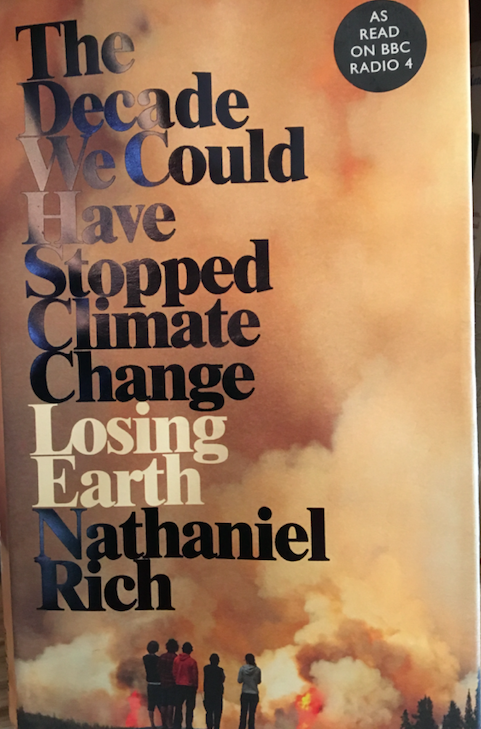
Reading this book you feel the United Nations ought to identify the crime of humanicide and turn to the book for its first list of suspects. It provides an account of how the issue of anthropocentric climate change was brought to the attention of politicians in the decade from spring 1979 to November 1989. What is shocking is the fact that the basic science was clear right from the start of the period. Indeed governments and the fossil fuel industry had been doing research into the issue for some considerable time before that and had come to the conclusion that fossil fuels were set to have a significant impact on climate if they continued to be burned at the rate they were.

At the start of the period the engagement of the coal, oil, motor and other industries seemed to be a genuine search for the truth. The problem was once they found it. They didn’t like it.

It tells a tale of how a few determined individuals, mainly scientists and environmentalists worked diligently to inform and then push to action politicians and policy makers. It charts the ups and downs of a process where two steps forward in scientific confirmation were pushed one step back, sometimes three steps, by doubt sowing special interests.

One of the three step back was the year Ronald Reagan was elected President. On taking office he increased coal production on Federal land, deregulated surface coal mining and appointed Anne Gorsuch as administrator of the Environmental Protection Agency. An “anti regulation zealot” she cut the Departments staff and budget by 25%. The parallels with the actions of the current President of the United States are remarkable.

Whilst the basic science and the trajectory of change was clear, the evidence of change in actual weather patterns, which voters could see, was not there in the early 1980’s. The scientists were aware this would not become apparent for “ten or twenty years” however they were also aware that if action was not taken immediately it would require far more dramatic change later, leave a legacy of negative environmental effects and in the worst case scenario simply be too late.

The book has numerous examples of issues which dogged the debate about climate change at the time and have continued to do so through the 1990’s, the 2000’s and 2010’s. In an early meeting of experts convened to provide policy proposals a public health scholar called Annemarie Crocetti made the following point, “I have noticed that very often when we as scientists are cautious in our statements, everybody else misses the point, because they don’t understand our qualifications.” This is a problem which the scientific community are still grappling with. The carefully calibrated language of IPCC reports does not chime with the existential nature of the threat they are reporting nor does it communicate the urgency of the issue they believe exists.

Another issue was how scientific results were spun to avoid what was regarded as precipitate action. The Changing Climate Report mentioned above was published in October 1983. Its preface made clear that action was required immediately, before all the detail could be confirmed with certainty as by then it would be too late. This is not how the Report was presented at the launch press conference. Its authors, the very people that had written the stark warning argued the opposite, no need for urgent action. The accompanying press release confirmed the no action needed story and of course this is what the press picked up. How many journalists read 496 page reports? Quite why a group of scientists provided a gloss which contradicted the findings of their report is not clear.

A rather sinister and worrying answer may be the direct intervention of the White House in the science. James Hansen of the NASA Goddard Institute for Space Studies was one of the scientists who had been working to convince politicians of the importance of CO² emissions throughout the 1980’s. In 1989 he was asked to provide evidence to a Congressional Committee chaired by one Albert Gore.  As a public employee he had to submit his evidence to the Office of Management and Budget for review prior to publication at the Committee. When his paper came back it had been amended to change significantly the strength of the conclusions. 

Hanson wrote to Congressman Gore and explained what had happened. He then went to the Committee and read the paper as censored by the Bush administration. Al Gore then questioned him about contradictions in the paper. Through a series of questions and answers the attempted censorship was revealed. At one point Hanson explained that he appreciated the need for the White House to review the policy statements of employees but went on to say, “…my only objection is being forced to alter the science.”

I certainly had not appreciated quite how well settled the science was as far back as the early 1970’s. Reading this book  and seeing how the denigration of experts, “alternative facts”, “fake news”, doubt funding were all used to undermine science back then. If it was a scandal then, how much more so now, 30 years later, when every prediction made in the early 1970’s has only been proved wrong in being too optimistic.

It would be wrong to say that political elites around the world have done nothing on climate change over the past 40 years.There has been real progress in alternative energy development and greater fuel efficiency. There has also been a whole lot of lip service about the rights of future generations. However, there is an enormous gap between ambition and reality. There is also an enormous lack of real political leadership.

When we consider the amount of political energy and time given to Brexit over the past 3 years to secure Britain’s future inside or outside of Europe you might have thought a similar level of effort would be worth expending on humanities future inside or outside of planet Earth.

If the 1980’s was the decade we could have stopped Climate Change we now face the decade where we may have to mitigate the devastation it will inevitably wreak. If we stopped all CO²e emissions tomorrow climate change would continue for centuries to come however its impacts would be significantly less than if we fail to act. Whereas change commenced in the 1980’s might have been a very inconvenient process we now face a quantum difference in the scale of the challenge. It needs to be a much more abrupt, radical and consequently painful process. A process which will involve adaptation to problems which are already inevitable. And a process which will require dramatic and profound changes to our behaviour to prevent compounding problems which may make the world effectively uninhabitable.

Those purveyors of doubt in the 1980’s have much to answer for. However, with the scale of scientific consensus that has built up over the intervening years with every fresh piece of evidence confirming the basic thesis it is inexcusable for anyone, much less political leaders, to deny the existence of the problem. Everyday their culpability grows.

It is time that the International Criminal Court started to arraign those guilty of recklessly committing actions likely to result in the crime of humanicide. Call Donald Trump, Leader of the United Fossil Fuel Purveyors of Doubt.


“The Decade We Could Have Stopped Climate Change”: Losing Earth. Nathaniel Rich, Picador, 2019.