A House Divided.

In 1858 Abraham Lincoln gave a speech at the Illinois Republican State Convention, which had just nominated him as their candidate for the position of Senator. The speech was about the issue of slavery and how it was dividing the States of the Union. His key phrase in the speech was that “A house divided against itself cannot stand.” The divisive issue of the time was slavery. An appalling institution but one which has a very tangible and clear definition.

At the moment the US is a house divided probably as vehemently as it was in 1858. Three years after that speech America was at war with itself.

The dividing line this time is less tangible. It is those that see MAGA as a theory of the world. One which addresses the reduction of well paid, middle class, jobs to the, “others” within, (or immigrants), and the “others” without, (notably China). A host of other economic and social issues are swept up into this portmanteau of grievance.

What it does effectively is point to genuine failures of the US to protect its citizens from the ravages of a financially driven economic system, one which is, wholly and exclusively focused on achieving the maximum rate of return on investments. A system which had concentrated wealth into fewer and fewer hands, and, with that wealth, power. Power, which has been used to defend existing riches and support their increase, partly by diverting resources from public services which historically played such an important role in redistributing wealth.

Simplistic slogans, like smaller government and lower taxes together with a host of socially repressive measures are presented as the way of MAGA.

At the moment the other side of the debate is poorly articulated and weakly promoted. The Democrats are AWOL, providing little incisive critique, nor the volume of justifiable outrage at the actions of the new President. Actions which are contradictory, but shifting, on the diplomatic level; the US from its Atlanticist position to little more than a mouthpiece for Putin; on the economic level, towards trade wars which will damage the US as much as its targets; and on the social level towards a patriarchy opposed to every form of equality which challenges white male supremacy.

Some of these shifts will be difficult for traditional Republicans. The GOP has, however, been cowed by Trump’s electoral success. Power before principle is an ever present risk in democracies. As his actions become increasingly outrageous one can only hope some may start to raise their heads above the parapet. An immensely brave action given the awesome power a US President wields, particularly one with little regard to the Constitution, much less the conventions which have evolved to ensure it remains fit for the operation of a liberal democracy.

It is quite possible that this Presidency will implode at some point. If it does, however, it will only be after millions of people have suffered and died, at home and abroad because of his megalomaniac certainty. If it does then it will likely not be because of the actions of the political elites. Rather, some more popular revolt, as the damage he inflicts on the US becomes apparent to some of those who voted for him because they thought he would bring positive change.

The MAGA brethren, those who have a millenarian faith in the truth and power of their leader will never change. But many ordinary Republicans may come to regret their vote.

Implosion is one option but there is a far darker one. The Nation made clear their concern about the sacking of the Joint Chiefs of Staff, General, Charle Brown Jnr, by Trump, and his replacement with a far less qualified loyalist. The headline “Make No Mistake, This Is Trump’s Worse Move Yet”. The reason they felt this was set out in the sub-heading which concluded, “Prepare for autocracy.”

In four years time the US tradition of a peaceful handover of power will be put to its most severe test in its history.
Syria: What does Ahmed al-Sharaa mean?

The west and Israel seem to be concerned about what Ahmed al-Sharaa, the leader of Hayat Tahrir al-Sham (HTS) is saying. His pronouncements both in recent years and since the HTS victory in Syria have been measured and seem to reject the idea that his aim is to establish a fundamentalist Islamic regime in Syria. However, his past connections with the Islamic State of Iraq (ISIS) and Al Qaeda are pointed to, as is his previous nom de guerre, Abu Mohammad al-Julani as evidence of his ideological position. They say they want to see actions not just words.

Given the experience of diplomacy in the region a degree of scepticism is sensible. Fine words butter no parsnips as they say. Furthermore, words do have a remarkable degree of flexibility in the Middle East. The term “defence” comes to mind.

However, given what went before, in the murderous Assad regime, and the scenes of celebration from Syrians across the country it is difficult to simply dismiss al-Sharaa. Given this most nations and agencies seem content to adopt a wait and see policy. Wanting to see if the promising words do get translated into actions.

Israel, as so often, is the exception here. It is busily defending itself against an attack, of which there is neither sign nor capacity, by bombing any and all military facilities in Syria. They are also annexing land inside Syria to secure Israel’s border.

If the scepticism of western, commentators, journalists, diplomats and politicians proves well founded then Syria’s appalling condition may simply continue under new management. If this is the case it will confirm a view of islamist insurgents as simply interested in gaining power in order to impose a version of Islam which is authoritarian, brutal and misogynistic. Together with a new regime of corruption and crime.

If this happens it will reinforce the view that you can never trust such groups. That radical islamism, or indeed, for some, merely islamism, is an inherently authoritarian and regressive force. Given this they must be opposed and where possible eliminated and certainly kept away from any levers of power.

It is right that the establishment of another fundamentalist regime with no interest in the rule of law outside of strict religious control, or an independent, multi-faith civil society, or any form of participatory government would certainly add to the woes of the people of Syria with negative consequences for other peoples in the region.

It may however be the case that the threat that al-Sharaa poses is not if he does not do what he says but rather if he does do what he says.

Clearly, it is early days however the actions taken so far by the new regime led by al-Sharaa and HTS are unlike previous insurgent takeovers. No bloody reprisals, no looting and no ill-disciplined soldiery. No immediate implementation of fundamentalist Islamic social measures. Co-operation with the existing governmental institutions with the existing government being asked to remain in power until March 2025 to oversee a prcess of transition. Universities have been opened as opposed to closed. No curfews.

The army is being maintained not dissolved, the civil service is not being replaced with people whose qualifications are ideological fervour as opposed to administrative competence. The strong underpinning message and fundamental aim is claimed to be a commitment to rebuild Syria and the “…establishment of a government based on institutions and a “council chosen by the people“. It will be interesting to see what this council is in due course. But there have been clear commitments to religious tolerance, the rule of law, and a strong civil society.

What seems to have happened to date in Syria seems to be characterised by a very disciplined fighting force. Disciplined in their approach to fighting certainly. But more importantly, disciplined in victory.

al-Sharaa has been absolutely explicit that the country has no interest or capacity to engage in a war with Israel. This, despite the illegal and substantial programme of bombing being done by their neighbour to “defend” themselves.

What might ring alarm bells in the West and Israel is the commitment to a process of change by Syrians for Syrians. A demand that all foreign forces now leave Syria to allow them to get on with the immense task of rebuilding a country that has been systematically destroyed by a brutal despot.

One of the many problems of the region is the constant maneuvering by global powers and Arab neighbours to secure advantage it times of uncertainty. Attempting to obtain territorial or other advantages when states are riven with internal conflicts or political instability.

If al-Sharaa does substantially what he says, it will create a real dilemma for the West, Israel and other Arabic nations. A moderate muslim nation with genuinely independent institutions, religious tolerance and a genuine distribution of power is going to stick out, in the region, like a sore thumb.

Time will tell but al-Sharaa presents very well. His interview on CNN is illuminating as much for the tone and thoughtfulness of his comments as for what he actually says. He has learned the lesson of previous insurgent groups, terrorists or freedom fighters depending on you politics. He is not picking fights he knows he cannot win. There is no inflammatory rhetoric about the State of Israel or the West. He does not shy away from his Islamic faith but neither does he see this as monopolising power in a new Syria.

The. task of rebuilding Syria will be monumental. An economy that is on its knees. Fighting continuing in the north as the Kurdish cause has Turkey and the United States maneuvering for advantage. Its South Eastern border with Israel being eroded, together with a substantial bombing campaign as Israel defends itself. Loud calls for swift and public retribution against those of the former regime engaged in the systematic torture of relatives of suvivers. And on top of all this external forces trying to ensure al-Sharaa fails.

If it does not fall back into a brutal fundamentalism Syria could become a model for a new kind if Islamic regime with enourmous consequences across the whole of the middle east.

What is the End Game for Netanyahu?

There has been a narrative about Prime Minister Netanyahu’s war aims and how they are shaped by the religious-right members of his cabinet. One which presents him as something of a hostage to their extreme demands. In parallel with this is the view that he is desperate to remain in power in order to delay the case against him relating to fraud, breach of trust and accepting bribes. This creates the impression that his personal legal woes are to a great extent shaping his approach to the War in Gaza and elsewhere.

It is almost certain that PM Netanyahu has an eye to his personal legal jeopardy. He may feel that victory in a war against Hamas would make hims so popular that no Israeli court would be able to find him guilty of the charges he faces. I’m not sure I would bet on that, however.

When PM Netanyahu appointed his current cabinet it was said to be the most right-wing in the history of Israel. However, the bar for this was set by PM Netanyahu himself. According to Ian Black in his work “Enemies and Neighbours” when Netanyahu formed his first government in 1996 it was “the most right-wing coalition in Israeli history.(pp349) And at the time he pledged to support the “pioneering settlement” of Eretz-Yisrael, making good on this promise by lifting the restrictions on settlement that the previous Labour Government had imposed.

PM Netanyahu is not a hostage to the religious right, he shares their expansionist view of the future of Israel and is very clearly an active promoter of their aims.

This brings us to the Prime Minister’s war aims. These were clearly articulated in a speech at the start of the military campaign as being about, 1) bringing home the hostages, 2) destroying Hamas. But in the same speech he also spoke more broadly about “changing the Middle East”. What these words meant was never specified at the time but they are starting to sound, and look, as if they related to a war aim as fundamental as the other two.

After the precision carpet bombing of the whole of Gaza there are signs preparations are being made for what happens when the war ends. Various corridors are being established which it is said will be used to divide Gaza in ways which will make it easier to control and so prevent Hamas regaining any foothold in the area.

If this were the case the picture of life, for remaining Palestinian civilians would look bleak. Their movements would be further constrained between secure areas within the largest open prison in the world. The practicalities of life within this context would mean its very viability as a place to live would be questionable. Which of course some on the religious-right in Israel may regard as a happy “unintended consequence” of their need for effective “self-defence”.

However, in the North of Gaza steps might be being taken for an even more radical solution. A corridor, or new military dividing line, is being developed to separate an area in Northern Gaza from the rest of the territory. Its ostensive purpose, according to the IDF, is to trap Hamas in a confined area with no means of retreat or supply. This is the area which the Israeli government through the IDF have ordered all civilians to leave on pain of being treated as hostile combatants if they remain. An area into which it was suggested no foreign aid would be allowed, nor water of power, on the basis that there would be no civilians to need it as it would simply be a battle zone.

Some rhetorical retreat from that has occurred however any aid that does get into the area is woefully inadequate and fears that starvation and the lack of any medical facilities or medicines will lead to further significant loss of civilian lives.

This area in the North is subject to significant clearance. A process which some fear may be followed, at some stage. by a new programme of settler development. This would mean the permanent loss of the area, thus reducing the size and viability of Gaza even further. It would be a brave person who would take a bet that this will not happen.

Indeed, this scenario is leading to fears amongst neighbouring Arab states that they may well face a massive refugee crisis in the not too distant future. A crisis caused by Palestinians fleeing from a non-viable and hostile Gaza and West Bank.

The Israeli government denies this as a war aim. If they are honest in this assurance, it still leaves open the possibility that their practice of “self defence”, in the long term, has the “unintended consequence” of making everyday life so intolerable that it drives the Palestinians out of Palestine.

The US and the UK have access to detailed satellite imagery, military strategy experts, intelligence reports and a whole lot more information than is in the public domain. Perhaps this all supports the Israeli contention that their acts of defence are within International humanitarian law. Further, they remain focused on their original and limited aims of getting the hostages back and destroying Hamas.

From outside it does not look like this. What is happening, right now, in the occupied territories is unspeakable. It is being called out by a number of western institutions including the UN and the International Court of Justice and a range of NGO’s operating in the region. And yet our government and that of the United States are not taking decisive action to prevent what is happening.

What is happening in Palestine is already having far reaching implications. The dramatic collapse of Assad’s Syrian regime is the result of many factors, however, the weakened position of Hezbollah in Lebanon will have played its part.

If it turns out that this is a second Nakba PM Netanyahu may well achieve his objective of “changing the Middle East”. However, it might not be for the better for the Middle East, or, indeed in the long term for Israel.

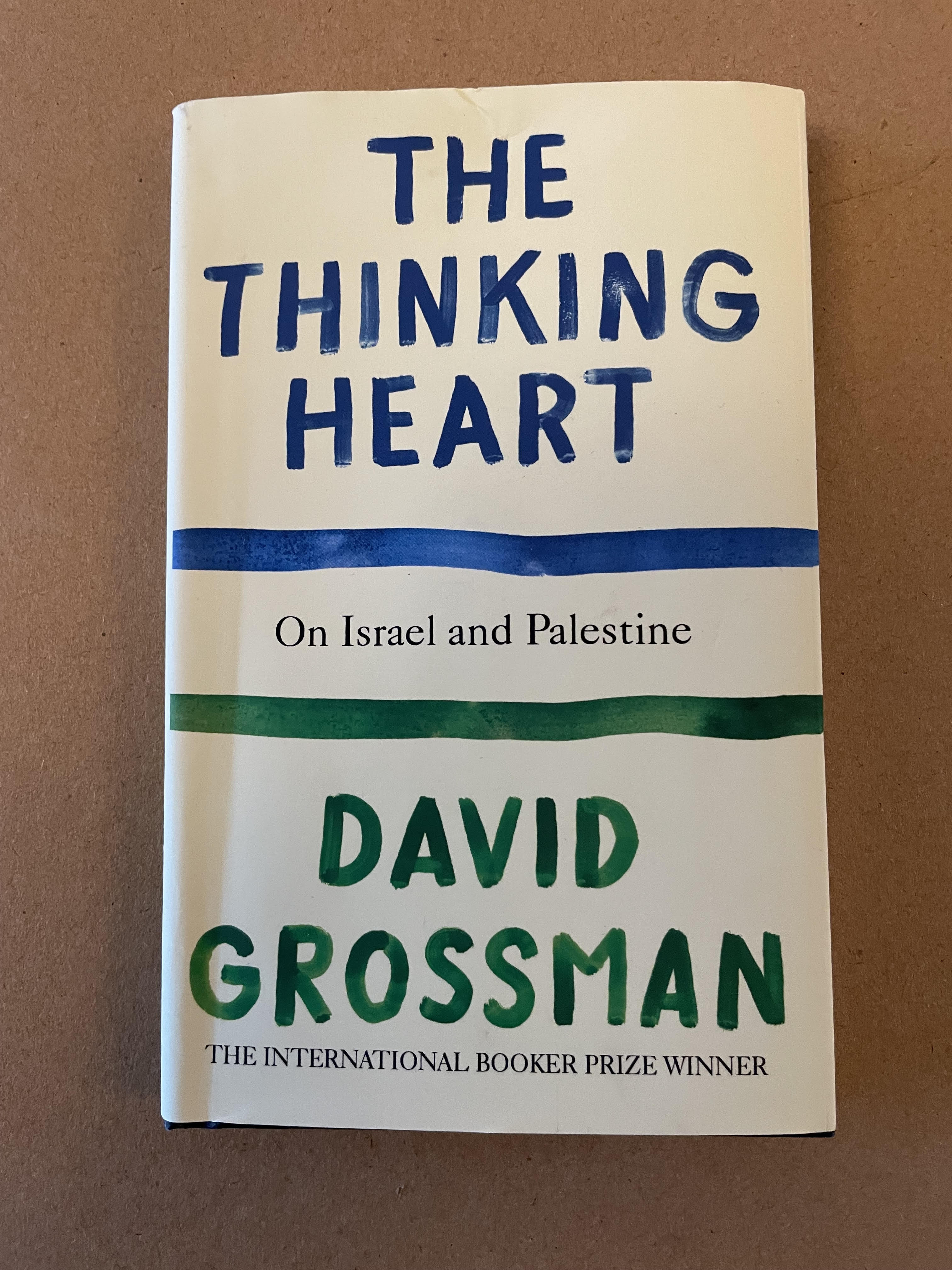
David Grossman: A Voice for Peace in Palestine

This is a collection of articles and speeches by novelist David Grossman, winner of the 2017 International Man Booker Prize. They span a period from July 2017 to June 2024, obviously taking in the barbaric attack of 7 October 2023. The book is a mere 87 pages long and exceptionally well written. It provides an intelligent and humane analysis of the problem of a just peace in Palestine, something Mr Grossman has spent decades campaigning for. It is a testament to his commitment that, despite the medeival horrors of 10/7 he remains convinced that “…it is impossible to begin resolving the Middle Eastern tragedy without offering a solution that alleviates the Palestinian’s suffering.”

His critique of Prime Minister Netanyahu is searing. He is equally critical of the ulta-Orthodox religious right who have a inappropriate and disproportionate say in the politics of the State of Israel. Promoting Eretz-Yisrael or Greater Israel, an area which has a number of definitions but certainly encompasses the current State of Israel, and the Palestinian Territories. It is this aspiration which “legitimises”, in their view, the settler movement in the West Bank and current demands for the same in Gaza.

Mr Grossman describes the Judaism he connects to as “…secular and humanist. It has faith in human beings. The only thing it holds sacred is human life.” You can imagine how acceptable this definition of Judaism is to those of the religious right who call for the State to go to War for a Greater Israel but “…refuse to send their own children to military service because, according to their faith, praying and studying Torah is what guarantees the continued existence of the Jewish people…”. Their single minded labours aim to preserve the purity of their contested view of the faith which sees God as being in the real estate business and having promised them the land of Palestine 2000 years ago.

What is interesting about the book is how it charts the growing stranglehold of PM Netanyahu and his actions to undermine, not just the rights of the Palestinians in the Occupied Territories, but also those of Arab citizens within the State of Israel. Mr Grossman sees all the actions of the Netanyahu government as being focussed on keeping alive and raw the wound that is the relationship between Israel and its Arab citizens and those in the occupied territories. He characterises the Nationality Law of 2018, which defines Israel as the nation state of the Jewish people and reserves the right of self determination to the Jewish people alone as a “…renunciation of the chance to ever end the conflict with the Palestinians.”

The articles in this collection remain optimistic and chart the growing internal opposition to Netanyahu. The demonstrations and marches against his attempts to consolidate his power and limit the rule of law were particularly vocal in the run up to 10/7. Despite the horrific terrorist atrocities of that day Grossman remains committed to negotiations and a move to a two state solution as the only viable route to a lasting peace.

Beyond this however Mr Grossman provides an insight into some of the psychological and other fears which shape Jewish thinking. Fears which certainly cannot be dismissed as irrational and which have an equal right to be addressed and must be part of any comprehensive solution in Palestine.

First among these fears is the pervasive view of the provisional nature of the State of Israel. Interestingly, this is not just seen as something driven by the hostile military objectives in the Hamas Charter of 1988 unabated in the eyes of Israel by the substantial revisions to that Charter in 2017, nor in chants about a Palestinian state from the Mountains to the Sea.

But more subtly than these attacks are the seemingly positive comments of supporters like the oft repeated formula by American Presidents that the US supports “Israel’s right to exist”. This phrase, although it challenges the opposite, subliminally concedes the possibility that such a right is not a given.

Another related but distinct issue is the attacks on Israel by its enemies. The objective of their campaigns against Israel is not simply to win a war against the Israeli state it is to abolish the state altogether. As Mr Grossman puts it “…Israel is the only country in the world whose elimination can be openly called for.” At the extreme end of this view is the antisemitic desire to eradicate the Jewish nation and people not just its state.

Mr Grossman asks the fundamental question, “Why is Israel – of the planet’s 195 countries – alone in being conditional, as if its existence depended on the goodwill of the other nations of the world.”

Mr Grossman also rejects the “intolerable”attempt to “…force the Israeli-Palestinian conflict into a colonialist discourse.” Arguing that colonialism can only be carried out by external nation states, and that as Israel does not have a state elsewhere it cannot be engaged in colonialism.

You can see why a people who have been persecuted and discriminated against in countries across Europe and beyond, and been subject to the most extreme attempt at industrial genocide the world has ever seen, would be extremely nervous about losing the safe haven of a nation state. This nervousness may at times become an existential panic resulting in a violent and disproportionate response to any form of challenge, perceived or real.

There are elements of Mr Grossman’s position that could be challenged. Being by far the most powerful military force in the region, the only one with a nuclear weapon capacity, and having the might of the United States foursquare behind it should allay some of the fears of its “provisional” nature. It is also the case that the vast majority of the nations on the planet recognise Israel as a legitimate member of the community of independent states.

Some of that sense of provisionality may stem from the manner in which the State was first established. One might argue this was by, “…the goodwill of the other nations of the world…” first in the actions of the League of Nations and secondly in the United Nations. Obviously, there were a range of other forces in play, not least the manouverings of declining imperial powers, notably France and Great Britain. Whatever its origins the world must, and in the vast majority do accept, the legitimacy of the State of Israel.

I fear the rejection of the colonialist model as applied to the actions of the Israeli State depends on an essentialist definition of colonialism relying on the preexistence of a colonialist state elsewhere as the aggressor. Whilst this might be a part of the definition there are key elements of the colonialist model, in the eviction of a preexisting peoples from their home lands and the repopulating of those lands by people from elsewhere which prima facie looks like it could be applied to the actions of the State of Israel.

Whilst there are parts of Mr Grossman’s argument which could be open to challenge, the tone and thrust of the book is exceptional. His analysis of the direction being followed by the current administration under PM Netanyahu is well-informed and trenchant. Despite the brutality of 10/7, Mr Grossman still argues for a negotiated settlement and a two state solution. In the end it is probably only this which will end the constant fear of the Israeli people about the provisional nature of the State of Israel. It is a book which everyone concerned about the current tragedy of Palestine should read.

The Thinking Heart. David Grossman. Johnathan Cape London 2024.