
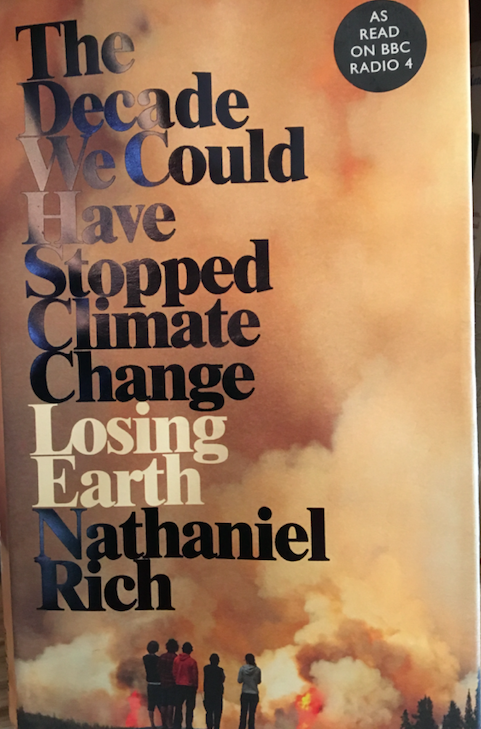
Reading this book you feel the United Nations ought to identify the crime of humanicide and turn to the book for its first list of suspects. It provides an account of how the issue of anthropocentric climate change was brought to the attention of politicians in the decade from spring 1979 to November 1989. What is shocking is the fact that the basic science was clear right from the start of the period. Indeed governments and the fossil fuel industry had been doing research into the issue for some considerable time before that and had come to the conclusion that fossil fuels were set to have a significant impact on climate if they continued to be burned at the rate they were.
 At the start of the period the engagement of the coal, oil, motor and other industries seemed to be a genuine search for the truth. The problem was once they found it. They didn’t like it.
It tells a tale of how a few determined individuals, mainly scientists and environmentalists worked diligently to inform and then push to action politicians and policy makers. It charts the ups and downs of a process where two steps forward in scientific confirmation were pushed one step back, sometimes three steps, by doubt sowing special interests.
One of the three step back was the year Ronald Reagan was elected President. On taking office he increased coal production on Federal land, deregulated surface coal mining and appointed Anne Gorsuch as administrator of the Environmental Protection Agency. An “anti regulation zealot” she cut the Departments staff and budget by 25%. The parallels with the actions of the current President of the United States are remarkable.
Whilst the basic science and the trajectory of change was clear, the evidence of change in actual weather patterns, which voters could see, was not there in the early 1980’s. The scientists were aware this would not become apparent for “ten or twenty years” however they were also aware that if action was not taken immediately it would require far more dramatic change later, leave a legacy of negative environmental effects and in the worst case scenario simply be too late.
The book has numerous examples of issues which dogged the debate about climate change at the time and have continued to do so through the 1990’s, the 2000’s and 2010’s. In an early meeting of experts convened to provide policy proposals a public health scholar called Annemarie Crocetti made the following point, “I have noticed that very often when we as scientists are cautious in our statements, everybody else misses the point, because they don’t understand our qualifications.” This is a problem which the scientific community are still grappling with. The carefully calibrated language of IPCC reports does not chime with the existential nature of the threat they are reporting nor does it communicate the urgency of the issue they believe exists.
Another issue was how scientific results were spun to avoid what was regarded as precipitate action. The Changing Climate Report mentioned above was published in October 1983. Its preface made clear that action was required immediately, before all the detail could be confirmed with certainty as by then it would be too late. This is not how the Report was presented at the launch press conference. Its authors, the very people that had written the stark warning argued the opposite, no need for urgent action. The accompanying press release confirmed the no action needed story and of course this is what the press picked up. How many journalists read 496 page reports? Quite why a group of scientists provided a gloss which contradicted the findings of their report is not clear.
A rather sinister and worrying answer may be the direct intervention of the White House in the science. James Hansen of the NASA Goddard Institute for Space Studies was one of the scientists who had been working to convince politicians of the importance of CO² emissions throughout the 1980’s. In 1989 he was asked to provide evidence to a Congressional Committee chaired by one Albert Gore. As a public employee he had to submit his evidence to the Office of Management and Budget for review prior to publication at the Committee. When his paper came back it had been amended to change significantly the strength of the conclusions.
Hanson wrote to Congressman Gore and explained what had happened. He then went to the Committee and read the paper as censored by the Bush administration. Al Gore then questioned him about contradictions in the paper. Through a series of questions and answers the attempted censorship was revealed. At one point Hanson explained that he appreciated the need for the White House to review the policy statements of employees but went on to say, “…my only objection is being forced to alter the science.”
I certainly had not appreciated quite how well settled the science was as far back as the early 1970’s. Reading this book and seeing how the denigration of experts, “alternative facts”, “fake news”, doubt funding were all used to undermine science back then. If it was a scandal then, how much more so now, 30 years later, when every prediction made in the early 1970’s has only been proved wrong in being too optimistic.
It would be wrong to say that political elites around the world have done nothing on climate change over the past 40 years.There has been real progress in alternative energy development and greater fuel efficiency. There has also been a whole lot of lip service about the rights of future generations. However, there is an enormous gap between ambition and reality. There is also an enormous lack of real political leadership.
When we consider the amount of political energy and time given to Brexit over the past 3 years to secure Britain’s future inside or outside of Europe you might have thought a similar level of effort would be worth expending on humanities future inside or outside of planet Earth.
If the 1980’s was the decade we could have stopped Climate Change we now face the decade where we may have to mitigate the devastation it will inevitably wreak. If we stopped all CO²e emissions tomorrow climate change would continue for centuries to come however its impacts would be significantly less than if we fail to act. Whereas change commenced in the 1980’s might have been a very inconvenient process we now face a quantum difference in the scale of the challenge. It needs to be a much more abrupt, radical and consequently painful process. A process which will involve adaptation to problems which are already inevitable. And a process which will require dramatic and profound changes to our behaviour to prevent compounding problems which may make the world effectively uninhabitable.
Those purveyors of doubt in the 1980’s have much to answer for. However, with the scale of scientific consensus that has built up over the intervening years with every fresh piece of evidence confirming the basic thesis it is inexcusable for anyone, much less political leaders, to deny the existence of the problem. Everyday their culpability grows.
It is time that the International Criminal Court started to arraign those guilty of recklessly committing actions likely to result in the crime of humanicide. Call Donald Trump, Leader of the United Fossil Fuel Purveyors of Doubt.
“The Decade We Could Have Stopped Climate Change”: Losing Earth. Nathaniel Rich, Picador, 2019.
 northerncomment