Boiling Frogs

Anyone who has read even a small number of business books over the past twenty years will have come across the story of the boiled frog. Allegedly if you throw a frog into a pan of boiling water it will leap out, however if you put it in a pan of cold water and heat it slowly it will not notice until it is too late and it is boiled to death. [I am not sure if any actual frogs were harmed in the discovery of this ‘fact’.]  The point of the story is that businesses need to be sensitive to small changes in their operating environment and respond to them early to prevent their extinction.

Sadly, it appears that the failure to take seriously initially small  changes in the environment that can lead to the downfall of companies (and frogs) can also apply to the entire human race. The Intergovernmental Panel on Climate Change (IPCC) was established in 1989. Ever since then broad awareness of the issue of climate change, its links to greenhouse gasses and their relationship to the activities of mankind has been growing. However for such a potentially existential threat the issue has rarely had any strong sense of urgency except amongst a relatively few scientists and activists. This is partly because there are powerful vested interests which depend on the continued emission of CO2. They have challenged the science at every step and monitor every utterance of members of the scientific community leaping on any failures to adhere to strict scientific rigour.

This has had an impact on how the findings of the IPCC are reported. If you read their reports, say, for example, the recent report “Global Warming of 1.5°C” which looks at the impact this would have to life on earth you are immediately struck by the  qualified nature of all of the comments. For example every key finding “is reported using the IPCC calibrated language” which has 7 levels of certainty, from “virtually certain” which has a 99% to 100% probability through to “exceptionally unlikely” with a 0 to 1% probability. Whilst I am sure this conforms with the best standards of scientific presentation it gets in the way of the communication of the startling nature of the findings.

As you read the document the very qualified nature of the language undermines the urgency of its message. You have to dig through all of the qualifications and probability-spreads to get to what is an incredibly scary message. Once you get to it a variety of psychological responses are apt to kick in to reassure you that the end is not nigh. Increasingly climate science activists are researching ways to make their message clearer looking at what the psychological barriers are as well as the plain disinformation of the flat earth climate change deniers.

For years scientists engaged in the multidisciplinary research into the causes and consequences of climate change have been frustrated by the lack of political engagement in the need for urgent and effective action. The Conferences of the Parties (COP’s) are annual United Nations Conferences to monitor progress on climate change. The Conferences, and indeed all of the work within the United Nations Framework Convention on Climate Change seem to be exercises in horse trading and seeking agreement at the level of the lowest common denominator. What that means is that the targets for reducing greenhouse gas emissions are contained within “Nationally Determined Contributions” which unfortunately do not add up to what is needed to avoid 2°C increase in global temperature over pre industrial levels much less 1.5°C.

In 2017 the total of green house gas emissions which includes CO2 amounted to just over 53 GtCO2e, a record high. That is 53 gigatons of emissions comprised of carbon dioxide (CO2) and all the other green houses gasses, eg. methane, nitrous oxide, aerosols, etc. (e). According to the UN Environmental Emissions Gap Report 2018 in order to reduce this figure  to a level which is consistent with a 66% chance of limiting global warming to 1.5% there needs to be a reduction in GtCO2e emissions of 55% by 2030. That is 11  years away.  In order to have a 66% chance of keeping global warming below 2°C we have to reduce GtCO2e by 25%.

But that is not the end of the story. Emissions of CO2 alone need to be net zero by 2050 to have a reasonable chance of keeping global warming below 1.5°C.

If the fact that the currently agreed targets for emissions reduction are significantly less than is needed isn’t scary enough, reflect on this. We are not even meeting the targets we have set. This means that unless we do something now, i.e. today, the gap by 2030 will be greater and the likelihood is we will be sailing towards a 3°C or 4°C increase in temperature by then end of this Century.

My youngest son is 18 this year, in 2030 he will be 29 and hopefully in the early part of his career. If we are to achieve the kind of reductions in green house gas emissions needed the amount of oil and gas extracted from the the ground will roughly have had to halve. How prepared are Exxon, BP, Saudi Arabia et al for this. What economic impact will that have on the extractive, transport and financial sectors of the economy? Currently the financial strength of the oil industry is partly based upon the reserves of oil they have identified in the ground and have on their balance sheets. At least half of that “wealth” will have to be written off if we are to avoid 2°C never mind 1.5°C.

By the time my son is 59, unless something spectacular happens to the economy that means he will be a long way from retirement, the world will have to have stopped altogether using fossil fuels. So in less than the working life of one person, the energy source which has powered the worlds industrialisation at an ever rapidly accelerating rate since at least the mid 19th Century, and shows no signs of stopping at the moment, will have gone. 

Some may think, well how bad can a 1.5°C increase be given that we are already two thirds of the way there [the climate has increased already 1°C above pre-industrial levels] or even 2°C or 3.2°C which is what we are on track for based on current plans. Well if you are measuring the height of Everest you have to be a measurement nurd to worry about 2 or three inches. But imagine you are in a swimming pool with your feet stuck to the bottom and the water is up to the middle of your chin, a one and a half inch increase would be very unpleasant, two inches very, very unpleasant and three inches terminal.

David Wallace-Wells published a book earlier this year reviewing the implications of climate change chillingly entitled “The Uninhabitable Earth“. He reviews the elements of chaos that are already starting to be unleashed by climate change and how they might evolve to 2100 and beyond. He talks about: the numbers likely to die from heat exhaustion; those who will be effected by hunger as key food producing regions are impacted; those drowned by, what now might be called, freak storms and sea level rising; wildfires which have dreadful direct impacts and also add to the problem of carbon in the atmosphere; dying oceans; and sadly much more.

To be clear some of these impacts will only occur if we do nothing and peak in centuries if not millenia to come. However, have in mind that we have put more greenhouse gas into the atmosphere since the IPCC in 1989 was set up (30 years) than we did in the whole of the period from the mid 19th Century to then. Also, if the world becomes uninhabitable in 80 years time it is of academic interest to know how much more uninhabitable it has become a thousand years after that.

Wallace-Wells occasionally seems to be a bit lose on the timescales, however if you calibrate back to what is contained within the IPCC reports his picture is one which communicates in a less qualified, but non the less accurate, way that global warming is here and now and set to accelerate in its impact on the world well within the lifetime of our children, and that impact will be at best very significant. I think I have slipped into IPCC calibrated language, for “very significant” read “awful”.

A more frightening yet picture has been presented by Prof Jem Bendell of the Institute of Leadership and Sustainability at the University of Cumbria. He conducted a literature review of the science surrounding global warming. He seems to have used the IPCC reports as his starting point but then looked into the latest work of the scientists engaged in producing those reports and considered what they have to say. His paper “Deep Adaptation: A Map for Navigating Climate Tragedy” is not for the feint hearted. To give you a clue he states the purpose of his paper to be “…to provide readers with an opportunity to reassess their work and life in the face of an inevitable near-term social collapse due to climate change.”

Professor Wendel founded the Institute for Leadership and  Sustainability, which provides sustainability themed MBA’s. In 2012  the World Economic Forum (Davos) declared him a young global leader for his work on sustainability. I am trying to say he does not look like someone who is out on the fringe. You need to decide whether his paper is a cri de coer attempting to communicate the implications of a message which is so carefully wrapped up in scientific probability-speak that its urgency is lost or someone who has lost perspective and is set to induce panic. He seems to be trying to move from “There is a high probability that the current combustion may lead to an increase in incidents of temporary or permanent inspiration and expiration failure” to just shouting “The theatre’s on fire. Get out.”

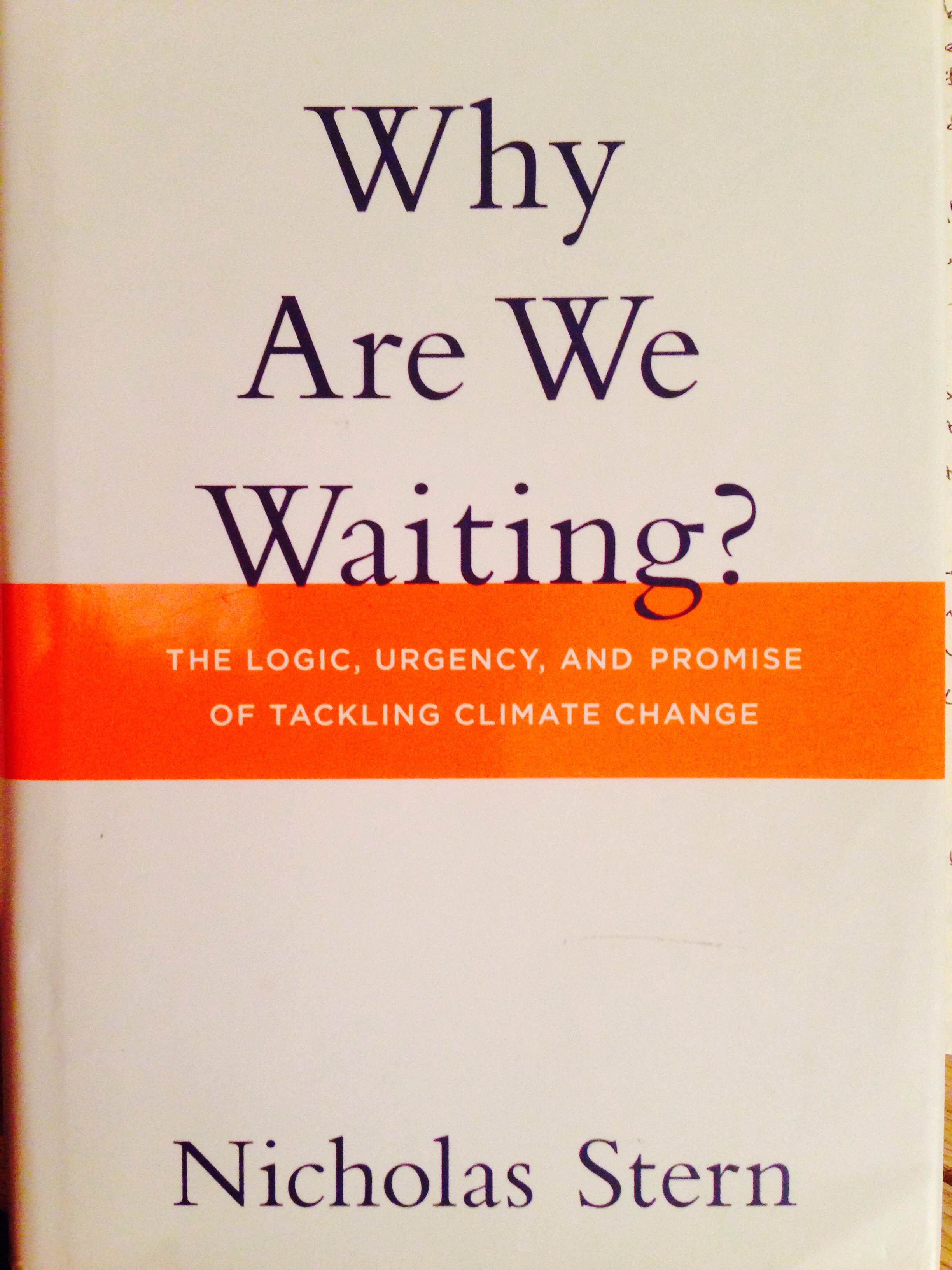
I am conscious that all of this paints a very pessimistic picture. There are however signs that what some have labelled “peak indifference” may have passed. The emergence in the past couple of weeks of Extinction Rebellion shows that there is a growing sense of urgency amongst a growing number of people around the world. Some of the most active members of this group are people who have been intimately engaged in the work of the IPCC and have lost patience with its failure to gain the political traction it requires. Real progress is being made with alternative energy sources. Political leaders who continue to deny climate change are being circumvented by their fellow citizens like Trump in the States. A good summary of the positives is provided by Nicholas Stern in his excellent book “Why are we Waiting?.”

For years now the political elite in this country have been obsessed with Brexit, and for the avoidance of doubt it is the single most stupid economic decision we have made since the war, however it is time to wake up and smell the burning. There is no easy option. Serious, difficult and comprehensive changes are needed right now. We are starting late. We have 11 years to avoid a catastrophe on a scale we have never experienced. We may well be at a tipping point. It is time to jump.

Climate change is set to become THE political issue of the next decade. If it does not a generation will have failed not the anonymous descendants of humanity but our children.
 

“Martial Aid”

Given the nature of their engagement in “diplomacy by other means” it is perhaps not surprising that the most sensible comments on what ought to be the direction of foreign policy in the Middle East has come from a retired United States General. John R Allen was President Obama’s Special Envoy to the Global Coalition to Counter ISIS. Before that he commended NATO and US forces in Afghanistan from 2011 to 2013.

His analysis of the current situation in Syria, and the wider Middle East, sees victory over ISIS as a necessary response to an immediate threat. However, he believes military success on the battlefield will yield no lasting peace. Battlefield war will simply evolve into terrorism, or “war carried on by other means”. Worse, for those in the West, is that this might mean more atrocities on the streets of London, Paris and New York.

At the moment the major part of the conflict is elsewhere and the vast bulk of the resources of ISIS and their backers is devoted to a military campaign for territory. If that territorial battle is decisively lost will the leaders and ideologues of militant Islam give up? Will they recognise defeat and accept the status quo ante?

General Allen’s view is this is highly unlikely. Much more likely is a terrorist diaspora. Battalions of soldiers will go home or to some other part of the world and become dispersed cells of terrorists along the Al-Qaeda model. What is happening in Syria at the moment is a battle, which ISIS may well be losing. If they do lose the battle however, we should not think we have won the war. The problem will not go away it will simply relocate. This might be in the west or it may be elsewhere in the region causing another round of death, destruction and dislocation. The result of this will be even more people fleeing the region creating greater tensions in Europe as they attempt to find a safe haven.

The citizens of Europe and the United States are fed up with the endless turmoil in the Middle East. More they do not want to expend blood and treasure trying to solve what looks like an insoluble problem when they are being told they must accept another half decade of austerity. This general opposition is reinforced by a wholly reasonable belief that when it comes to wars in the region our political leadership are incompetent or duplicitous, or both.

It is clear that the Bush/Blair invasion of Iraq had no thought to what needed to happen beyond a successful campaign on the battlefield. Similar criticisms were levelled at Mr Cameron’s unclear war aims when he proposed the intervention in Syria in 2013.

The reality the region remains one, which has strategic importance for the west and will continue to do so for years to come. Clearly the supply of oil is a major consideration with more than 25% of the world’s annual oil production coming out of the area. Significant disruption of this would have an impact on the global economy and the living standards of millions of people.

The populations of the region are unlikely to stop in their struggle for political freedoms and, perhaps more importantly, economic progress. This will result in more conflicts, population disruption and emigration to regions perceived as safer and offering more opportunity.

The option of ignoring the problem, therefore, is not a practical one. However, continuous forays into the region to shore up one regime or change another is not a viable long-term strategy either. General Allen made the point on the Today Programme on 22 October 2016 that what is needed is a radical, long-term plan of engagement with the region. He recognised the challenge of securing this. He felt however that until we “embrace the enormity of the newness of thinking” required we shall be condemned to “interminable conflict” in the region which we can neither ignore nor avoid being dragged into.

What new thinking was he proposing? In essence something like the Marshall Plan. This was the provision by the United States of something in excess of $12bn (circa $120bn in today’s money) to help rebuild Western European economies after the Second World War. The ambition of this is not lost on General Allen. However, you can see that without something along these lines, which helps establish a dynamic economy in the region benefiting the vast bulk of the population peace is likely to be a pipe dream.

Clearly progress needs to continue to be made on the military and diplomatic fronts however a prerequisite of effective democracy is social cohesion and that is only possible when people have a stake and a future in the society they live in. This can only happen if there is a functioning economy which provides gainful employment to the majority of the people.

Recent years have seen massive destruction of cities across the Middle East. They need to be rebuilt. As Lord Stern makes clear in his recent book “Why are we Waiting” the next twenty years of infrastructure development are going to be absolutely crucial to determining whether the world meets its targets of constraining global warming to less than 1.5 degrees C.

It would make sense for the West to work together to help fund the reconstruction of those cities and to treat it as a demonstration of what can be achieved in terms of low-carbon development, management and maintenance of urban centres.

All this may sound hopelessly idealistic but we should keep in mind that between 2003 and 2009 the Iraq war cost the UK alone £8.4bn. Whatever happens we and the rest of the West are going to be spending large amounts of money trying to stabilise recurrent conflicts in the region. Eventually we will either reconcile ourselves to perpetual war and the insecurity this generates or face the need to try a radically different approach. There is no doubt this would require political leadership in the West of the highest order and to be fair that doesn’t look likely to arise any time soon.
General Allen has pointed a way forward. He recognises this is a generational strategy not a tactical deployment between elections. Investing in this would support building the economies of the region, create employment and save millions of lives from the blight of war. It might also contribute to saving the planet. It must be worth a go.

Why Are We Waiting?

If you want to read one book on climate change, which provides a balanced and comprehensive overview of the topic this is it. Nicholas Stern has been engaged in the issue for decades. In 2006 he produced “The Stern Report: The Economics of Climate Change” reviewing the economic implications of moving to a low-carbon global economy. The authority of the writer comes across from the start and builds as you read the book, which, for those that did woodwork, is not without its challenges.

IMG_1258The book came out just before the 2015 Conference of the Parties (COP21) in Paris. It set out a new approach to the global management of climate change moving away from top down, legalistic targets to an approach premised more on, effective measurement of emissions, individually set voluntary targets and regular review of these to establish more ambitious ones. In essence this seems to have been a recognition of the political reality that a) the US Senate would block any Treaty ratification and b) many of the emerging economies were unlikely to sign up to something that undermined their economic growth.

The title of the book aims to challenge the current complacency around the issue of climate change. Stern sees the next two decades as fundamental to determining whether the world can create a viable response to the threat of global warming. The reason for this is a combination of demographic, economic and infrastructure changes that are set to occur over the next twenty years.

Demographic projections between now and 2050 suggest the world’s population will grow from something over 7bn to just under 10bn. What is more, 70% of that population will live in cities compared with 50% now. Many of these people will be in the rapidly expanding emerging economies, notably China, whose growth is hugely energy resource hungry.

These mega trends have enormous investment and resource consequences, which, are intensified by the fact that the existing infrastructure of many developed nations is dilapidated and also requires significant investment. This means over the next twenty years there will have to be massive investment in developing new cities and improving existing ones.

How this investment is undertaken and its results will structure the world’s energy demands for the rest of this century and beyond. This is fundamental as the science makes clear we are now close to the limit of CO2 equivalent gasses (CO2e) that we can put into the atmosphere without creating an existential challenge to the future of the human race.

Currently, the world emits about 50bn tonnes of CO2e gasses annually. If we want to constrain the global temperature increase to no more than 2 degrees Celsius we need to reduce emissions significantly. Specifically by 2035 we need to be <35bn tonnes and by 2050 down to <20bn tonnes. Whilst the specific path might vary this level of reduction reasonably represents the scale of the challenge. A challenge magnified of course by the growth in the world’s population and in its wealth.

The book is well documented and provides a brief history of the underlying science relating to the impact of CO2e gasses on global warming. It charts the ups and downs of the international policy response since the establishment of the Intergovernmental Panel on Climate Change in 1988.

The arguments in the book are very balanced. Stern is not one for “sexing up” the evidence. He genuinely believes it speaks for itself. He is meticulous at presenting the positive progress that has been made in some areas. Indeed he thinks this is vital in convincing people the issue is something that can be addressed, as well as must be.

His emphasis, however, is urgency. He explains how the nature of the problem is such that it conspires to undermine effective policy action. Its scale, the risk and uncertainty surrounding it, the delays in consequences and the “publicness” of greenhouse gas emissions all undermine an appreciation of what is a clear and present threat.

The notion of the “publicness” of greenhouse gas emissions is worth a word. By this Stern means it does not matter where the emissions come from, it is the cumulative total which matters, and its main impact will not be distributed on the basis of who has contributed most to the problem. This raises enormous questions of equity given that the largest contributors to the problem to date have been the, rich, developed nations of the Northern hemisphere and, per head, this remains the case. Ironically the, poorer nations in the Southern Hemisphere, who to date have contributed least are those likely to face the earliest significant consequences of change.

It is partly because of this that one, if not the, key theme of Stern’s book is the need to link the issue of climate change and poverty reduction. As he puts it “… the two defining challenges of our century are overcoming world poverty and managing climate change.” If you think solving world poverty sounds a bit idealistic reflect on the following. The current level of global CO2 emissions is 7 tonnes per person. If we want to keep global warming to 2 degrees Celsius this needs to come down to 2 tonnes per head by 2050. Currently China, the largest national emitter of CO2, emits the equivalent of 9 tonnes per person. The United States on the other hand emits 20 tonnes per person.

People living in grinding poverty, or even at standards which are half those of a small minority of the planets population are unlikely to worry about the impact of climate change if those that have been the “winners” to date are not seen to be doing a lot of the heavy lifting. The eradication of global poverty is no longer just a moral issue it is tied to the long-term sustainability of the planet.

There is a technical section of the book which looks at the models used to predict the impact of climate change. Stern feels there are some fundamental flaws to some of these models. He argues, “The basic problem is that they have assumed underlying growth plus only modest damages from big increases in temperature, plus very limited risk.”

Because they ignore some significant “tipping point” risks and issues like potential migration patterns they lead to overly optimistic conclusions. So, for example, some of the models assume 2% annual growth and 20% damages from climate change over time. These end up showing the world to be 6 times better off economically even with 8% temperature increase. So the economy is fine, it’s just that all the people are dead.

The book is written in a very clear and persuasive manner. There are no flights of emotional rhetoric, no avoiding difficult questions. The evidence is laid out systematically and rigorously. Mr Stern clearly believes in the power of rational argument, which is much to his credit. I would be very loath to question his grip on international policy development. If I have one concern it is that he may underestimate the strength and resolution of those with a material interest in rejecting the risks associated with climate change.

Unless there is a massive technological breakthrough on carbon capture and storage the reducing CO2e emissions path set out above is probably the only viable way to limit the increase in global temperatures. The implications of this are that somewhere between 65% and 80% of the known fossil fuel reserves currently in the ground have to stay there. That is a lot of pain. Pain, which would be felt by some of the most wealthy and thus powerful people on the planet. I am not sure how far rational argument will go along that line.

I started by suggesting that if you only want to read one book on climate change “Why are we waiting?” should be it. I would conclude by saying don’t read one book on climate change, read two. Read Nicholas Stern in conjunction with Naomi Klein’s “This Changes Everything”. Stern and Klein have very different views about who will play the leading role in addressing the issue of climate change. For Stern the private sector has to be mobilised. For Klein it is an effective state energised by local activism. Whatever their differences they are both attempting to inject a much-needed level of urgency into the issue of climate change. They both provide insight and illumination. A Kein/Stern synthesis would be tremendous until then the effort of reading two substantial books will not be wasted both are excellent in their different ways.

Nicholas Stern. Why  Are We Waiting. MIT Press 2015

Unprecedented does not mean unexpected

The word of the moment is unprecedented. First we had unprecedented rain in Cumbria, then unprecedented rain in Lancashire and the latest unprecedented rain is in Yorkshire. In a few days we may well have more unprecedented rain. Everyone knows that we cannot control the weather therefore we can hardly be critical of government when mass flooding is the result of unprecedented rain.

This sounds a bit like the bankers comments about unprecedented debt default in 2007/08. But if your risk strategy is based upon calibrating future risk based upon past events you are always in danger of being caught out by changed circumstances. If default levels were low at times when credit was only provided to people who could afford to repay it one cannot use risk levels based on this when you start giving debt to anybody that asks for it, indeed to many who did not even ask for it.

In relation to the unprecedented rain levels they should not have some as a surprise to any government. Earlier in December 195 countries from around the world got together to talk about how collectively they were going to tackle climate change. Reports of the Intergovernmental Panel on Climate Change and the International Energy Agency have provided reports making it quite clear that our weather is now and will be more and more affected by climate change. Earlier this year Committee on Climate Change provided a report to the Government warning of precisely the problems we are now facing. The government chose to ignore it.

If you are told that unprecedented weather is likely to become the norm it is not good enough, once that weather comes, to say it is unprecedented as if this provided an excuse. Governments are supposed to have an eye to the future they should be preparing for what is going to happen not what has happened. The last government was much criticised for “failing to mend the roof when the sun was shining”. Ironic that we now have a government who seems to have done the same only rather more literally.

The truth of the matter is the government were unprepared for events which global, international and national agencies have warned about increasingly loudly for years. Expressions about our hearts going out to the victims of this devastation and the sterling work of our brave emergency services and armed forces does not cut it. This government needs to get real about climate change and recognise that it is going to cost serious amounts of money for sustained periods. The longer we pretend this is not the case the worse it will be in terms of personal upset and disruption and societal cost.

There is one important thing we should not lose sight of and that is the low number of casualties and very low fatalities resulting from these floods. This is in large part a testament to the improvements in weather warnings issued by the met office and Environment Agency. Timely warnings have enabled, in the main, contingency plans to be put in to operation. It is ironic we are so dependent on the micro-forecasting capability of climate scientists whilst we continue to treat the macro warnings with such a cavalier attitude.