
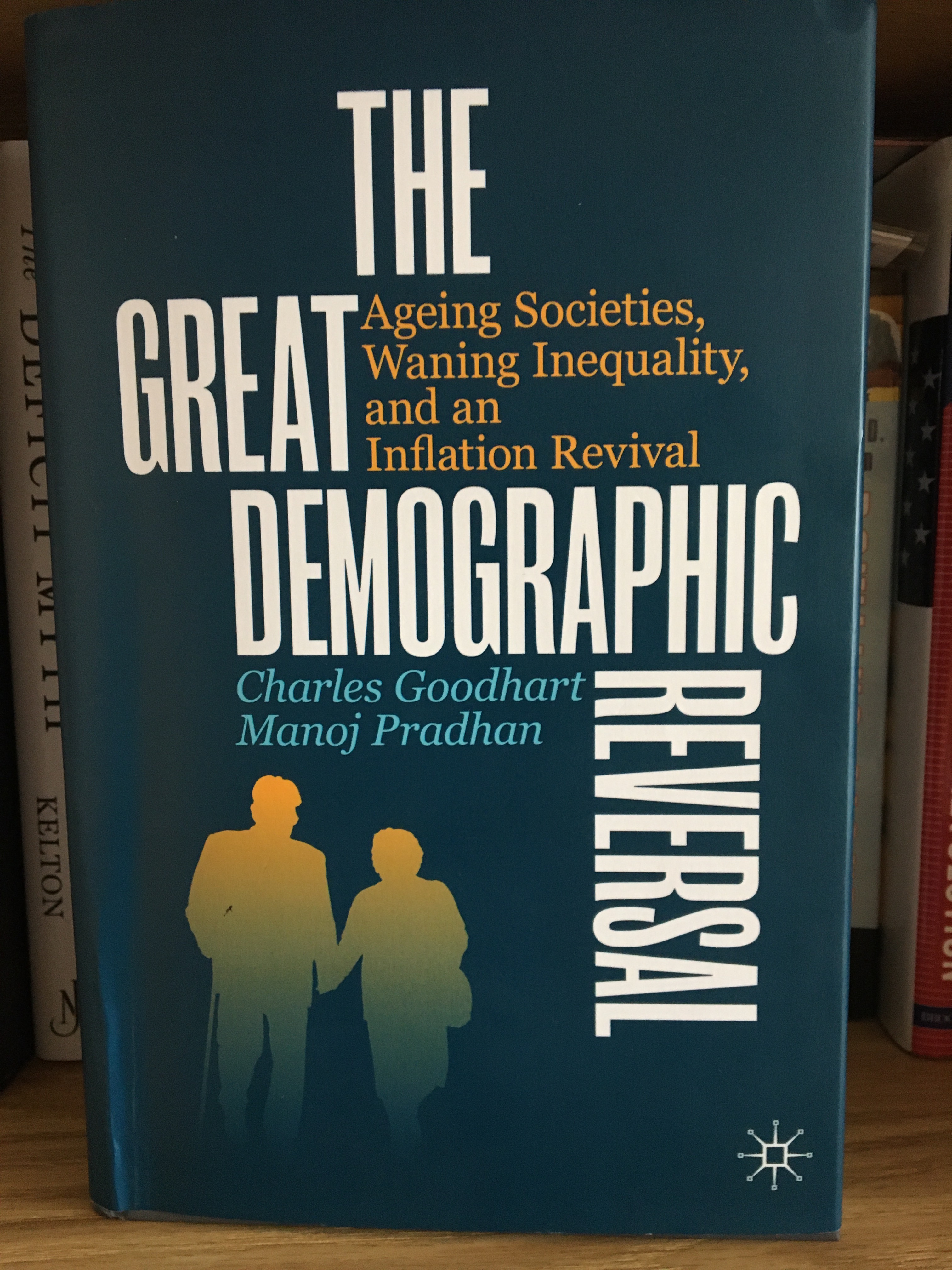
“The Great Demographic Reversal” is an immensely stimulating book by Goodhart and Pradham which amongst other things predicts a shift in the balance of power between capital and labour, reductions in levels of intra-state inequality and, worryingly for highly indebted nations, the return of higher nominal interest rates and higher inflation.
The predictions run counter to what seems to have become a prevailing view about the state of the world economy distilled into the concept of “secular stagnation”. This model, discussed elsewhere on this site, focusses on many of the same drivers as Goodhart and Pradham. An ageing population, increasing dependency ratios, a glut of savings, changes in the capital intensity of growth industries all leading to a paucity of demand for capital for investment. The demand for money is thus reduced pushing down its cost ie. interest rates. These things are also presented as part of the explanation for the aneamic productivity growth rates in advanced economies and a whole lot of other ills.
Goodhart and Pradham have a different take on these issues. They share the view that a demographic sweet spot in critical economies around the world has combined to create a benign low inflation and low interest environment. But looking forward they analyse how that national sweet spot is turning sour and is set to impact the evolution of the global economy.
In essence, they see that over the past thirty years China has proved to be a massive engine of deflation which it has exported around the world. Its insertion into the global economy through its membership of the World Trade Organisation in 2001 effectively increased the supply of cheap labour into an increasingly integrated globalised capitalism. This sucked in jobs from the advanced, relatively high wage, economies of the world and pumped out cheap manufactured products.
This meant a decline in demand for workers in manufacturing jobs in the West, a consequent reduction in their bargaining power leading to wage stagnation and or unemployment. This reinforced a shift towards service industries with a generation of baristas and deliveroo employees on minimum wages only able to remain fashionable because of the rock bottom prices provided by the House of Primarnia with its Asian manufactured clothing.
However, the positive demographic is being replaced by negative trends in both the East and the West. In China and many parts of the West population structures are shifting towards the elderly end of the bell curve. What is more the tail on the elderly end is being pushed out as people are living longer. This has a number of interacting consequences on society and the economy.
Firstly, there is the increasing demand on health and social services as the old and very old members of the population create increasing levels of demand for support. Goodhart and Pradhan have an excellent chapter on the health and care challenges of an ageing society.
Second, their living longer puts increasing strain in terms of national and private pension requirements. Responses to these may including raising the retirement age, reducing levels and or benefits, and closing final salary schemes. Whilst some element of all these have occurred in the UK there is a limit how far these things can be taken if not for moral, then for reasons of electoral arithmetic. Old people vote.
In summary both of these factors create significant levels of demand on public finances just at a time when the dependancy ratio, ie. the ratio of those who are economically inactive to those working and paying taxes is getting worse.
Not only is this happening in many advanced economies it is also happening in China. The dependency ratio there is moving in the same direction and labour availability is set to reduce over the coming decades. This will, over time switch off the deflation machine.
In parallel with all this is the shift in political sentiment away from globalisation linked to an increasingly populist rhetoric. Goodhart and Pradham make the point that this will have a doubly negative effect. Controls on immigration will exclude the labour required by the economy to improve the dependency ratio. It will also limit the importation of inflation reducing cheap imports.
Watchers of the Global economy may respond to the predictions of this book by pointing to Japan. A nation which has gone further along the demographic ageing curve than any other advanced economy. There is little sign of inflation or increasing nominal interest rates after the best part of three decades of economic stagnation and a national debt which, as a percentage of GDP, is 1.6 times worse than the current UK position, c260% plays c100%.
Goodhart and Pradham have a chapter on this and provide, to a laypersons point of view, a convincing explanation of why Japan’s experience cannot be seen as a prediction of the future impact of demographic changes globally. Not least because they were able, and did, take maximum advantage of the demographic sweet spot of their neighbour to import deflation.
The book does not simply explain the likely trajectory of the world economy based sole on demographics. They outline what significant challenges this creates but they look at a whole host of other factors as well including the rise of indebtedness in the non-financial corporate, household and public sectors. They also talk about the misalignment of management incentives with investment needs negatively impacting productivity growth. Goodhart and Padhan are clear that, whilst, ageing is inevitable its economic and social consequences are not. They depend on policy actions.
The final chapter of the book points to a number of actions that might be taken to start to address the issues of indebtedness, productivity and inequality. They see tax increases as inevitable but have interesting proposals about how they might be structured in the most equitable and effective way possible.
They explore the benefits of a land tax and a carbon tax . They also look at ways to reduce the differential tax benefits of debt over equity through an Allowance for Corporate Equity or a Destination-based Cash Flow Taxation (DBCFT). Both of these are mechanisms to push corporates to rely more on equity than debt which may be critical if the authors are correct about the likely direction of interest rates. They also talk about reforming the incentive structure for corporate managers which, currently, positively promotes the loading on of debt, excessive cost reductions particularly in relation to R&D, and the buy back of equity in order to push up the Return on Equity (ROE), all of which increase the benefit corporate managers derive from share incentive schemes.
At 218 pages this book deals with an enormous topic with a mix of close technical discussion of things like the Philips curve and the Non Accelerating Inflation Rate of Unemployment (NAIRU) and very easy to follow logic. It is definitely swimming against the tide of much current thought about the prospects for inflation and interest rates. However, much of what it has to say makes sense as a strategy for addressing some of our current problems of productivity whether or not the demographic time bomb is as powerful or as pervasive in its impact as they predict.
In the interests of full disclosure, as a pensioner the issue of inflation is close to my heart, and wallet, however, I recommend this book for anyone who wants to read an accessible and interesting analysis of the possible evolution of the global economy over the next few decades.
The Great Demographic Reversal: Ageing Societies, Waning Inequality, and an Inflation Revival. C Goodhart, M Pradham. Palgrave Macmillan. 2020
 northerncomment