What a difference a day makes!

On Sunday I posted about a likely shift in gear as the government responded to a growing chorus of concern about the scale of the response to COVID-19. I agonised over sharing a link to an article by Tomas Pueyo which painted a rather bleak picture and was urging radical action on social distancing immediately. I did not want to contribute to a growing sense of unease. Little did I know.

I have more confidence now and believe yesterday was merely an introduction of what is to come and that by the end of the week legislation will be in place to enforce a much more rigid programme of social distancing, nay social isolation.

The report from Imperial College London has focused policy makers minds with its projections of a quarter of a million deaths unless radical action is taken to slow the spread of the disease. This would overwhelm the NHS and involve medial staff making live or die decisions.

There were a number of criticisms one could make about yesterday’s speech and it is easy to snipe from the sidelines. however phrases about what we are “going to recommend” do not help. And suggesting what people do is too weak. There may not be the legislation to back up clear instructions at the moment but that should not prevent them from being given and it is a matter of days, maybe hours, before that legislation is in place.

Two things are absolutely clear:

  1. Social distancing should be taken really seriously. No social gatherings at all. There is plenty of guidance on this. One practical piece of advice, have a soap dispenser that you have to step over to get into your home. As soon as you come in from outside wash your hands before you touch anything. The virus can remain on surfaces for 72 hours+
  2. Isolated individuals and families, particularly the elderly, who do not have local support will need help from their neighbours. Such help is the right thing to do from a moral point of view but also from a public health point of view. If people are infected  and hungry they will go out. Unless they are critical hospitals will not be interested. There is not the infrastructure of public social care support to help them. It is going to come down to neighbours to help them maintain the isolation.

Yesterday was tantamount to a declaration of war. Like all wars it depends upon public servants to be won. Sometimes that is the soldier, this time those on the front line are doctors, nurses and a range of other healthcare workers. We should not however forget the private sector workers who are on the front line particularly those operating the supermarket tills and transport staff who interact with the hundreds of members of public every day.

What is crystal clear now is that time is of the essence, and no longer should we underestimate what a difference a day makes.
Boris the radical remainer.

The moment he became Prime Minister Boris Johnson became an arch remainer. His one overriding goal is to remain in 10 Downing Street. Having been selected by c150k Tory party members on the basis that he would achieve Brexit, and having the example of what happens to PM’s that fail he devised a strategy which would secure Brexit come what may.

The problems he faced were a hopelessly divided legislature, a slim majority and a pressure group within the Conservative Party who were not for compromise. In these circumstance Mr Johnson decided the strategy to achieve his goal would be, “no ifs, no buts, no-deal”. However he needed cover for what would happen if he failed by 31 October, and also, for if he succeeded.

If he failed his credibility with the electorate might be shot and in any subsequent election he would face losing votes to Mr Farage. If he succeeded and Yellowhammer came home to roost he might be fighting an election with growing queues at ports, disrupted holidays, food and drug shortages and who knows what other disruptions.

Plan A was to have a snap election and get majority to deliver Brexit. When Jeremy Corbyn refused to play the part offered to him a revised strategy was needed. This involved ensuring that the blame for; a) not securing Brexit, or b) securing Brexit would fall on others.

It is almost certain his first and final offer to the EU will not be acceptable, it is becoming increasingly clear it was never meant to be. If they had rejected it outright he would have claimed foul and that it was the fault of the EU we have crashed out. Again they refused to play ball and are considering what they know is a non-starter. At the coming summit it will become clear that it is not workable. There will then be a lot of manouvering and synthetic anger by Boris and his team trying to portray the Europeans as intransigent and unwilling to negotiate in good faith. This is a tactic we see more and more often in politics where a party will do something outrageous but attempt to hide it by accusing the other side of doing the exact same thing.

Following all the sound and fury we will get to the point where the Ben Act comes into play. Mr Johnson then faces the dilemma, should he really attempt to overcome the Ben Act, crash out of the EU and risk an election in the context of Yellowhammer, or should he manouver himself into a position where he appears to have been forced to accept an extension, then have an election where the risk is Mr Farage is able to portray him as another failed Brexit leader.

It looks as though he is opting for the latter, pinning his hopes on a “people versus parliament” election. He must have calculated the combination of die in a ditch Brexiters and more widely held Brexit fatigue will produce him a majority which he can then apply to taking the UK out of the EU in January. He is probably correct in assuming that Brexit fatigue might quickly evaporate following a no deal departure.

Like most carefully crafted battle plans, Mr Johnsons did not survive the first engagement with the enemy. People refused to behave as they were supposed to. The tactics that have survived are about attempting to threaten and bully and lie their way to Brexit. It is a moot point whether this will be successful. 

However, elections are unpredictable as Theresa May found to her cost. There is no certainty about what the election result will be. And there is no doubt it will be anything other than a Brexit election. What happens then if the popular vote is for remain candidates but the electoral result is a leave majority in parliament? Who knows?

There are only two things that I think are clear, first, Mr Johnson’s steadfast commitment to leaving Europe, second his absolute commitment to remaining in 10 Downing Street.


What’s in a word.

The Prime Minister believes there is nothing wrong with labelling the Benn Act, which prevents him from leaving the EU without a deal, the Surrender Act. His colleagues have suggested it is a legitimate part of robust political discourse. It is equivalent to the Labour Party’s labelling the removal of the “spare room subsidy” as  the “bedroom tax”. This is however a false equivalence.

In the case of the bedroom tax there was a dispute over the change to a welfare benefit which penalised households deemed to have chosen to live in accommodation which had a bedroom they did not need. The Government attacked the Opposition for tax and spend profligacy and a failure to recognise the seriousness of the deficit. The Opposition attacked the Government for a heartless attack on some of the most vulnerable members of society. The debate about this was passionate some might say vitriolic.

However, whilst the terms were strongly contested the disputants were always arguing about who was right and who was wrong. However much they disagreed about who was right and who was wrong they accepted the legitimacy of the other side putting their case. On the bedroom tax, critically, the Government thought the opposition was wrong, but not the enemy.

Using terms like surrender and other rhetoric that has its origins in military discourse and war time challenges the legitimacy of the other sides right to argue a case. The patriotic integrity of the other side is brought into question. They  are no longer people who have a very different view of the world they are the “enemies of the people”.

The distinction between this kind of language and the the dispute over the bedroom tax is fundamental, and profoundly important. It takes public debate into very dangerous territory. At best the PM’s hubris is clouding his common sense. I don’t like to think about the worst.

Recently, I looked at how President Trump compared against a number of tests set out by Levitsky and Ziblatt. in their book How Democracies Die. He did not fare well, which is a real worry for democracy in the US. Sadly, looking at the actions of Mr Johnson we also have cause for concern.

Before I go any further however, let me make clear I do not think Boris Johnson is equivalent to President Trump. Mr Trump is in a category of his own for venality, banality and an absolute stranger to the meaning of right and wrong, truth and lies. By contrast Boris is a pale imitation. But imitation he is.

In their book Levitsky and Ziblatt look at how how populist leaders gain democratic support and then proceed to corrode the democratic system from within. Typically they argue the system is frustrating the “will of the people”. Initially they may well be implementing popular policies but over time their view of the “will of the people” becomes less consistent with what most people think and they transition into increasingly authoritarian systems of government.

This transition is not always the result of a conscious strategy. They did not set out to be an authoritarian. They started out shortcutting the democratic system because it was too bureaucratic, or complex. The shortcuts outrage the opposition who push back and a tit for tat process spirals out of control and can lead to the establishment of a genuinely authoritarian government.

Levitsky and Ziblatt recognise that many people in long established democracies think “it could never happen here”. Their research, however, is a wake up call as in a number of the examples they consider similar views were present before it did, in fact, happen. Their aim is to provide warning signs of the kind of behaviour that precedes a drift to increasing authoritarianism. They identify 4 key indicators and for each indicator they give examples of more or less egregious behaviour which evidence a move towards  it. Thankfully, as yet in Britain, there is evidence of only the first two indicators and indeed the behavioural evidence is at the lower end of the spectrum.

The first key indicator is “Rejection of (or weak commitment to) democratic rules of the game”  evidenced by whether they “… they reject the constitution or express a willing ness to violate it.” The Supreme Court seemed to think, eleven / nil, that the Prime Minister’s behaviour did evidence this. Choosing which laws to obey probably falls into this category also.

The second indicator and the one most relevant to the question in hand is the “Denial of the legitimacy of political opponents” evidenced by whether “… they describe their rivals as subversive, or opposed to the existing constitutional order?” Talk of “surrender”, “traitors” and “betrayal” clearly attack the legitimacy of those opposed to a no-deal Brexit.

Boris Johnson is not a “dictator” and he has not staged a “coup”. He is, however, playing with fire. Talk about a people versus Parliament election ignores that 48% of “the people” wanted to remain. Reinforcing and promoting the divisions in a country should not be the aim of a  of a democratic leader. It may not work  in achieving the leaders goal but even if it does it could well be a case of an operation which was a great success but sadly the patient ended up dead.


IFS Green Budget

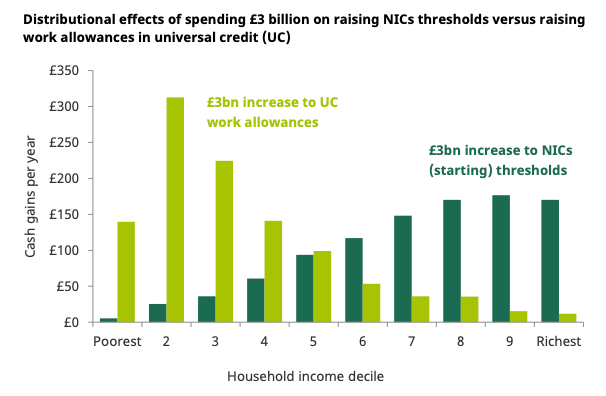
Sometimes a single chart encapsulates a whole policy agenda. The one below from the independent Institute for Fiscal Studies looks at the impact of one of Boris Johnson’s proposals to radically overhaul personal taxes. There are two major proposals.

The first is simply to  increase the higher rate threshold (the level of earnings you must have in order to pay higher rate tax) from £50k per annum to £80k. A straight tax give away to the better off.

The second, and the subject of the chart below, is to raise the point at which National Insurance contributions start. This, they claim, is in order to help the poorest in our society. The dark green bars in the chart shows the government must believe those with most money are the poorest.

The chart also looks at an alternative way to boost the incomes of low earning families by boosting the work allowance in Universal credit. This is shown in the lighter green colours. Clearly, the IFS seems to have a view of who are the poorest in society which more closely aligns to that of people here on planet earth.

It seems caring Conservatism doesn’t care any more.