
The political turmoil in the States has thrown up the best of people and the worst of people. James Comey’s autobiographical reflection on leadership presents a picture of the both.
Obviously, autobiography is a partial view, which it would be foolish to accept uncritically. Reassuringly perhaps, the self Mr Comey is willing to reveal to us is not without fault. He confesses to weaknesses, sins of omission and commission including bullying a fellow student when at University and lying about playing basketball in high school.
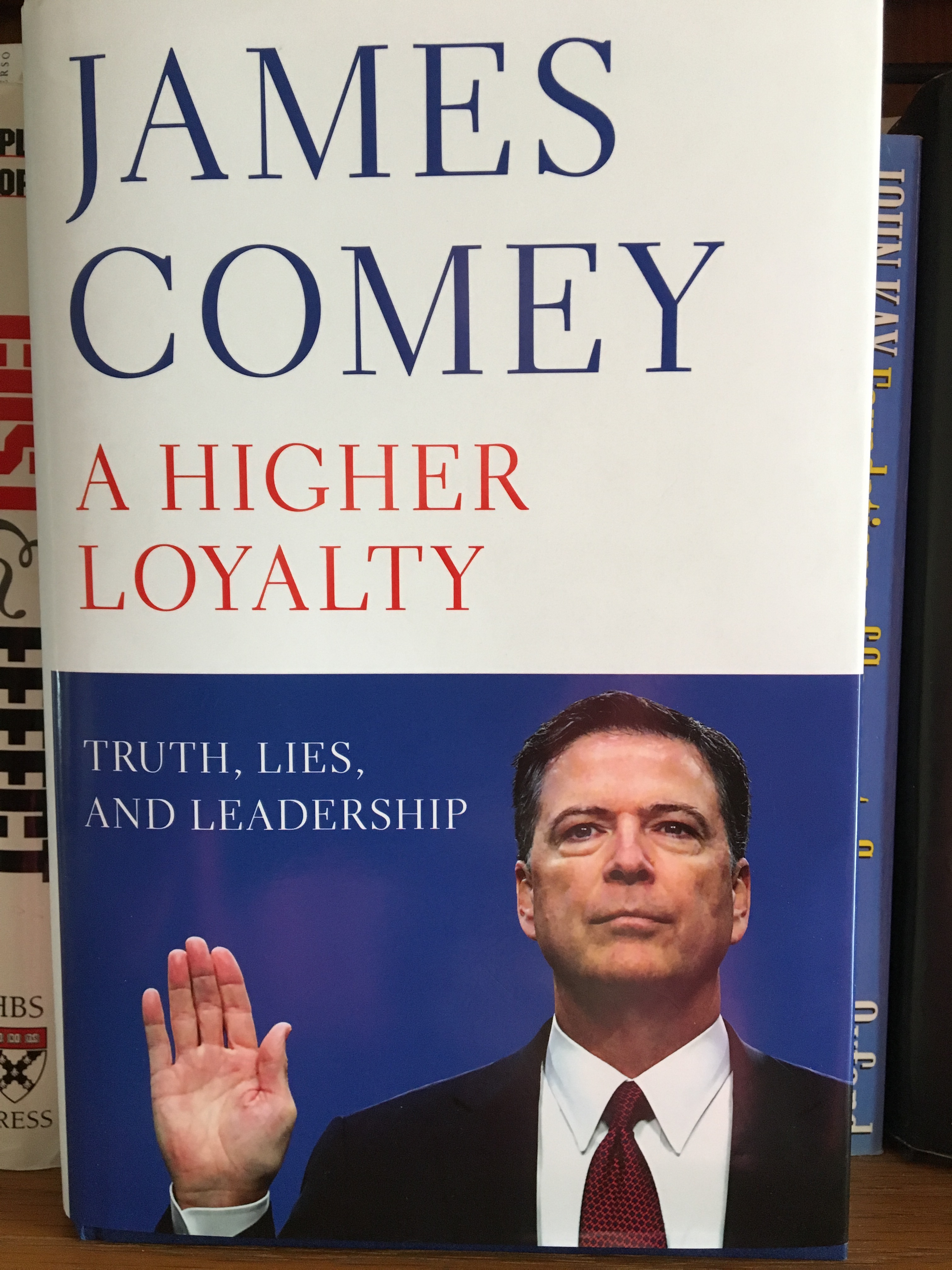 He makes no claims to infallibility, indeed quite the contrary recognising that key decisions he has made in his career may have been wrong. He appreciates how difficult it is to understand how motives shape decisions consciously or unconsciously particularly his own. If there is one thing he is keen to convince the reader, it is that, in his professional career he has always tried to act in good faith according to the law and the Constitution of the United States. He presents himself as a fallible human being but a deeply patriotic person who aims high in his professional behaviour.
The book considers the events and people in his life he believes shaped him as a leader. Whether or not he genuinely absorbed those influences and lived up to the high standards he describes only those he led would be able to answer. However his descriptions of what good leadership looks like are compelling and worth reading.
Whilst the leadership style of President Trump is not addressed directly until the end of the book one cannot but feel the first 210 pages create, consciously or not, a sharp point of contrast. Its elements include the ability to listen actively, to seek out the opinions of others and see the value of those that contradict your own. It understands the difference between intelligence and judgement. Intelligence being the ability to “…master a set of facts.” Judgement on the other hand being the ability to “…say what those facts mean and what effects they will have on other audiences.”
Comey, a Republican voter, describes what he thinks are characteristics of good leaders but his examples are absent of partisan bias. He describes characteristics and behaviours of President Obama he thinks are important including a good sense of humour which he believes to be a good indicator of a persons ego. The ability to laugh at someone else’s joke reveals a degree of self confidence in a willingness to look a little silly as you laugh and an appreciation of others.
Central to Comey’s view of a good leader is personal confidence. Being comfortable in your own skin, knowing yourself, including your weaknesses as well as your strengths. Such confidence facilitates the ability to be humble. To recognise that a good leader does not have to pretend infallibility, rather they recognise others may have more to offer on certain matters and indeed provide better insight into an issue. A good leader blends confidence and humility in a mutually reinforcing whole.
Comey is clear a leader cannot take respect it has to be earned. Earned through consistency of words and actions. Living the values you espouse. He understands that as a leader you are constantly under scrutiny. Some will be willing you to exhibit actions which contradict your words, the vast majority will be looking for examples of what you value. Your words and actions are signposts, you constantly have to take care are pointing in the right direction.
Access to truth, for Comey is seen as fundamental to good leadership. Loyalty of those around you means having people who will challenge you with vigour when they think you are making a mistake. Helping you discover the uncomfortable truth as opposed to reassuring your convenient prejudice. Loyalty expressed through flattery magnifies errors when whatever “the boss” says is agreed to as right. This is the loyalty offered to the Mafia boss.
There are lots of textbooks on leadership but if you want a passionate guide from someone who at the very least has occupied some very senior leadership positions you could do a lot worse than read this book. Comey sets the bar high and from his autobiography you do get the impression he measured himself against it. He clearly reflected a lot on leadership and thought deeply about it.
And then of course there is President Trump. Clearly, the fact that President Trump sacked him will have shaped Mr Comey’s views about the man. However, the manner of his sacking, reported live on TV speaks volumes to the leadership style of the man who now ‘leads the free world”.
In summary, Comey was in the FBI’s Los Angeles field office speaking to a room full of staff when he saw the news of his sacking being reported on the TV screen running across the back of the room. Once it had sunk in that this was not a joke he got onto his assistant back in Washington who had been given a letter which she scanned and emailed to Comey which fired him with “immediate effect”.
If Comey had been guilty of some act of gross misconduct this would have been a shocking and deplorable way to handle his dismissal. The ostensible reasons in the advice given by the Deputy Attorney General Rod Rosenstein were, ironically, about his handling of the Hilary Clinton email investigation which had been conducted 6 months previously, before Trump had been elected to the Presidency.
Whilst this manner of sacking might seem unprofessional it does not plumb the depths of the sacker. The issue of how Comey would get home arose. The Deputy Director of the FBI, Andrew McCabe, who had suddenly become the Acting Director of the agency, decided it was appropriate to return Mr Comey to Washington in the official plane with his security detail.
Millions saw the return of the sacked Director live on TV, including, it seems, the President. Many would have thought this national coverage of his return a public humiliation. It was, but seemingly not enough for the President. The next day Trump rang the new Acting Director and asked how Comey had been allowed to use the official plane to get back to Washington. When McCabe explained he had authorised it, “The President exploded.” He ordered that Comey should never again be allowed into any FBI property anywhere. This meant his staff had to box up his personal effects and take them to his home.
Are we at the bottom yet? No. The Deputy Director’s wife had once run unsuccessfully as a democrat for the Virginia state legislature. Apparently in his fury with McCabe Trump asked “Your wife lost her election in Virginia, didn’t she?” When McCabe replied “Yes, she did.” Trump said “Ask her how it feels to be a loser.”
Confidence, humility, judgement? No. Petty, spiteful, vindictive? Yes.
In the epilogue Comey manages to maintain a sense of optimism. Whilst he deplores those who stand silent and provide tacit assent to Trump’s outrageous behaviour, he believes after the forest fire which is the Trump presidency the United States will refocus and restore the balance between the executive, legislative and judicial arms of government. We can only hope his optimism is well founded.
Having read this book I think about the lift test. Would I want to be stuck in a lift with Comey. He sounds genuine and interesting so the answer is yes. If it were Trump? I’d jump.
A Higher Loyalty: Truth Lies and Leadership. James Comey. Flatiron Books 2018
 northerncomment