Robo Financial Advisors

Article from FT

“Goldman Sachs has just bought a small financial technology company in Texas called Honest Dollar, which organises pension plans for small companies and self-employed workers, writes John Gapper. Builders and taxi drivers are not exactly Goldman’s usual set of customers so it is a sign of the revolution in asset management. 

Honest Dollar, although it dislikes being labelled as such, is one of a new breed of “robo-advisers” that offer a cheap, automatic version of something that used to take a long time and cost a lot of money. Instead of an expensive adviser picking out the stocks and bonds in which savers should invest, a computer does a more sophisticated job at the touch of a button.

Robo-advisory start-ups such as Betterment and Wealthfront in the US and Nutmeg in the UK are growing rapidly. They offer investors ease and simplicity at a very low price — often a quarter of the fee an investment adviser at Morgan Stanley or Bank of America Merrill Lynch would charge.”

Interesting and very welcome example of automation of professional services. Whilst one might be concerned about the automation of many professions Financial Services is not on of them.

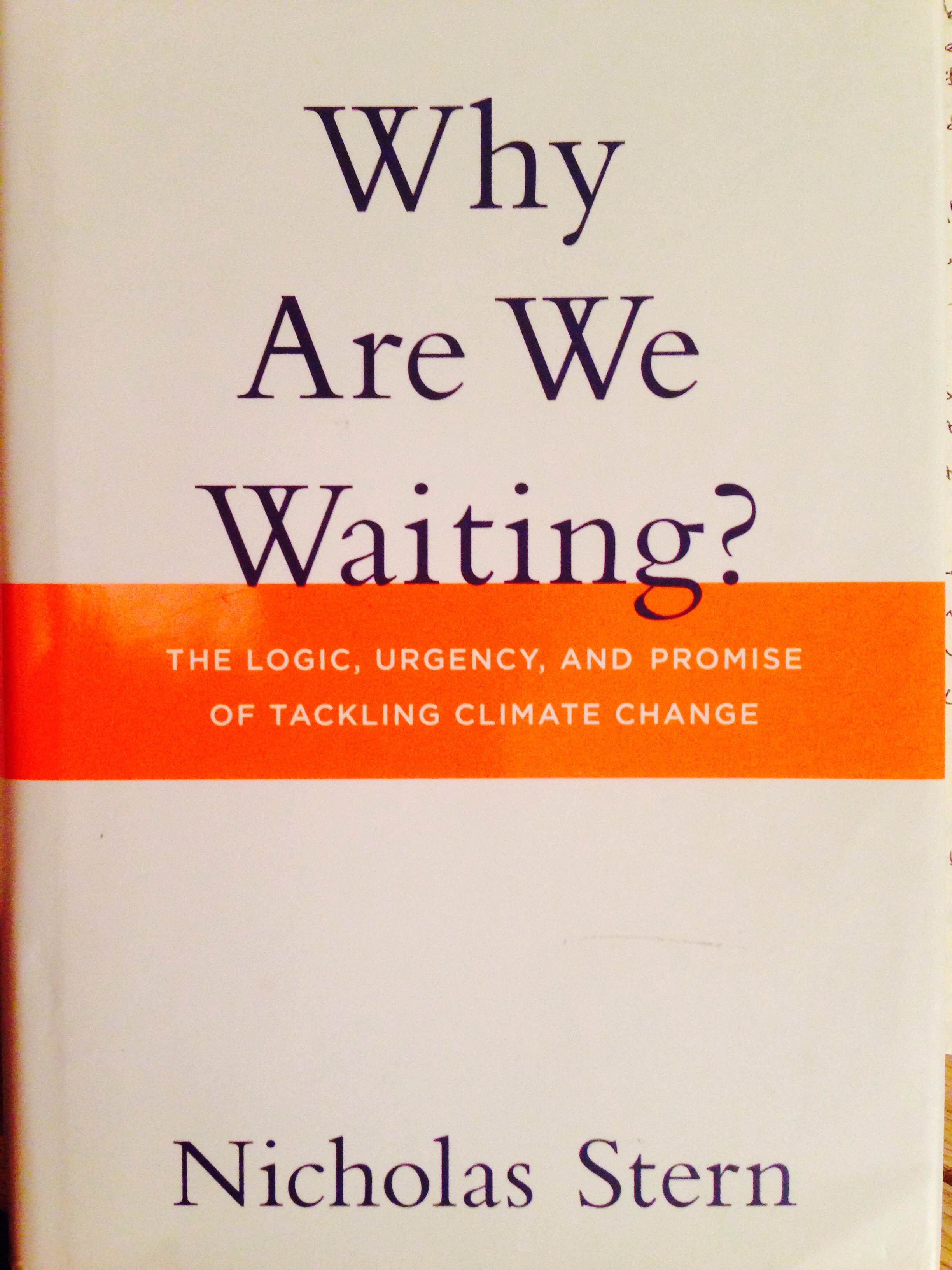
Why Are We Waiting?

If you want to read one book on climate change, which provides a balanced and comprehensive overview of the topic this is it. Nicholas Stern has been engaged in the issue for decades. In 2006 he produced “The Stern Report: The Economics of Climate Change” reviewing the economic implications of moving to a low-carbon global economy. The authority of the writer comes across from the start and builds as you read the book, which, for those that did woodwork, is not without its challenges.

IMG_1258The book came out just before the 2015 Conference of the Parties (COP21) in Paris. It set out a new approach to the global management of climate change moving away from top down, legalistic targets to an approach premised more on, effective measurement of emissions, individually set voluntary targets and regular review of these to establish more ambitious ones. In essence this seems to have been a recognition of the political reality that a) the US Senate would block any Treaty ratification and b) many of the emerging economies were unlikely to sign up to something that undermined their economic growth.

The title of the book aims to challenge the current complacency around the issue of climate change. Stern sees the next two decades as fundamental to determining whether the world can create a viable response to the threat of global warming. The reason for this is a combination of demographic, economic and infrastructure changes that are set to occur over the next twenty years.

Demographic projections between now and 2050 suggest the world’s population will grow from something over 7bn to just under 10bn. What is more, 70% of that population will live in cities compared with 50% now. Many of these people will be in the rapidly expanding emerging economies, notably China, whose growth is hugely energy resource hungry.

These mega trends have enormous investment and resource consequences, which, are intensified by the fact that the existing infrastructure of many developed nations is dilapidated and also requires significant investment. This means over the next twenty years there will have to be massive investment in developing new cities and improving existing ones.

How this investment is undertaken and its results will structure the world’s energy demands for the rest of this century and beyond. This is fundamental as the science makes clear we are now close to the limit of CO2 equivalent gasses (CO2e) that we can put into the atmosphere without creating an existential challenge to the future of the human race.

Currently, the world emits about 50bn tonnes of CO2e gasses annually. If we want to constrain the global temperature increase to no more than 2 degrees Celsius we need to reduce emissions significantly. Specifically by 2035 we need to be <35bn tonnes and by 2050 down to <20bn tonnes. Whilst the specific path might vary this level of reduction reasonably represents the scale of the challenge. A challenge magnified of course by the growth in the world’s population and in its wealth.

The book is well documented and provides a brief history of the underlying science relating to the impact of CO2e gasses on global warming. It charts the ups and downs of the international policy response since the establishment of the Intergovernmental Panel on Climate Change in 1988.

The arguments in the book are very balanced. Stern is not one for “sexing up” the evidence. He genuinely believes it speaks for itself. He is meticulous at presenting the positive progress that has been made in some areas. Indeed he thinks this is vital in convincing people the issue is something that can be addressed, as well as must be.

His emphasis, however, is urgency. He explains how the nature of the problem is such that it conspires to undermine effective policy action. Its scale, the risk and uncertainty surrounding it, the delays in consequences and the “publicness” of greenhouse gas emissions all undermine an appreciation of what is a clear and present threat.

The notion of the “publicness” of greenhouse gas emissions is worth a word. By this Stern means it does not matter where the emissions come from, it is the cumulative total which matters, and its main impact will not be distributed on the basis of who has contributed most to the problem. This raises enormous questions of equity given that the largest contributors to the problem to date have been the, rich, developed nations of the Northern hemisphere and, per head, this remains the case. Ironically the, poorer nations in the Southern Hemisphere, who to date have contributed least are those likely to face the earliest significant consequences of change.

It is partly because of this that one, if not the, key theme of Stern’s book is the need to link the issue of climate change and poverty reduction. As he puts it “… the two defining challenges of our century are overcoming world poverty and managing climate change.” If you think solving world poverty sounds a bit idealistic reflect on the following. The current level of global CO2 emissions is 7 tonnes per person. If we want to keep global warming to 2 degrees Celsius this needs to come down to 2 tonnes per head by 2050. Currently China, the largest national emitter of CO2, emits the equivalent of 9 tonnes per person. The United States on the other hand emits 20 tonnes per person.

People living in grinding poverty, or even at standards which are half those of a small minority of the planets population are unlikely to worry about the impact of climate change if those that have been the “winners” to date are not seen to be doing a lot of the heavy lifting. The eradication of global poverty is no longer just a moral issue it is tied to the long-term sustainability of the planet.

There is a technical section of the book which looks at the models used to predict the impact of climate change. Stern feels there are some fundamental flaws to some of these models. He argues, “The basic problem is that they have assumed underlying growth plus only modest damages from big increases in temperature, plus very limited risk.”

Because they ignore some significant “tipping point” risks and issues like potential migration patterns they lead to overly optimistic conclusions. So, for example, some of the models assume 2% annual growth and 20% damages from climate change over time. These end up showing the world to be 6 times better off economically even with 8% temperature increase. So the economy is fine, it’s just that all the people are dead.

The book is written in a very clear and persuasive manner. There are no flights of emotional rhetoric, no avoiding difficult questions. The evidence is laid out systematically and rigorously. Mr Stern clearly believes in the power of rational argument, which is much to his credit. I would be very loath to question his grip on international policy development. If I have one concern it is that he may underestimate the strength and resolution of those with a material interest in rejecting the risks associated with climate change.

Unless there is a massive technological breakthrough on carbon capture and storage the reducing CO2e emissions path set out above is probably the only viable way to limit the increase in global temperatures. The implications of this are that somewhere between 65% and 80% of the known fossil fuel reserves currently in the ground have to stay there. That is a lot of pain. Pain, which would be felt by some of the most wealthy and thus powerful people on the planet. I am not sure how far rational argument will go along that line.

I started by suggesting that if you only want to read one book on climate change “Why are we waiting?” should be it. I would conclude by saying don’t read one book on climate change, read two. Read Nicholas Stern in conjunction with Naomi Klein’s “This Changes Everything”. Stern and Klein have very different views about who will play the leading role in addressing the issue of climate change. For Stern the private sector has to be mobilised. For Klein it is an effective state energised by local activism. Whatever their differences they are both attempting to inject a much-needed level of urgency into the issue of climate change. They both provide insight and illumination. A Kein/Stern synthesis would be tremendous until then the effort of reading two substantial books will not be wasted both are excellent in their different ways.

Nicholas Stern. Why  Are We Waiting. MIT Press 2015
Stopping Smoking

In the next few hours large numbers of people around the world will be united by a common desire to stop smoking. Many good intentions will be mapped out for the new year.  There will be those who decide to go for the big bang, having their “last cigarette ever, ever” on New Years Eve. Most however will see the personal cost of this as too great and opt for a phased withdrawal.

To achieve this some will try to adopt a low-tar bridge away from the more toxic high-tar tobacco dependency. Others will adopt a strategy of mitigation where they chart a future of declining dependence with monthly targets for the consumption of reducing numbers of cigarettes. They may attempt to support their efforts by wearing nicotine patches, or chewing special gum. Some will go for a more radical lifestyle change encompassing healthy eating, exercise and alternative treats funded from the money saved on cigarettes.

Of course there will also be those smokers who do not intend to stop at all. Those that understand completely they are increasing their risk of cancer dramatically but don’t care. Their addiction to tobacco being so great they genuinely cannot face a world without it.

Some will engage it a bit of self-deceit colluding with the now bankrupt blandishments of the tobacco industry that have moved on from attempting to sell doubt about the health impacts to the extolling of smoking as an expression of individual liberty.

There will be those who argue  the problem is so far off and the current impact so limited that it is not worth taking action on something they enjoy so much now. Next year maybe or the year after that, or sometime in the future.

Others may put their faith in medical breakthroughs which lead to a cure for cancer. Obviously they will be hoping the cure comes before they succumb to the disease.

Those opting to continue to smoke will accept they need to focus on strategies for adaptation, e.g. recognising that running for the bus is something they will never do again.

Despite the science of doubt funded and disseminated by the tobacco industry most people now accept they are taking a significant risk with their health by smoking. For many there will be real anguish and sincere intent over the next few days as they wrestle with what the best strategy for them is.

In Paris earlier this month 195 nations grappled with essentially the same problem. How is the world going to stop smoking? Specifically, how can we break our dependence on fossil fuels. The responses were very similar. Some were keen on drastic reductions immediately, particularly those on low-lying islands in the Pacific, most saw this as too radical however.

As among smokers there were those who felt a bridging strategy should be adopted by “smoking” less-toxic natural gas. Then there were those who wanted to invest in alternatives to overcome our need for greenhouse gas-emitting forms of energy.  Most agreed a phased reduction in the use of fossil fuels was probably the best way to quit however there was a deal of uncertainty about how quickly this should happen, how a tally on the number of “cigarettes” smoked would be kept and who was going to lead the way. The balance on all this was effected by the amount of faith people were willing to put in a “moonshot” technology breakthrough to suck carbon out of the atmosphere. If you believe the technology will come in time then you can burn what you want now and suck it up later. Of course the technology might not come and so then you may really have to “suck it up”.

Analogies always break down and whilst there are similarities there are also significant difference between an individual’s struggle to cut their dependency on cigarettes and the collective struggle of the world’s population to reduce its dependency on fossil fuels.

First, the problem of passive smoking is of a different order of magnitude to climate change. Everyone on the planet is at risk of the impacts of climate change irrespective of whether they individually smoke (emit CO2e) or not. Worse, some, who have smoked a long time, notably the developed nations of the world, have created a problem which is as toxic for  those who have only just started smoking (emerging economies) or indeed, those who only have, the fossil fuel equivalent of, the odd cigar at Christmas (least developed countries).

Also climate change seem a long way off. There are lots of much more pressing problems in the here and now, ISIS; Europe’s economy; migration; the Ukraine etc. Whilst it seems the planet is beginning to show some symptoms they are not seen as portends of an existential challenge. Dreadful as they are, for the people involved, things like the “unprecedented” levels of rainfall causing floods in the north of England this December are in the “awful but manageable” category.

The opportunity to do something about climate change look like it now has a trajectory and timescale similar to the development of cancer in a person. Currently as a planet we are smoking at the rate of around 50 giga tonnes of CO2e emissions a year. Think of it as the equivalent of an individual smoking 50 Capstan full strength a day. If they both continue at the same rate over the next twenty years the outcomes for the individual and the planet are likely to be equally bleak. Action to reduce the amount of CO2e in the atmosphere needs to start now.

Unfortunately, the voices of those denying the reality of global warming still have real power for instance dominating the US Senate. No doubt there will be some who continue to deny the reality of the process at some point in the future from their tropical hideaway at the North Pole. People that espouse these claims now need to be dismissed as extreme, stupid or those whose job depends upon it. Individuals who chose to smoke now do so in the full knowledge they are harming their health. Increasingly the world must realise greenhouse gas emissions have a similar impact.

The real collapse of the analogy between smoking tobacco and burning fossil fuels is the scale of the impact they have respectively. If an individual choses to continue to smoke 50 Capstan full strength a day it ends in personal tragedy for them. If we continue to smoke 50 giga tonnes a year it will end in collective tragedy for the human race. If we are to avoid this we need to find a way to act collectively more rationally than we sometimes do individually.

Stopping smoking requires support, encouragement, substitution, alternatives. It also requires resolution. This year the World’s resolution on stopping smoking has to firm up. The resolutions of nations, so far, made in Paris does not get us there. Stopping smoking is not easy, it really hurts. Reducing our dependence on fossil fuels will hurt and it will be costly. Politicians alway talk about vision but act on focus groups. If the floods of the past few weeks begin to focus people on how the world’s climate is beginning to change then some collective good might come out of the personal catastrophes they have created.

The issue is too important to leave to short-term politicians keen on a “soundbite solution” today which they undermine by their long-term actions once the news agenda moves on. Parents and grandparents need to think seriously about what kind of world they want their offspring to grow up in. We all need to resolve to stop smoking now. If we fail we risk succumbing to the cancer of climate change.

Unprecedented does not mean unexpected

The word of the moment is unprecedented. First we had unprecedented rain in Cumbria, then unprecedented rain in Lancashire and the latest unprecedented rain is in Yorkshire. In a few days we may well have more unprecedented rain. Everyone knows that we cannot control the weather therefore we can hardly be critical of government when mass flooding is the result of unprecedented rain.

This sounds a bit like the bankers comments about unprecedented debt default in 2007/08. But if your risk strategy is based upon calibrating future risk based upon past events you are always in danger of being caught out by changed circumstances. If default levels were low at times when credit was only provided to people who could afford to repay it one cannot use risk levels based on this when you start giving debt to anybody that asks for it, indeed to many who did not even ask for it.

In relation to the unprecedented rain levels they should not have some as a surprise to any government. Earlier in December 195 countries from around the world got together to talk about how collectively they were going to tackle climate change. Reports of the Intergovernmental Panel on Climate Change and the International Energy Agency have provided reports making it quite clear that our weather is now and will be more and more affected by climate change. Earlier this year Committee on Climate Change provided a report to the Government warning of precisely the problems we are now facing. The government chose to ignore it.

If you are told that unprecedented weather is likely to become the norm it is not good enough, once that weather comes, to say it is unprecedented as if this provided an excuse. Governments are supposed to have an eye to the future they should be preparing for what is going to happen not what has happened. The last government was much criticised for “failing to mend the roof when the sun was shining”. Ironic that we now have a government who seems to have done the same only rather more literally.

The truth of the matter is the government were unprepared for events which global, international and national agencies have warned about increasingly loudly for years. Expressions about our hearts going out to the victims of this devastation and the sterling work of our brave emergency services and armed forces does not cut it. This government needs to get real about climate change and recognise that it is going to cost serious amounts of money for sustained periods. The longer we pretend this is not the case the worse it will be in terms of personal upset and disruption and societal cost.

There is one important thing we should not lose sight of and that is the low number of casualties and very low fatalities resulting from these floods. This is in large part a testament to the improvements in weather warnings issued by the met office and Environment Agency. Timely warnings have enabled, in the main, contingency plans to be put in to operation. It is ironic we are so dependent on the micro-forecasting capability of climate scientists whilst we continue to treat the macro warnings with such a cavalier attitude.