Partisan Thoughts

At the moment it is common to see the partisan state of its politics as a major problem for American democracy. A picture is painted of the Republican and the Democratic parties retreating behind increasingly high walls of partisan prejudice. Dialogue and debate being replaced with name calling and assertion. Both sides having blind faith in a revealed truth, impervious to criticism and reinforced in echo chambers of the like minded. In consequence there is a popular dismissal of of all political debate and a pervasive cynicism where the views of all politicians are dismissed as self serving bunkum.

Whilst there certainly is a more aggressive debate in America, and a very clear divide between the two major parties, a universal condemnation of partisanship is misplaced. It leads to an exasperated response of, “a plague on both your houses”. At the extreme a view that there is no such thing as truth, or no such thing as truth other than what my side thinks. This is dangerous.

This needs to be resisted. In the current political debates within the United States there is no comparison between the position on fundamental issues between the Republicans and the Democrats. One is just more right than the other, by a lot.

No one has a monopoly on truth. However, that does not mean truth does not exist. Real distinctions can be made between right and wrong when the wrong in question is egregious. Similarly, between science and fanciful, self serving propaganda. If we reject this then we are allowing a world where “alternative facts” are real. Where debate is pointless as there is no way to arbitrate between what is personal preference and what is true.

It is not partisan to believe there are scientific truths that exist independent of my beliefs. Partly because there are people who devote their lives to something called the experimental method which in area after area has demonstrated the truth and effectiveness of this fundamental belief.

It is not partisan to believe climate change is real. Nor that man, through CO2e emissions, is affecting it. To believe thousands of scientists across the globe, in dozens of different disciplines all providing evidence pointing in one direction are part of a massive conspiracy is not partisan, it is stupid.

To believe that Covid-19 is a non-partisan killer because medical experts and epidemiologists say so, … oh, and also because there are a lot of dead people, is not partisan. It is common sense supported by science and should not compared in any way with the views of those who believe they will not catch the virus because they are immunised by the blood of Christ. 

The first priority of a national leader is to protect their citizens. There are a host of ways in which this can be done. Suggesting it might make sense to ingest disinfectant is not one of them. That is not partisan thinking outside the box, it is not thinking. It betrays a lack of common sense, never mind scientific awareness, of breathtaking proportions.

Trump did not create the current pernicious divides in US politics. In truth they have been decades in the making. He is however their apotheosis. When you start down a road where you denigrate science in the interests of carbon extractive interests; where you try to tip the scales of justice in your favour by gaming the appointments system of justices; where you undermine the role of the state as a part of the problem not the solution; where you denigrate public service; where you use the law to persecute your opponents; where you blame foreigners for the problems besetting more and more of your fellow citizens, eventually you end up with a disaster like Trump.

This is not the unfortunate outcome of a mutually destructive partisanship. It is a result of a conscious process funded by an ultra wealthy elite. An elite which is growing in confidence as to what it can get away with. One which avoids, an already regressive taxation system, and prioritises economic growth over peoples lives, without compunction.

We laugh too much at President Trump. His outrageous stupidity is his best defence. Challenging and opposing him is not partisan politics it is a life and death struggle for the future of American democracy. At the moment the Republican party in the US is just wrong and the States are paying an awful price for this.

Being a partisan is about being a strong supporter of a party or cause. It is not about surrendering your capacity for critical thought. The Democrats are partisan however when you compare what they are attempting to do on a whole range of issues their partisan proposals make sense. They are in no way equivalent to what the Republicans are defending if not supporting. The Republicans are wrong not because they are partisans. They are wrong because they are wrong.



Seeing your “R’s”

It seems to becoming clear that in order to transition out of lock down a strategy of testing, tracing, isolating and quarantining (TTIQ), at scale, needs to be adopted. What is interesting is how “the science”  around all this in the UK seems to evolve, almost in lock step, with the availability of the resources to implement the science. This helpfully means the Government can pretty much always do the right thing at the right time.

But how much testing needs to be done? To address this I guess one question is, what is testing for? From a lay persons point of view it seems to me there are broadly three purposes to testing.

First, a clinical one. This is about testing to identify which people, exhibiting serious symptoms are actually infected with Covid-19. The outcome of this being critical in determining the way the patient is managed.

Another clinical reason for testing is to check those managing the disease, working closely with patients and caring for the most vulnerable are not infected and thus in danger of spreading the disease. Ideally, I guess you would want to test front line staff perhaps once a week to ensure they are not working whilst infected but asymptomatic.

With these types of testing you would expect the ratio of positive to negative results as likely to be high. Essentially you are using self selected samples of most at risk people and therefore most likely to prove to have the disease. As of 9.00am on 30 April roughly 690k people had been tested and of those 170k tested positive which is almost 25% of those tested.

The second purpose for testing we might call epidemiological. It is about trying to understand the progress of the disease, its prevalence and spread, where the hot spots are etc. How effective this testing is will probably be critical to the design and success of any transition out of lock down.

This is what I take Pillar 4 of the testing regime to be partly about.  Currently the numbers devoted to this are very low, just short of 10k out of the 690k tested to date. It may be that fancy sampling techniques means this is sufficient. However none of these random tests have so far proved positive so to a lay person this suggests a larger sample may be needed.

Given the 25% ratio between sampling and disease in the self selected groups mentioned above and the zero infection rate in the Pillar 4 sample you suspect there must be a Goldilocks sample size and structure that gives more useful information. One suspects  the size of Pillar 4 sample is currently being determined by availability of tests rather than statistical design.

The third role for testing  is “R” management. This is about running a “wack a mole” programme of early identification of potential carriers and trying to break the chain of infection, of which they are a link, as soon as possible.

We know when we come out of lock down the disease will still be with us, lurking in the community. Success will be about managing not eliminating infection. Keeping the “R” as low as possible, so those who contract the disease and require critical care do not overwhelm the NHS. Or indeed take up all available resource thus increasing the collateral, non Covid-19, mortality rate.

In lock down “R” was controlled by the radical separation of people. Confining them within their homes. The less opportunity people have to interact at all the less opportunity for the disease to spread. This does appear to have been effective  but it is incredibly disruptive economically, socially and also, as time goes by, on people’s mental and physical health.

Having applied the hammer of lock down to get the “R” down to something below 1 we now need to look for more sophisticated ways of managing the spread to keep the “R” in check without lock down. Presumably when the R is above a certain level the only way to control it is through lock down. But when you get it below a certain level (something below 1) the progression of the disease is at least susceptible to less disruptive forms of management.

Social distancing protocols will be important in this but it is impossible they will be as effective as lock down so the virus will inevitably begin to spread again. This is where TTIQ at scale comes in, breaking the chain of infection as soon as the mole emerges into the light.

Ideally of course you would like to track it and intervene before it fully emerges into the light. To do this you would have to test everyone at least once a week to keep absolutely on top of the disease. That is 66m tests per week, 3.4bn tests a year. Mmm, probably not.

In the absence of this fanciful ideal what you need is a very agile and fast regime of TTIQ which responds immediately to individuals with even minimum symptoms, ideally supplemented with some large scale randomised tests to try and get ahead of the disease.

This means having significant numbers tests available and Test and Trace teams. Their job would be to go out as soon as someone identified as symptomatic, even if mild flu like symptoms, and test them. If the test was positive isolating those individuals and then tracing all of their contacts over, say, the past two weeks and ensuring those most at risk are tested and quarantined. For this, speed is obviously of the essence, as every day an infected person is not isolated they are spreading the disease.

TTIQ is foremost a logistical challenge. You need teams of well trained individuals with excellent interpersonal skill. Able to instantly respond to cases in the community, test the person, identify, trace, meet and test all their high risk contacts. Harvard Global Health Institute estimated an average of 10 tests of contacts per infected person.

Given all this how many Test and Trace teams would you need? That has to be a function of how many suspected cases are identified in the community per day. And how many cases a team can manage effectively per day. These are a couple of questions journalists might like to ask.

A related issue is the number of tests available to be used by the Test and Trace Teams. We should be up to 100,000 per day by now. Is that enough? In a recent blog, “Dancing out of lock down” I talked about research coming out of Harvard Global Health Institute suggesting a minimum number of tests as being of the order of 152 per 100k population. Which for the Uk seemed to work out at around 100k tests.

Whether this is right or not remains to be seen. An alternative estimate of the numbers needed comes from Tomas Pueyo who has now written a series of articles on the progress of Corvid-19 and how it is being managed. His latest is precisely about how to do testing. Initially I was cautious about Mr Pueyo’s credentials on this issue, however, over time I have found his common sense approach much more informative and convincing than the carefully honed statements of the UK press briefings.

Mr Pueyo argues sampling needs to be such as to ensure the proportion of positive outcomes is below 3%. This is what those countries which seem to have managed the disease well have done with early mass testing. Whilst I see the logic of his argument I guess this must be sensitive to the stage of the disease and thus general level of infection in the population. However, given all countries are probably at an early stage in this pandemic this is probably not a fatal criticism at the moment.

In the absence of statistically significant random testing identifying the level of “R” must involve working back from hospitalisation and death rates and some, no doubt, very clever epidemiological statistical manipulation.

The problem with this is you are looking backwards at the “R” rate which existed some days previously, and days matter. Fast and effective Test and Trace teams will not stop transmission of the disease but they may ensure, together with social isolation protocols, that its progress is reduced and the “R” kept within what the NHS can manage until we get a vaccine.

Throughout this blog so far I have talked about “the” “R” as if there is a single infection rate. This is not the case. Whilst the “R” in the general community seems to be managed by lock down it does not seem to be anywhere near as well managed in those communities that are locked in care and nursing homes and those locked up in prisons.

Urgent action needs to be taken to support these communities or what is a tragedy for those that live there, their carers and their families will become an ongoing source of infection in the wider community. We need to be able to see and address all the “R’s”

If increased resources are not supplied to these current hot spots, and a combination of social distancing and TTIQ do not slow the disease down enough, over time it will accelerate and we will have to resort, once again, to the blunderbuss which is lock down.

The World Health Organisations advice on managing this disease was “testing, testing, testing”.  As the resources become available “the science” will show this is right and we will begin to do the “right thing at the right time” and see our “R’s”. The sooner the better.


The State of Taxes

If taxes buy civilisation you can understand President Trump’s lack of interest in paying them. However, it is an indictment of contemporary democracy that someone running for office can characterise tax avoidance as being “smart”. There is a pervasive problem about the attitude towards taxation in many western democracies. The vast bulk of the population seem to be resigned to the fact that for them they as inevitable as death but that somehow for the rich it is an optional sport.

There is a growing literature on this issue making clear the scale of the problem and the urgent need for reform. Reform which closes loopholes and ensures tax authorities have the support and resources they need. But also reforms which ensure income and wealth is effectively traced, not hidden away in secrecy regimes. And where progressive rates of tax are consistently levied on all forms of income.

One work which has looked at this problem in in detail in the United States is “The Triumph of Injustice: How the Rich Dodge Taxes and How to Make them Pay” by Emmanuel Saez and Gabriel Zuckman. It provides an incisive overview of taxation policy and practice from the start of the 20th Century to the current day.  Drawing on a century of tax data from a range of sources it analyses the total tax burden paid by groups from the very poorest up to the multi billionaires. It looks at Federal, local, sales and property taxes. It also includes payroll deductions for things like Medicare which are compulsory and effectively hypothecated taxes.

Using this data it outlines the levels of basic income inequality, how this was reduced by progressive income tax in the middle years of the 20th Century but how, since around 1980, that process has been reversed.  It explores the role of secrecy jurisdictions or tax havens in undermining the taxation of corporations and high net worth individuals. It also looks at the industry of tax avoidance that has grown up, ironically as tax rates have come down.

The results are sobering. In the period since 1980 the amount of income captured by the top 1% in the US has grown spectacularly from 10% of national income to 20%. This is the result of two processes which interact. Firstly, differential salary increase rates where higher incomes increase at higher rates than lower incomes. Secondly, lower effective taxation rates on higher incomes. 

The results of this process are illustrated by Saed and Zuckman with a wealth of data. They begin by looking at the current distribution of incomes in the US. To obtain some kind of a base line they start with the nations GDP, make a couple of technical adjustments and divide the figure by the total adult population  to get to an average  $75,000 per adult. However, averages tend to hide at least as much as they reveal. So the next step is to look at how the income is distributed amongst various groups.

Four groups are identified: the working class or the bottom 50% of the adult population; the middle class, the next 40%; the upper middle class, the next 9%; and the rich, top 1%. Taking the figures for 2019 the average income for members of each of these groups was as shown in Table 1.

Table 1 Average Income by Population Group

Table 1 Average Income by Population Group


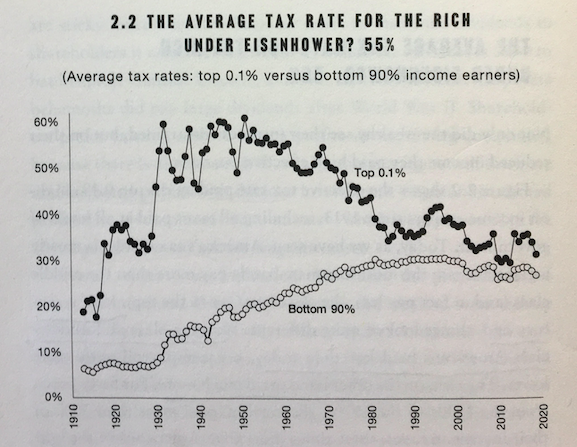
The second issue relates to the level of taxation applied to these various groups. What Saed and Zucman show is that over time this has come down, so that now the amount paid by those on the top 0.1% of incomes is very close to that paid by 90 % of the population. Indeed they show that the 400 highest earners in the US paid lower effective tax rates than the bottom 50% of earners.

The graph below, taken from their book, shows how effective taxation rates for the top 0.1% has evolved over the course of the 20th Century in comparison with that of the bottom 90%. There are three things to take away from this chart. Firstly, at the start of the last century and through to the late 1970’s taxation was essentially progressive with the richest paying a rate at least twice as much as the vast bulk of the population. Secondly, from 1980 taxation rates became essentially flat.  In other words the rate of taxation on fortunes and pittances were not that far apart. Third, from the start of the 1930’s through to the late 1970’s the average rates charged on the top 0.1% were high not just in comparison to the 90% but also high in absolute terms.

The high average rate which takes account of all taxes, some of which are regressive, was driven by some vey high progressive Federal rates. In 1944 the top marginal rate of the Federal income tax was 94% on incomes of $200,000 or more, equivalent to a salary today of £6m. 

One of the key conclusions Saez and Zukman want to drive home is that rates of taxation are not cast in stone. It is not a case of ” ’twas ever thus.” Far from it. There were times when taxation rates were very high and when avoidance was minimal. The low levels of taxation on the rich are the result of conscious political decisions coming out of contested belief systems. They could be changed.

One of the arguments against change is that such high rewards are needed to ensure a growing economy and rising GDP. However the average growth rate for the period of high taxation and lower inequality was much better than that for the period since 1980 since when growth rates have slowed. Some will argue the two things are not necessarily connected. Happy to concede that but of course it means that high progressive taxation wont necessarily undermine growth going forward.

Saed and Zukman look at what can be done in a world where sovereign states compete with one another to tax corporations less and less, and where the absence of progressive taxation, amongst other things has allowed inequality in wealth to sky rocket. They address the need to treat all forms of income  uniformly, so income from financial assets (the main source of income of the rich) is taxed at the same rate as income from employment. They explore a wealth tax and how this might work and they look at the scale of resources which could be brought into support public services that have been starved of resource for the past decade.

The timing of this book could not be better. Once Covid-19 is brought under control there will be an enormous bill to pay. That bill, like the bill for the Wars of the 20th Century needs to be shared in accordance with ability to pay. Expect much more debate about taxation in the coming years. Hopefully it will become clear that smart people pay taxes, and that smart rich people pay higher taxes than smart poor people. And the benefit of that is civilisation for all people.

The Triumph of Injustice: How the Rich Dodge Taxes and How to Make them Pay. Emmanuel Saez & Gabriel Zucman. WW Norton and Co. 2019.


Capital and Ideology

Thomas Picketty has produced another enormous tome. Like Capital in the 21st Century, it is an excellent analysis of the growing problem of inequality and comes at a really interesting time. Whereas his first work looked at the economic drivers of inequality and produced the formula r>g where r stands for the annual rate of return on capital and g stands for the growth rate of the economy. In essence claiming that the wealth of owners of capital’s income will increase at a faster rate than the growth in the overall economy. This facilitates a remorseless concentration of wealth in the hands of fewer and fewer people. In essence that book looked at the mechanics of this process. 

Capital and Ideology is a companion volume which essentially looks at how the inequality produced by this mechanism is justified. It does so by setting the process of justification of inequality regimes in there long term historical setting. He explores the transformation from, what he sees as a sort of pre-modern template for all inequality regimes, ternary or trifunctional societies, to the inequality regimes of modern unified states. 

Trifunctional sytems are those which divide society into three variously described social orders. Essentially, a clerical, a noble and a mass grouping. The clerical is the religious and or intellectual order, the noble is essentially the warrior class, and the final group is the third estate, the property-poor remainder of the population. Picketty applies this trifunctional analysis to an enormous canvass. Ranging across a number of European civilisations but also, India, China, Iran and others. He sees this system of distinctions as the oldest and most common type of inequality regime.

His analysis is aimed at showing how the trifunctional historical roots of different societies shape the changed circumstances of inequality and continue to echo in the forms of justification used today. Throughout there is an impressive wealth of historical data and analysis. 

Picketty also looks at how the “age of exploration” and imperial dominance impacted the shape of the global economy, the emergence of the modern centralised state and a new template to support the new inequality regime. A template structured around the deification of property ownership. Under trifunctional regimes there was an overlapping of property rights and regalian powers at the local level. In other words the local baron owned the land, defended it, taxed it, maintained order and dispensed local justice. The emergent modern age was organised around “a strict separation of property rights, ostensibly open to all, and regalian powers, a monopoly of the centralised state.” 

This model persisted through to the beginning of the 20th Century when three challenges arose causing a crisis for the ownership model founded on private property. The three challenges were around, growing inequality within European ownership societies; inequality amongst countries as colonial competition and increasingly powerful independence movements contended; and finally a nationalist and identitarian challenge which reinforced competition amongst European powers with the consequences of economic collapse and two world wars.

All of this led to a different view of property and willingness to redistribute it as an outcome of conscious public policy. A massive reduction in levels of inequality resulted with the advent of social democratic movements across the world, building upon demands from the 19th Century for wider franchise and greater state support for the unemployed and the old. Accelerating the creation of social states with substantial public services and economic and industrial engagement by governments. The New Deal in the US, the National Health service are just two, albeit shining, examples of how the needs of the majority of the population started to be met.

In truth the first two parts of the book are building up to this point and the last three are an analysis of how the period of classist, social democratic politics after the end of World War 2 consciously addressed the issue of inequality and created a trente glorieuses where the living standards of millions in the west were increased beyond any historical precedent. It then analyses the period from 1980 when a new model of Hypercapitalism evolved through the twin processes of globalisation and communications technology innovations, and the new justificatory regime which supported this model. One dressed in notions of equality of opportunity, set in a context where the levels of wealth concentration are returning to levels last seen in the gilded age of the robber barons.

This is a political economy history book but focussed very much on the here and now and critically the ideas and ideologies which have created and sustain the world we live in. By setting these in a historical framework Picketty aims to show how what exists at the moment as the economic reality is contingent and can be contested, but more importantly can be changed. The book does not just analyse the world but aims to change it. Picketty sets out what can be done via progressive taxation of all sources of income and wealth to reduce unsustainable levels of inequality. He addresses the issues of tax avoidance and secrecy regimes; the problem of European unity; the beggar my neighbour race to the bottom of corporate taxation; inequality in educational opportunity and much more. The book does not lack ambition.

By bringing into the public consciousness the experiences of the past, where, for example, property rights were so sacrosanct when slavery was abolished it was the slave owners who were compensated, it provides depth  and shade to many contentious issues of the hear and now.

This book is very much a marathon but one where you are running through the pages of history brought to life in limid prose and substantial detail. Acres of statistical evidence are marshalled and reveal trends in the longue duree which impact now on the issues shaping national and international political debate. They are deftly handled by a writer at the top of his game. Dissecting ideologies and debates of the past and illustrating how they continue to be evoked in political debate. Like a marathon the work is daunting at the start but on completion there is a real sense of elation. I have every confidence there will be those who profoundly disagree with it and I am certain some of the arguments are contestable, however, as a catalyst for change it is unrivalled.

It would be fascinating to hear what Picketty has to say about the political economic implications of Covid-19 as I suspect they may provide a catalyst for much more profound change than anything we have seen to date.

It is said that those who fail to study history are condemned to repeat it. Picketty is doing his best to help us overcome this failure. Help him. 

“Capital and Ideology” Thomas Picketty. Belknap Harvard Press 2020.