What is the End Game for Netanyahu?

There has been a narrative about Prime Minister Netanyahu’s war aims and how they are shaped by the religious-right members of his cabinet. One which presents him as something of a hostage to their extreme demands. In parallel with this is the view that he is desperate to remain in power in order to delay the case against him relating to fraud, breach of trust and accepting bribes. This creates the impression that his personal legal woes are to a great extent shaping his approach to the War in Gaza and elsewhere.

It is almost certain that PM Netanyahu has an eye to his personal legal jeopardy. He may feel that victory in a war against Hamas would make hims so popular that no Israeli court would be able to find him guilty of the charges he faces. I’m not sure I would bet on that, however.

When PM Netanyahu appointed his current cabinet it was said to be the most right-wing in the history of Israel. However, the bar for this was set by PM Netanyahu himself. According to Ian Black in his work “Enemies and Neighbours” when Netanyahu formed his first government in 1996 it was “the most right-wing coalition in Israeli history.(pp349) And at the time he pledged to support the “pioneering settlement” of Eretz-Yisrael, making good on this promise by lifting the restrictions on settlement that the previous Labour Government had imposed.

PM Netanyahu is not a hostage to the religious right, he shares their expansionist view of the future of Israel and is very clearly an active promoter of their aims.

This brings us to the Prime Minister’s war aims. These were clearly articulated in a speech at the start of the military campaign as being about, 1) bringing home the hostages, 2) destroying Hamas. But in the same speech he also spoke more broadly about “changing the Middle East”. What these words meant was never specified at the time but they are starting to sound, and look, as if they related to a war aim as fundamental as the other two.

After the precision carpet bombing of the whole of Gaza there are signs preparations are being made for what happens when the war ends. Various corridors are being established which it is said will be used to divide Gaza in ways which will make it easier to control and so prevent Hamas regaining any foothold in the area.

If this were the case the picture of life, for remaining Palestinian civilians would look bleak. Their movements would be further constrained between secure areas within the largest open prison in the world. The practicalities of life within this context would mean its very viability as a place to live would be questionable. Which of course some on the religious-right in Israel may regard as a happy “unintended consequence” of their need for effective “self-defence”.

However, in the North of Gaza steps might be being taken for an even more radical solution. A corridor, or new military dividing line, is being developed to separate an area in Northern Gaza from the rest of the territory. Its ostensive purpose, according to the IDF, is to trap Hamas in a confined area with no means of retreat or supply. This is the area which the Israeli government through the IDF have ordered all civilians to leave on pain of being treated as hostile combatants if they remain. An area into which it was suggested no foreign aid would be allowed, nor water of power, on the basis that there would be no civilians to need it as it would simply be a battle zone.

Some rhetorical retreat from that has occurred however any aid that does get into the area is woefully inadequate and fears that starvation and the lack of any medical facilities or medicines will lead to further significant loss of civilian lives.

This area in the North is subject to significant clearance. A process which some fear may be followed, at some stage. by a new programme of settler development. This would mean the permanent loss of the area, thus reducing the size and viability of Gaza even further. It would be a brave person who would take a bet that this will not happen.

Indeed, this scenario is leading to fears amongst neighbouring Arab states that they may well face a massive refugee crisis in the not too distant future. A crisis caused by Palestinians fleeing from a non-viable and hostile Gaza and West Bank.

The Israeli government denies this as a war aim. If they are honest in this assurance, it still leaves open the possibility that their practice of “self defence”, in the long term, has the “unintended consequence” of making everyday life so intolerable that it drives the Palestinians out of Palestine.

The US and the UK have access to detailed satellite imagery, military strategy experts, intelligence reports and a whole lot more information than is in the public domain. Perhaps this all supports the Israeli contention that their acts of defence are within International humanitarian law. Further, they remain focused on their original and limited aims of getting the hostages back and destroying Hamas.

From outside it does not look like this. What is happening, right now, in the occupied territories is unspeakable. It is being called out by a number of western institutions including the UN and the International Court of Justice and a range of NGO’s operating in the region. And yet our government and that of the United States are not taking decisive action to prevent what is happening.

What is happening in Palestine is already having far reaching implications. The dramatic collapse of Assad’s Syrian regime is the result of many factors, however, the weakened position of Hezbollah in Lebanon will have played its part.

If it turns out that this is a second Nakba PM Netanyahu may well achieve his objective of “changing the Middle East”. However, it might not be for the better for the Middle East, or, indeed in the long term for Israel.
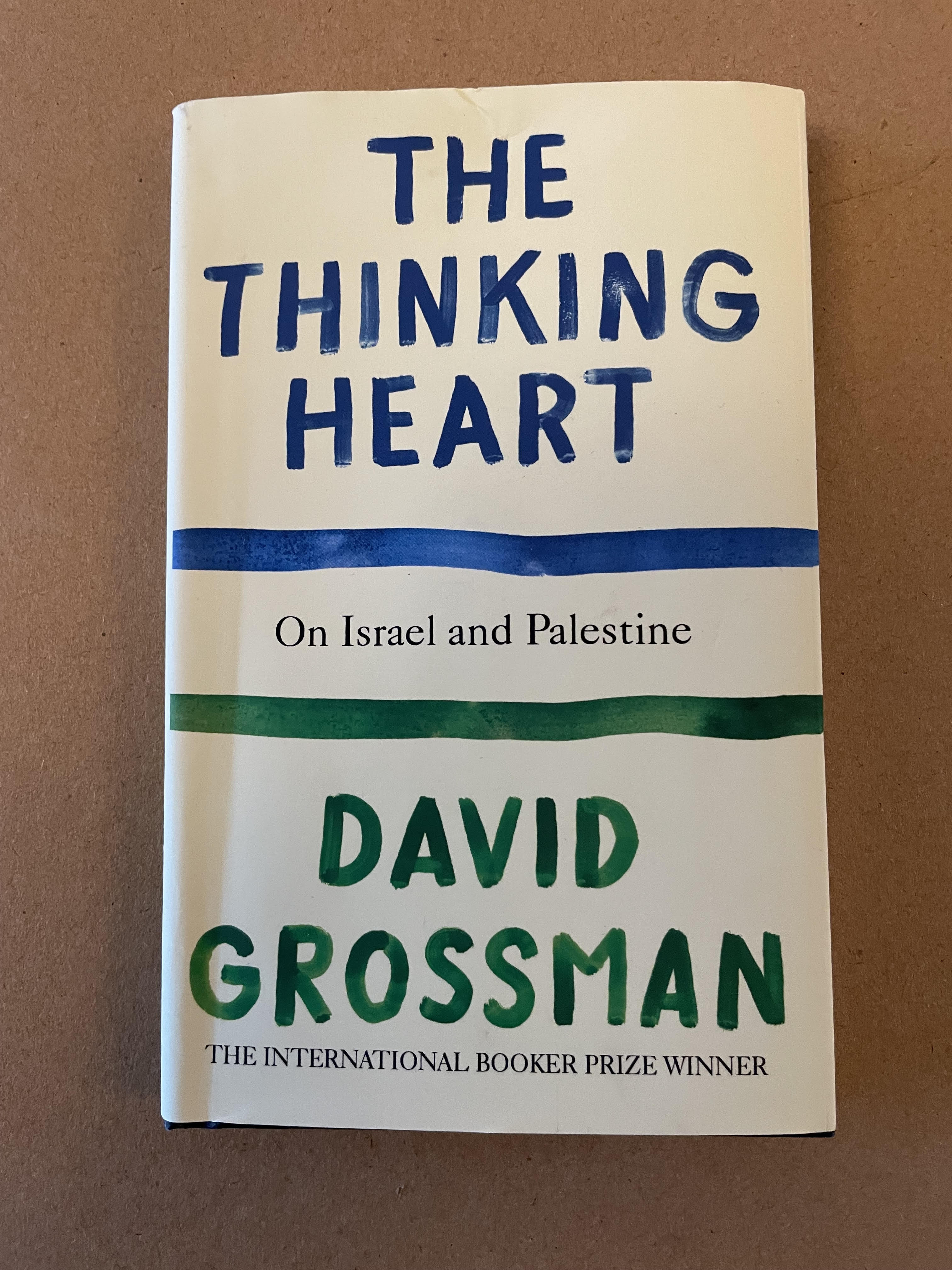
David Grossman: A Voice for Peace in Palestine

This is a collection of articles and speeches by novelist David Grossman, winner of the 2017 International Man Booker Prize. They span a period from July 2017 to June 2024, obviously taking in the barbaric attack of 7 October 2023. The book is a mere 87 pages long and exceptionally well written. It provides an intelligent and humane analysis of the problem of a just peace in Palestine, something Mr Grossman has spent decades campaigning for. It is a testament to his commitment that, despite the medeival horrors of 10/7 he remains convinced that “…it is impossible to begin resolving the Middle Eastern tragedy without offering a solution that alleviates the Palestinian’s suffering.”

His critique of Prime Minister Netanyahu is searing. He is equally critical of the ulta-Orthodox religious right who have a inappropriate and disproportionate say in the politics of the State of Israel. Promoting Eretz-Yisrael or Greater Israel, an area which has a number of definitions but certainly encompasses the current State of Israel, and the Palestinian Territories. It is this aspiration which “legitimises”, in their view, the settler movement in the West Bank and current demands for the same in Gaza.

Mr Grossman describes the Judaism he connects to as “…secular and humanist. It has faith in human beings. The only thing it holds sacred is human life.” You can imagine how acceptable this definition of Judaism is to those of the religious right who call for the State to go to War for a Greater Israel but “…refuse to send their own children to military service because, according to their faith, praying and studying Torah is what guarantees the continued existence of the Jewish people…”. Their single minded labours aim to preserve the purity of their contested view of the faith which sees God as being in the real estate business and having promised them the land of Palestine 2000 years ago.

What is interesting about the book is how it charts the growing stranglehold of PM Netanyahu and his actions to undermine, not just the rights of the Palestinians in the Occupied Territories, but also those of Arab citizens within the State of Israel. Mr Grossman sees all the actions of the Netanyahu government as being focussed on keeping alive and raw the wound that is the relationship between Israel and its Arab citizens and those in the occupied territories. He characterises the Nationality Law of 2018, which defines Israel as the nation state of the Jewish people and reserves the right of self determination to the Jewish people alone as a “…renunciation of the chance to ever end the conflict with the Palestinians.”

The articles in this collection remain optimistic and chart the growing internal opposition to Netanyahu. The demonstrations and marches against his attempts to consolidate his power and limit the rule of law were particularly vocal in the run up to 10/7. Despite the horrific terrorist atrocities of that day Grossman remains committed to negotiations and a move to a two state solution as the only viable route to a lasting peace.

Beyond this however Mr Grossman provides an insight into some of the psychological and other fears which shape Jewish thinking. Fears which certainly cannot be dismissed as irrational and which have an equal right to be addressed and must be part of any comprehensive solution in Palestine.

First among these fears is the pervasive view of the provisional nature of the State of Israel. Interestingly, this is not just seen as something driven by the hostile military objectives in the Hamas Charter of 1988 unabated in the eyes of Israel by the substantial revisions to that Charter in 2017, nor in chants about a Palestinian state from the Mountains to the Sea.

But more subtly than these attacks are the seemingly positive comments of supporters like the oft repeated formula by American Presidents that the US supports “Israel’s right to exist”. This phrase, although it challenges the opposite, subliminally concedes the possibility that such a right is not a given.

Another related but distinct issue is the attacks on Israel by its enemies. The objective of their campaigns against Israel is not simply to win a war against the Israeli state it is to abolish the state altogether. As Mr Grossman puts it “…Israel is the only country in the world whose elimination can be openly called for.” At the extreme end of this view is the antisemitic desire to eradicate the Jewish nation and people not just its state.

Mr Grossman asks the fundamental question, “Why is Israel – of the planet’s 195 countries – alone in being conditional, as if its existence depended on the goodwill of the other nations of the world.”

Mr Grossman also rejects the “intolerable”attempt to “…force the Israeli-Palestinian conflict into a colonialist discourse.” Arguing that colonialism can only be carried out by external nation states, and that as Israel does not have a state elsewhere it cannot be engaged in colonialism.

You can see why a people who have been persecuted and discriminated against in countries across Europe and beyond, and been subject to the most extreme attempt at industrial genocide the world has ever seen, would be extremely nervous about losing the safe haven of a nation state. This nervousness may at times become an existential panic resulting in a violent and disproportionate response to any form of challenge, perceived or real.

There are elements of Mr Grossman’s position that could be challenged. Being by far the most powerful military force in the region, the only one with a nuclear weapon capacity, and having the might of the United States foursquare behind it should allay some of the fears of its “provisional” nature. It is also the case that the vast majority of the nations on the planet recognise Israel as a legitimate member of the community of independent states.

Some of that sense of provisionality may stem from the manner in which the State was first established. One might argue this was by, “…the goodwill of the other nations of the world…” first in the actions of the League of Nations and secondly in the United Nations. Obviously, there were a range of other forces in play, not least the manouverings of declining imperial powers, notably France and Great Britain. Whatever its origins the world must, and in the vast majority do accept, the legitimacy of the State of Israel.

I fear the rejection of the colonialist model as applied to the actions of the Israeli State depends on an essentialist definition of colonialism relying on the preexistence of a colonialist state elsewhere as the aggressor. Whilst this might be a part of the definition there are key elements of the colonialist model, in the eviction of a preexisting peoples from their home lands and the repopulating of those lands by people from elsewhere which prima facie looks like it could be applied to the actions of the State of Israel.

Whilst there are parts of Mr Grossman’s argument which could be open to challenge, the tone and thrust of the book is exceptional. His analysis of the direction being followed by the current administration under PM Netanyahu is well-informed and trenchant. Despite the brutality of 10/7, Mr Grossman still argues for a negotiated settlement and a two state solution. In the end it is probably only this which will end the constant fear of the Israeli people about the provisional nature of the State of Israel. It is a book which everyone concerned about the current tragedy of Palestine should read.

The Thinking Heart. David Grossman. Johnathan Cape London 2024.

Gaza Buffer Zone: Impact on Population Density

Early on in the conflict in Gaza Israel unilaterally decided to create a buffer zone stretching from the top right hand corner of Gaza ie. the North East corner by Beit Hanoun down to the Egyptian border. A distance of approximately 48 kilometres. The zone would be 1 kilometre wide so would steralise 48 square kilometres of Gaza territory.

Gaza comprises 360 square kilometres per the CIA World Fact Book which also records a population in the Strip of 2.1m people. This works out at 5,833 persons per square kilometre (ppsqk). This slightly more than London at 5,608 ppsqk but less than Tokyo at 6,362 ppsqk. When the 48 square kilometre’s are taken off however Gaza’s populations density increases to 6,730 ppsqk exceeding that of Tokyo.

Of course the Gaza strip is not a City it is a… territory. If you were to compare with a nearby country, say Israel the population density there is circa 400 ppsqkm.

The reason for the buffer zone is to protect against another 10/7. But there is currently a 20 foot high fence around the whole of Gaza and a blockade of its coastal waters. Will a kilometre wide buffer provide greater security? Or will it just reduce further the land available in the occupied territory?

Bad and Badder, Dumb and Dumber

The Conservative leadership process has whittled the runners down to two. This may be as a result of an incompetent attempt to game the process or it may be the will of the Party but the two candidates are vying with each other to appear farthest to the right. The continuous drift in that direction over the past decade has resulted in a number of bizarre decisions. With “One Person Toryism” exemplified by Boris Johnson removing the whip from such giants of “One Nation Conservatism” as Michael Heseltine and perhaps culminating in the appointment of Liz Truss as Prime Minister. Someone whose blind ideological fervour was only excelled by her gross incompetence and lack of personal insight.

At one time this drift to the right would be seen as a strategic mistake. The orthodox view being that there were bedrocks of political support on the right and the left and in order to win, parties had to extend their appeal as far as possible in the direction or their opponents to secure the floating voters who would determine the outcome of the election. This had a moderating effect preventing parties drifting too far away from the centre ground.

It may be argued that this balancing process reasserted itself at the last election. However other “theories” are available to explain this landslide shift. The “pendulum theory” which suggests the electorate just feel its time to give the other side a go. A theory based on young children’s universal appeal to fairness when they have not “had a turn” on the bouncy castle yet. Another is that a party which has been in government for a long time has “run out of steam”. They are “exhausted” and unable to come up with new ideas to address the evolving challenges they face. Again it relies on an analysis which simplifies and anthropomorphises a complex social/political reality.

My own guess is the main driver of the last election was, above all, the complete lack of credibility of the Tories, informed by their spectacular incompetence in managing, public services, the economy, a global pandemic, the national finances, in fact, pretty much anything they turned their inattention to.

Supporters of the Labour party may rejoice at the options being put forward for the Conservative Party leadership. They may feel the option of bad or badder for their opponents is a positive thing as both candidates seem set to push the party further away from the “centre” where elections are supposed to be won.

This view may be too optimistic. If we look across the Atlantic we have in the Republican Party a situation which could be characterised as dumb and dumber but none the less may have a winning strategy. A strategy based on moving the bedrock.

Donald Trump is certainly not the sharpest knife in the draw. His record demonstrates he does not have the moral insight, the intellectual capacity nor the personal interest to address the fundamental problems facing the United States at the moment. His shortcomings are well documented and largely come out of his own mouth.

He does have one real strength however. He has, inadvertently, acted as a lightening rod for the broad discontent which has been building across America for at least the last two decades, but with roots going much further back. The growing awareness that the age of the American Dream has passed and the sense that history might be moving East has created a level of uncertainty about the future which has not existed previously for many Americans. Whilst the Dream may never have existed as promoted, there was a long period of sustained and significant growth in the US which meant it was normal for parents to expect their offspring to be better off than they were.

The tectonic plates of growing inequality, a concentration of economic power and willingness to use this to exercise political influence/control, ignored by both Republicans and Democrats, began to reveal themselves in tensions and fissures in the body politic. This process exploded into sharp relief in the earth shivering event which for short hand was called the credit crunch in 2007/8. The credibility of the political elite was significantly undermined by its response to this crisis created by the purely profit motivated innovations of the banking and wider financial sector. To address the rapidly building catastrophe Main Street was sacrificed to Wall Street. Millions of hard working Americans lost their homes and their life savings whilst the banks were bailed out.

Prolonged austerity, “difficult decisions”, technological change and globalisation seemed to be leaving huge numbers of Americans behind. Low wage, short term jobs replaced the blue collar jobs that had sustained decent lifestyles for millions, their circumstances becoming increasingly challenging and, indeed, desperate if any members of the family fell ill. A widespread feeling they were the victims of processes they did not understand but a strong feeling of unfairness, being ignored and left behind.

Fertile ground for someone to come along with slogan simple solutions. Particularly, ones which focused the blame on foreigners in general and immigrants in particular. This approach has manifest risks both for the United States (indeed their very unity) and the wider world given the pivotal role the nation plays in global economics and diplomacy.

To blame the current problems of the United States just on Donald Trump, even accepting the wide range of personal failings he suffers from, is unfair. The leadership of the conservative right in the US has to accept a substantial proportion of the blame. They have remained dumb when some of their number have turned their back on bipartisan politics and the conventions which resulted and sustained that approach. The refusal of a Republican Senate to confirm appointments to the Supreme Court of the sitting president was a particularly egregious example of this, which happened before Trump was elected.

When you start down this road you are faced with having to rationalise and make sense of statements and policy proposals which are incomprehensible, inconsistent or even contradictory. A lot of very clever people have to race around trying to minimise the damage being done. Ultimately you end up having to support a convicted felon as your candidate for the White House.

Remaining dumb in the face of a clearly unqualified candidates ramblings, or “weavings”, results in a spiral into a realm of dumber and dumber actions which may have existential implications not just for the United States and not just for countries around the world but indeed for the future of the planet.

The party political system has many functions. One of its key functions in the past has been to train and develop political leaders. And, perhaps more importantly to winnow out those who are simply incapable of doing what is a very difficult task. On both sides of the Atlantic the parties of the right have failed in this critical function. Their desire for power has overwhelmed all other considerations. Leaders and political policies have become judged first and foremost on whether they will secure power not whether they will contribute to the welfare or wellbeing of their citizens.

Such a value free environment is set I fear to end badly. Conservatives who should and probably do know better need to stand up and be counted. Easier to propose than to do. Liz Cheney, a person of impeccable right-wing conservative credentials took a very public and brave stance against Trump and paid the price as her party turned against her and ousted her. Indeed there are many Republicans who have made a stand but the Republican party machine is so much in awe of Trump’s ability to shift a bedrock of voters that they continue to boost his credibility by backing him.

Going back to the theory about how the floating voters in the centre of politics are a reassuring stabiliser against extremist positions. This mechanism breaks down if the bedrocks of political support move and the centre ground is shifted to the right or indeed the left. What The Republicans have done in the US has been to shift the centre to the right. This process has been going on for many years however it became supercharged when Donald Trump came to dominate the political landscape. His character, or lack of it, has raised the stakes significantly. His challenge to the rule of law, constitutional conventions, the very notion of rational argument and, indeed, any view of the world other than his own has changed the very nature of politics.

This same process of the centre right being undermined from the far right is evident in the the United Kingdom but has not had a character as egregious as Trump to supercharge it. However problematic they are bad and badder do not constitute the same level of threat to democracy as the dumb and dumber issue that the States face… yet.

It may seem odd for someone on the left to be concerned about the health of the right. However, democracies have to be based on compromise. There needs to be a broad degree of agreement of what is acceptable and what the aims of government, in the broadest sense, are. When this breaks down, whatever the longevity or sophistication of its institutions and conventions might be, democracy is at risk. When this is combined with an unstable demagogue much worse may happen. If Donald Trump is elected in November the Republican Party will have to take responsibility for what follows. They may regret this for a very long time.