
“Sudden death syndrome”

Alexi Navalnay’s mother has been told that her son died of “sudden death syndrome” (SDS). Alexi would appear to be the latest victim of what seems to be an a growing epidemic of this unexplained cause of morbidity.

It appears that genetics may play a part as it seems to be mainly Russians who suffer from it although there have been non-Russian cases also.

Those researching the disease have noticed it seems to be related to those with an underlying case of “democracy” which itself appears to be quite a healthy syndrome. In fact it is estimated that there are millions of Russians infected with this but do not exhibit any systems publicly and can thus live to a ripe old age.

The problems begin when individuals present with outward signs of democracy. This seems to mark the onset of SDS which, initially may not be fatal. Those with limited symptoms who occasionally parade them in public can suddenly be struck down with severe pains to their back, head and other parts of their body which some have described as like being beaten with a base ball bat.

Others who have gathered together with fellow sufferers have complained of a severe burning sensation in their eyes and nose leading to real difficulty breathing. Often this is accompanied by the pains mentioned above.

Victims who exhibit persistent symptoms of democracy are often taken to local treatment centres and treated with electric shocks and cold baths. This sometimes works although it may leave the victim with long term medical and mental issues and an inability to secure employment. Ironically, in many cases the treatment can lead to an even more virulent version of democracy.

The most unfortunate cases are those where their infection becomes widely known and they become a real focus for the spread of the disease. These individuals are taken to remote, specialist treatment centres. The centres are often in very cold climates presumably as part of the process of attempting to contain the disease. Sometimes individuals need to be kept in total isolation so as to prevent the possibility of cross contamination with other patients or indeed staff at the facility.

It is when individuals exhibit these advanced symptoms of democracy that they become at risk of SDS. At this point the pathology becomes completely baffling as it seems the final step can be triggered by the most mundane of events. Those recorded to date include: catching ones leg on an umbrella, drinking a cup of tea, opening the front door of ones home and various versions of lead poisoning. Some sufferers seem to have to take matters into their own hands by blowing themselves up in their cars or leaping out of apartment windows.

Victims can be struck down in their homes or in the street, within Russia or abroad. They seem to often be subject to an attack in a pubic space, say, somewhere like outside the Kremlin in Moscow.

Occasionally a victim will exhibit symptoms but survive the initial episode. Following this they may be subject to forced removal to a special facility to be helped. Sadly, the victim may still succumb to SDS which may be triggered by something as innocent as a walk in the forrest.

Fortunately, much work is being done by those at risk of the syndrome in attempting to identify how the malignant transformation of benign democracy into malignant SDS occurs. There seems to be a growing understanding of the pathology of the disease and specifically the primary agent causing the transformation. The problem they are wrestling with at the moment is how to eradicate that agent once and for all. We must all wish them luck with that work.

Ed. The above is as credible as any previous explanation of the death of opponents of Vladimir Putin and in the current case, given the previous and various attempts on his life, more credible than any statement that has or will come out of the Kremlin on the matter. According to Wikipedia, in Mein Kampf Hitler talked about the source of the credibility of the colossal lie as being the fact people could not believe that someone “could have the impudence to distort the truth so infamously”. Clearly Putin has taken this lesson to heart. Whatever happens leaders in the West need to remember this particularly if the unthinkable happens in the United States next year.

One can only hope there is a circle of hell in which Putin spends eternity waking up each day to the knowledge that he will experience a new version of SDS and that it will be worse than the day before.
Democratising Democracy

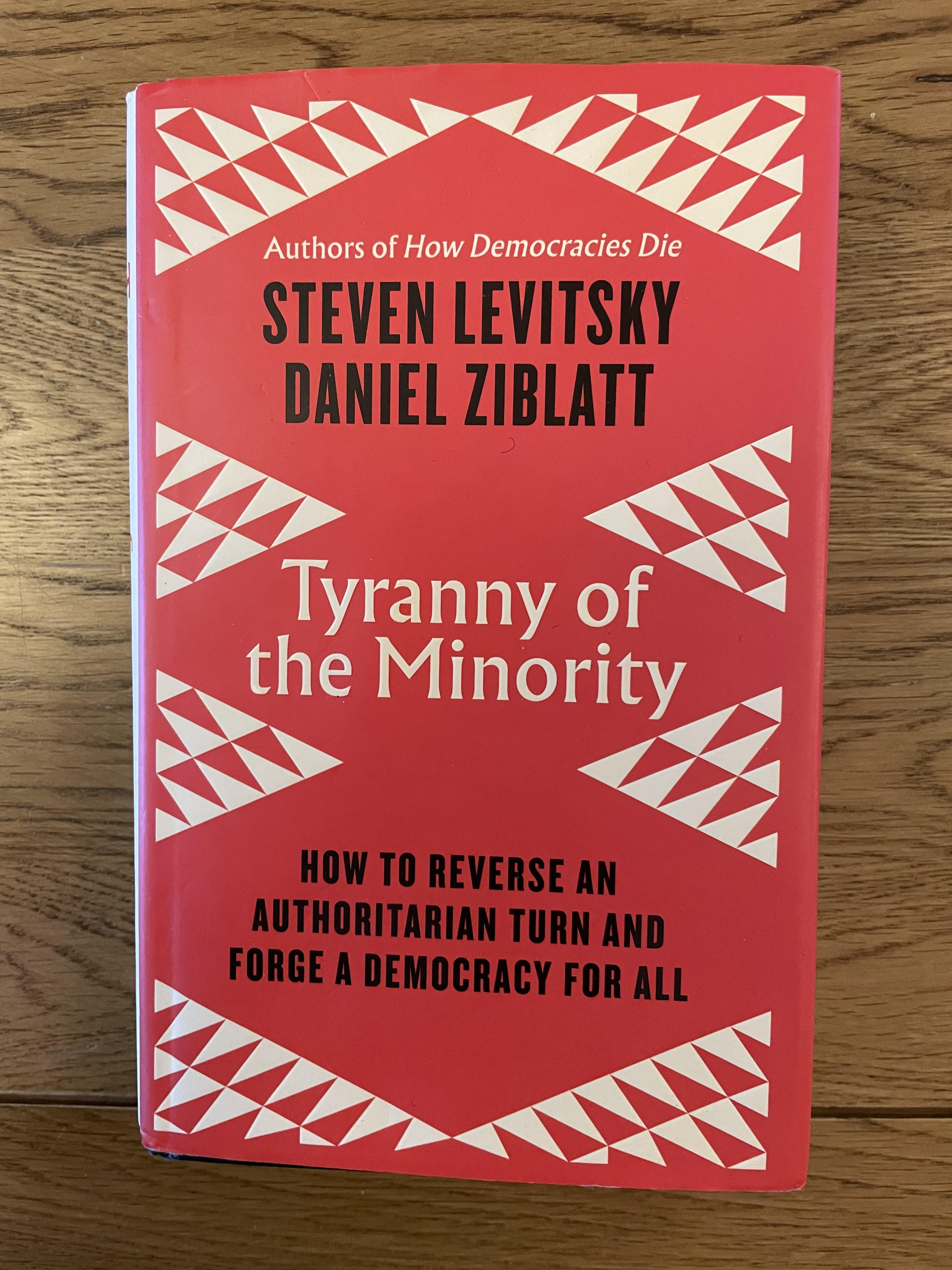
Given the current state of US politics this book is incredibly timely. It builds on and develops themes set out in their earlier work “How Democracies Die” published in 2018.

They begin by identifying the way in which “strongmen” leaders, once elected turn the institutions of democracy against itself. Creating laws which seem to be general but are actually aimed at undermining opposition. Playing “constitutional hardball” by manipulating the dead letter of the constitution to kill its living spirit.

Critically such leaders are facilitated by those who may previously have played by the democratic rules of the game, and indeed protest that is what they continue to do, whilst actually supporting actions which are the classic actions of wannabe dictators.

Undermining the independence of the judiciary is one of the key actions in the despot’s playbook. An example of this was the refusal of the Senate Republicans to allow Barack Obama to appoint a Supreme Court Judge in his last year in office. Whilst all done strictly legally it went against a 150 year old precedent that no Senate ever stopped an elected president from filling a Supreme Court vacancy.

In essence the Tyranny of the Minority is about the way the checks and balances established in the US Constitution, written in the 18th Century, have become all check and no balance. Worse the checks work in a partisan manner tipping the balance of institutions towards the Republican party. Shifting a constrained majority rule towards unconstrained minority rule.

They point out that the US Constitution is treated more like the Tablets of the Laws handed down by an omnipotent being rather than a political document forged in compromise at a time where the very existence of the nation was under direct threat. They compare it as the oldest written democratic constitution with that of Norway, the second oldest.

The US has been amended its constitution 27 times since its ratification in 1788. Of those amendments the first ten were ratified together in 1791 becoming known as the Bill of Rights. The last amendment was ratified in 1992. By way of contrast the Norwegian Constitution was amended 316 times between 1814 and 2014.

The limited amendments to the US Constitution was not through lack of effort. Since its adoption there have been 11,848 attempts to make amendments. Why the difference? Because the US Constitution is very difficult to amend. It requires a a two thirds majority in both the House and the Senate and then be ratified by three quarters of the States. In Norway a two thirds majority is required in two successive parliaments but that is it.

Does it matter? Well when the US Constitution was adopted America was a predominantly agricultural and rural society. Slavery was still in place and was reflected in the Constitutions “three fifths clause” which meant slaves counted for legislative apportionment despite their having no rights whatsoever. Whereas Norways Constitution has evolved to address a radically different social, economic and political environment, the American Constitution has not.

Checks which were baked into the constitution consciously to protect against tyranny by the majority have over time evolved into mechanisms which tend to support tyranny by the minority.

The credibility and legitimacy of any democracy depends on state authority being exercised by those that secure the majority of votes. Genuine checks and balances and the occasional change of administration of provide for a process where ruling parties respect the interests of those that did not vote for them. However, the system must be seen as a level playing field and when someone wins they must be allowed to govern.

Levitsky and Ziblatt see the current stalemate in American politics where effective government is impossible as caused by two key problems. First the manipulation of the electoral system which has now reached such proportions, with the collusion of a super-conservative Supreme Court, that it effectively disenfranchises significant numbers of people from specific groupings. Most notably black Americans.

The second issue is to update a number of Constitutionally embedded institutions to ensure that they produce a more democratic outcome than they do at the moment.

Amongst the change they propose a key one is a constitutional amendment establishing a right to vote for all citizens. Who knew this was not in the Constitution? This would be accompanied by the restoration of Federal level voting rights protection. In effect reinstating the 1965 Voting Rights Act which wqas eviscerated by the Supreme Court 2013.

They also propose that electoral administration should not be within partisan political control. Rather an independent electoral administration should be established with non partisan officials. In parallel with this there should. be the equivalent of our independent boundaries commission to prevent the often egregious examples of gerrymandering.

Other key institutional changes include abolition of the Electoral College. In a modern democracy those that get the majority of the popular vote should become leader. The Electoral College means this is often not the case.

Reform of the structure of the Senate which provides two senators per State irrespective of the size of the State. This builds in a rural and agricultural bias which is significantly out of line with and an urban industrial/post industrial nation. Something which more accurately reflect the size of the population of States.

Abolition of the Senate Filibuster. This mechanism which means that 40 out of 100 senators can prevent any proposed law getting on to the statute book however big a majority it received in the House of Representatives and however popular amongst voters.

Establishing term limits for Supreme Court Justices who currently serve for life. Appropriately structured this could ensure all presidents get to appoint the same number of Justices in their term in office. This woudl avoid the situation as now wher there is a super conservative majority in the Supreme Court which is manifestly out of touch with majority American opinion on many issues.

Finally, and possibly the most crucial proposal is that the method of amending the Constitution be made simpler by removing the requirement for any amendment to secure ratification by three quarters of the individual States. This would bring it into line with most modern democracies and provide for the Constitution to become living document growing with its people, reflecting more accurately the needs of a modern polity.

There are a range of other proposals put forward by Levitsky and Ziblatt but these give an indication of the depth of change they are proposing and also the difficulty such change might face. It is a really well argued case and given the recent experience of the Disunited States particularly between 2016 and 2020 it is an important one.

Political paralysis undermines belief in democracy with potentially extreme consequences. It is clear something has gone wrong when the almost certain Republican candidate for the presidency encourages Russia to attack treaty allies.

If I have a criticism it is that the analysis is very much focused at the institutional level.Whilst this is vitally important there is a socio-economic set of issues structured around inequality which need to be addressed. It could be argued that the current challenges to American democracy would have got very little traction had not civil society experienced a long period of growing inequality. Stagnation and even decline in real standards of living for many. Neglect of public services and reducing welfare provisions.

Having said this what Levitsky and Ziblatt do is illuminate critical weaknesses in the US polity which are putting its democratic future at risk. They make sensible proposals about how to address these problems. They do this with clarity and illustrate their arguments with examples from around the world and from history. It is a great book for understanding some of the structural forces underlying the current travails of the United States. The coming election probalbly makes it vital reading.

Tyranny of the Minority: How to Reverse an Authoritarian Turn and Forge a Democracy for All. S Levitsky, D Ziblatt. Penguin Viking 2023.

UNWRA

The current controversy around the United Nations Relief and Works Agency for Palestinian Refugees in the Near East (UNWRA) is dfifficult to make sense of.

On the strength of allegations by the the Israeli Government that 190 employees of the agency are members of Hamas or Palestinian Jihad and, even more seriously, that 12 of it employees were active participants in the atrocities of 10/7 some of its major donors have suspended their funding of UNWRA.

This is funding to an organisation of 30,000 employees who operate across Gaza, the West Bank, Jordan, Syria and Lebanon providing a range of welfare services including health, education and relief for people displaced by decades of conflict in the region.

More specifically it is currently engaged in providing food, water and health services into Gaza where the Israeli government’s war on Hamas has cost over 25,000 Palestinian lives and displaced 85% percent of the territories 2.2m inhabitants.

The speed with which the USA and the UK suspended its payments seemed remarkably swift. It was based on the allegations contained in a 6 page dossier which the Israeli Government would not provide to UNWRA. It is still not clear if these allegations have been independently corroborated.

It is not as if the allegations have emanated form an independent source. The allegations came shortly after the International Court of Justice found it plausible that Israel’s acts could amount to genocide in relation to its operations in Gaza. Trying to undermine the work of UNWRA might be seen as consistent with attacking the Palestinian civilian population as opposed to Hamas.

But even if we assume the allegations are eventually proved to be true. Is the response of the US and the UK appropriate?

If we add together the 190 accused of membership of Hamas and the 12 accused of engagement in 10/7 it amounts to 1.5% of UNWRA’s workforce in GAZA. Hardly definitive evidence that the Agency is systemically infiltrated by Hamas.

As soon as the allegations were made the head of UWRA preemptively dismissed the twelve employees accused prior to any independent investigation into their guilt or otherwise. Further, he referred the allegations to the UN’s Investigations Department for a thorough, Independent review of them.

Whilst UNWRA does carry out background checks on its employees, it also provides a list once a year to the Israeli government of the names of all its employees in Gaza and the West Bank.

An agency which acts in such a manner seems to be behaving precisely as you might expect and it is difficult to see what more it could do. Particularly as it is operating in a very challenging environment and has had 133 of its staff killed in Gaza since 10/7 as they struggle to support the 85% of the 2.2m Palestinians that have been displaced by the Israeli bombing.

In any circumstances a more appropriate response from our government and that of the US would be to set out their concerns and seek to ensure that a thorough and independent assessment of the allegations is carried out. If it proves to be true that 1.5% of UNWRA’s staff have gone rogue but that sensible precautions to avoid this have been taken then it should be a “lessons learned” exercise. UNWRA should set out how it would seek to prevent this in the future. This can never been anything other than best endeavours.

Only if it were to be proved definitively that the leadership of UNWRA were actively engaged in supporting the activities of Hamas should further action be taken.

But of course if UNWRA did not exist it would have to be invented. The needs of the Palestinians will not go away. Israel is not going to support them. Is Britain or America wanting to take on the role themselves?

After some very harsh words there seems to be some drawing back. The US pointing out that the vast bulk of its funding has already been paid to UNWRA. That they have money until the end of February. That the UN Investigation should be carried out in record time. Investigations that normally take months are to be completed in weeks.

It may have started to occur to the US and Britain how this is going to play around the world if relief via UNWRA stops. They will look even more complicit in the destruction of one of the last remaining homelands of the Palestinians. In a changing world this is not just morally indefensible it is diplomatically crazy.

“so it goes.”

In Slaughterhouse-Five, Kurt Vonnegut’s character, Billy Pilgrim, uses the phrase “so it goes” every time he comes across a dead body. The repetition of the simple phrase tallies the fatalities of war and illustrates how people become desensitised to death. In Gaza death must now be so familiar that people are becoming numbed by its occurrence.

For most of us the loss of a family member is a shock and source of deep sadness. Particularly intense if it is a child. How does one cope when 10 members of your family have been killed in an instant, including brothers, sisters, mothers, fathers? Worse, when the cause of that sudden loss continues to threaten your own existence.

For those removed from the conflict the rolling news coverage first shocks, then disgusts and then it risks becoming sedimented, “so it goes.”

I have no doubt that the US Secretary of State, Antony Blinken, is working hard to mitigate the actions of the Israeli government in Gaza, the West Bank, and now Lebanon. War in the Middle East would be a disaster for the global economy and for US interests. Not great in an election year.

One detects an increasingly frustrated tone in his comments about the need to protect civilians and focus on the future when Israel ends the war against Hamas. Particularly in view of the fact that Prime Minister Netanyahu not only ignores Blinken but as much as tells him that he will be ignoring him.

Prime Minister Netanyahu may be happy to risk a regional conflict. He may conclude that Israel has previously benefited at the expense of the Palestinians in such events. However, the world is a different place to what it was in the 1940s and 1960s. Prime Minister Netanyahu may be in danger of overplaying his hand.

At the moment there are two players only who can stop what is happening in Gaza. One is Israel. A right-wing prime minister held hostage from the extreme right in a country where many ordinary Jews feel properly aggrieved at the murderous events of 10/7, does not look like a place to find compromise.

The only other player is the United States who could apply pressure through the $3bn per annum military aid it provides to Israel. So far Secretary of State Blinken does not appear to have even threatened to use that leverage in public. We don’t know what he might have said privately. But whatever he has said does not seem to have impacted much on the Israeli government’s plan of action.  

As I have said previously, when this does stop, it is very likely to look like an exercise in ethnic cleansing, whatever the intention. Further, it is going to be difficult for the US and the UK to look shocked and surprised at what has happened. Their credibility in future negotiations with Arab partners after the bombs stop will at best be threadbare.

However much the Palestinians in the West Bank are chased around the strip by bombing campaigns, at the end of the day, they are still going to be there. That reality should be front and centre of any government’s thinking about long term security and screams the need for significant compromise by Israel if they want peace.

Apart from a brief humanitarian pause to secure the release of some of the hostages abducted by Hamas there has been a pretty much continuous campaign of bombing in Gaza. From the start there have been civilian casualties.

On 10/7 around 2,300 Israeli civilians were killed, “so it goes”. Some 240 Israelis, mainly civilians, were abducted, some of whom have since been killed, “so it goes”.  More than 250 Palestinians have been killed in the West Bank, “so it goes”. Palestinian deaths in Gaza are well in excess of 20,000, “so it goes.” Of the 20,000 killed, around half have been children, “so it goes”.

The scale of death in Palestine is mind numbing. In three months roughly twice as many civilians have been killed in the Palestinian territories than in Ukraine during almost two years of war, 10,000 Ukrainians, 20,000 Palestinians.

In neither case should we, or more particularly our political leaders, succumb to the dehumanised response, “so it goes”.

However powerful the justification for Israel taking action against Hamas originally, the scale of civilian deaths has undermined the moral force and validity of its campaign. Increasingly the reference back to 10/7 looks more like a rationalisation for something altogether different to a war against Hamas.

If there is no material action taken to apply pressure on Israel to curtail its programme of mass destruction in Gaza there will be no excuses for those that failed to act. The fundamental moral position they have taken will be captured in three words, “so it goes.”