Clutching at straws

The election of Donald Trump is an unmitigated disaster and every part of me thinks it will  have far reaching and devastating consequences over a wide range of issues. Women’s rights, race relations, the middle east to name but a few and global warming to name the, potentially, most significant. However I am an eternal optimist and I have been trying to think of some positives. There are not many and I may well be clutching at straws however here goes.

First, the respect for the democratic process evidenced by Mrs Clinton and President Obama were exemplary. The call to concede the election, the plea to followers to get behind their new President Elect, and the commitment to do everything to ensure a smooth handover ware all examples of tremendous political discipline. I freely confess I would have struggled. Even Mr Trump responded to the power of the moment and talked with respect about Mrs Clinton, the President and about the process of hand over. All this demonstrates that the notion of democracy remains an element of social capital with significant power and force.

Second, whilst Mr Trump may have been a Republican in name only he clearly now has considerable support from that party which has control of Capitol Hill. It will be difficult to hide behind an argument that says I would have done it if “they”, The Senate and/or the House of Representatives had not stopped me. It also means, if there are Republican Senators who see the benefit of Obama Care but have previously adopted the rhetoric of repeal they are now going to get what they might not want.

Third, many have elected Mr Trump because they think government lacks the expertise of businessmen to run it and the economy. If Mr Trump does bring to bear his business prowess we may get an object lesson in the differences between running a business or household, and running a national economy. “Tightening belts” and “living within means” are great homely soundbites but have little relevance in a discussion about macro economics. (Paul Krugman has written convincingly about this although I accept the argument plays to my prejudice.) He may also find that there are things about political processes people complain about but would not like to lose. Everyone complains about bureaucracy but no one wants planning decisions to be made on the basis of payments, threats or whim. We can hope that his experience helps people see it is a category error to see government and business as in any way analogous.

Perhaps more significantly, Mr Trump has shattered the traditional terms of political debate. By this I do not refer to his propensity to lie or promote illiberal, regressive policies. His answers are not just offensive they are wrong. Its the questions his very election raises that are significant. He has exposed the anger of many ordinary citizens and raised issues of distributional justice which have been absent in any real sense from politics for many years.

He has challenged the left/right continuum. Both sides of this political coin have remained in a mode of political dispute that has become increasingly irrelevant over the past thirty years. He has rocked the complacency of the  major, traditional parties. Unfortunately they are struggling understand the new political agenda and are busy trying to squeeze the new politics into old bottles. It does not and will not fit.

Naomi Wolf on the Today programme this morning talked about the way Mr Trump had thrown into sharp relief the obsolescence of the left right categories. Unwittingly perhaps he has exposed the opposition between on the one hand trade and wealthy elites and on the other hand, the rest of the population.

It would be an incredible irony if Mr Trumps election did what the Democratic Party in the United States and the Labour Party in the United Kingdom failed to do, place the issue of inequality firmly front and centre of the politics of the 21st Century. I might be grasping at straws but one can hope.


“God Help America”

So now we know. Mr Trump is the new President of the United States. There will be many who think that America has taken leave of its senses. That it has committed an enormous act of folly, an act of unparalleled irrationality. In some ways this may be true. But even if this is the case there has been an enormous failure of the political establishment, a failure that is to some extent replicated around much of the West.

Isaiah Berlin distinguishes two types of thinkers. On the one hand is the Fox who knows lots of things, and on the other, the Hedgehog who knows one big, important thing.

Hilary Clinton is like the Fox, she knows a lot of things. Go to her web site and she has a policy on everything. The policies are about the traditional issues of a political campaign, about how to get the economy back on track, how to create jobs, how to improve health care provision and other social welfare elements of the modern state. It is the type of agenda that has dominated politics since World War Two. It is an agenda which at one time would have been familiar to both major parties and their divisions would have been on emphasis. It is about the efficient administration of the state.

To be fare there is some recognition of the anger that her fellow citizens feel about Wall Street; their declining living standards and corporate tax avoiders with promises to extend Dodd-Franks to the shadow banking sector and a crack down on tax inversions and other scams. However, it looked like politics as usual.

Mr Trump on the other hand is like the Hedgehog. His great strength is that he knows one very important thing. He knows that a large number of Americans are hurting, and hurting badly. His knowledge is not the product of careful research and rational analysis. Few people are going to accuse Mr Trump of that.

Mr Trump’s understanding is visceral, not intellectual. He has an instinctive feel for the symptoms of pain of many, many Americans. Pain that has been building for years, indeed decades, as globalisation and technological innovation has stripped the country of well paid middle class and blue collar jobs. Whilst, in parallel with this, wealth in the country has been trickling, and indeed, surging upwards so that an ever smaller group of Americans own an ever greater proportion of its wealth.

The political elite have defended this process on the basis that a rising economic tide lifts all boats. Whilst there may have been some truth in this through the late 1940’s to the mid 70’s when annual growth rates were around 3% and taxation and welfare expenditure grew in tandem, it has been less and less true over the past 30 years or so. The proportion of the national income going to wage earners has declined and, an increasing proportion of that smaller amount has been taken by an elite group of ultra high-income individuals.

The American public have increasingly perceived the political elite of donkeys and elephants as out of touch, defending a system that only seems to benefit the already rich. The credit crunch reinforced this view in spades when the political establishment rushed to the defence of Wall Street at the expense of Main Street. Those on multi-million dollar salaries, who had gambled with other peoples money, and lost, were bailed out by the tax payer and almost without a stumble returned to their high reward culture.

Worse, it looked as if that defence was grounded in self-interest. Millionaire politicians and senior officials who pass through a revolving door from high-ranking public office into well-paid, private board rooms, often of financial institutions, were rescuing the very institutions which they would later obtain spectacularly well paid jobs in. The vast sums of money needed to secure access to this club meant ordinary voters felt more and more that the only log cabin route to the White House was the Aspern ski lodge of the very rich and not for the likes of them.

Mr Trump now sits astride a Tiger. When his empathy for the symptoms is not translated into a cure of the problem, as it most assuredly will not, the question arises of how long he will be able to assuage the anger with what are almost certain to be increasingly irrational initiatives. Socially reactionary initiatives like the criminalisation of abortion and the legitimisation of racial discrimination, inquiries into the affairs of the Clintons, isolationism, increased spending on the military to defend fortress America.

If what America needs, as many think, is a rebalancing of market forces involving a significant shift in the balance of power from a super rich elite towards the majority of the population it is unlikely to come from President Trump. What he will therefore be forced to do is seek out scape-goats for the lack of substantive change, the liberal media, foreigners, neighbours (Mexico), the political establishment, the courts anybody who public anger can be directed at for undermining his project to make America great again.

But worse, when politicians run out of scape-goats at home there is one other way they often attempt to shore up their standing, a foreign adventure. President Trump’s isolationism may have global consequences for trade and growth but it might be infinitely preferable to his engagement outside of the United States.

When America sneezes the world catches a cold. America now has a viral infection which has existential implications for the rest of the world. It is difficult to be optimistic. Even as an atheist I pray God Help America.

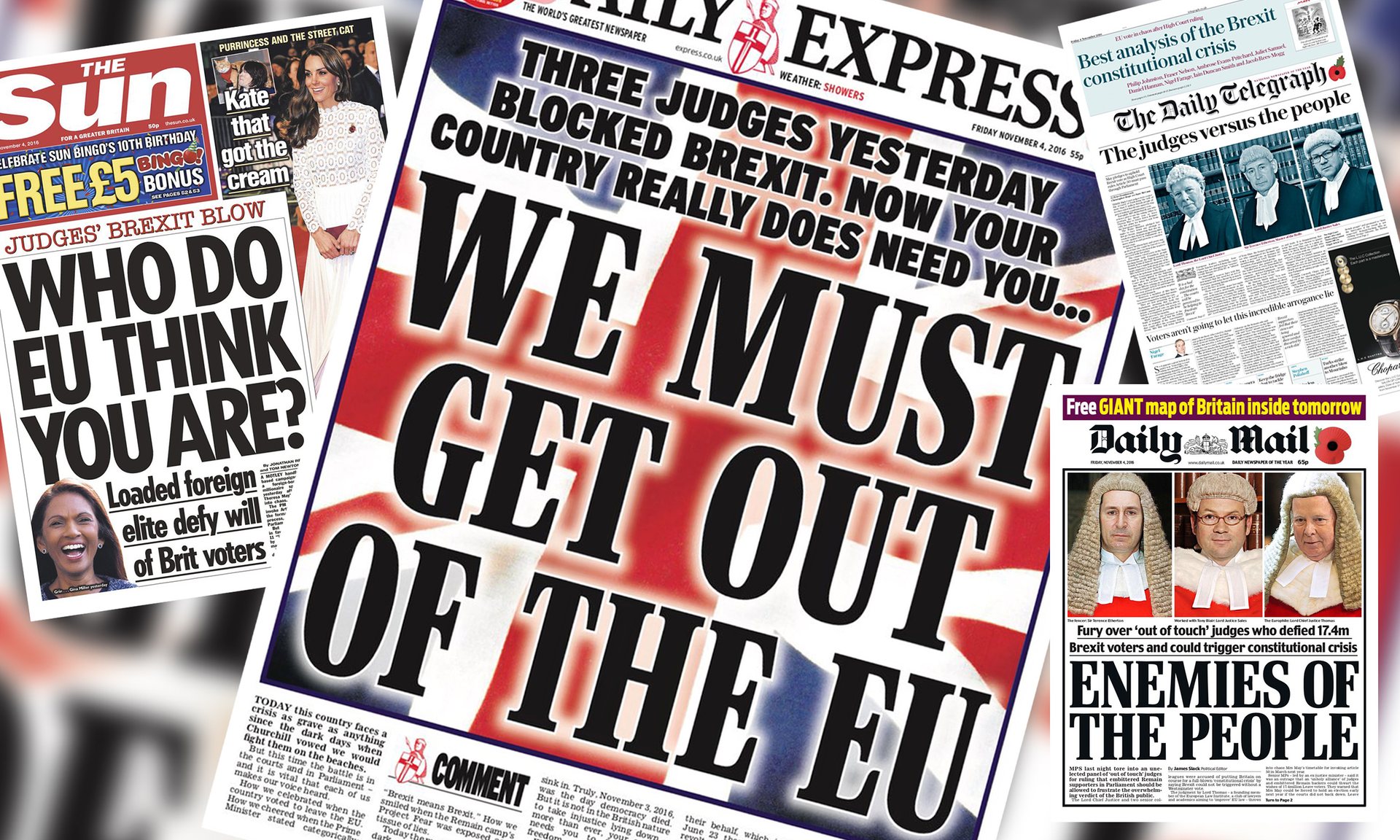
Who are the “enemies of the people.”

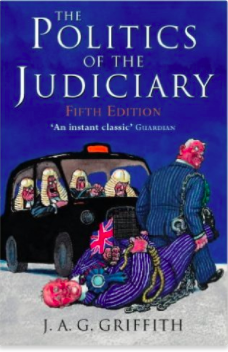
When I was at university a book was published entitled “The Politics of the Judiciary” by JAG Griffith. It was immediately recognised as a classic work and indeed a new and revised 5th Edition was published in 2010. I though the book was brilliant because it played directly to my prejudices about the judiciary as being a part of the repressive apparatus of the state. Indeed the book does look at where the judiciary are drawn from and it is pretty clear they come from the upper echelons of the British class system.

screen-shot-2016-11-06-at-13-51-42A more balanced reading however reveals a complex story about the relationship between the judiciary and politics and particularly between the judiciary and the government of the day. At times judges appear to have acted as tribunes of the people, defending the little man against the might of the state, and at others intent on implementing the repressive spirit of legislation rather than simply the literal meaning of its letter.

What Mr Griffith’s book does is describe in a measured and authoritative way how the law and politics collide. It is an excellent rebuttal of the notion that judges somehow live in Olympian detachment from the affairs of mankind and bring to their deliberations minds free from all prejudice. This is a good thing. Judges, like all members of society are fallible and have all manner of irrational assumptions about the way the world works just like everyone else.

Because of this there are many ways in which the judiciary could be reformed to ensure a wider range of backgrounds and experiences are represented in its ranks, so that the frameworks of reference through which the job of interpreting and developing the law is widened. There are many organisations working at this and some progress has been made. That progress is painfully slow, for example, here we are, well into the 21st Century, and out of 106 High Court Judges in England and Wales, 22 are women. Mind it wasn’t until 1919 that women were allowed to enter the legal profession at all!

All of this is by way of introduction to the main issue. I hope to have indicated that I have moved from a position of seeing judges as lackeys of the bourgeoise state to a slightly more balanced view. One which recognises the legal system is not perfect, however also recognises that society needs an authoritative way of arbitrating the meaning of laws. The English legal system is the way we have all implicitly agreed that should be done. We might not always like the outcome and we may work to overturn the outcome in various ways through the democratic process. However, it is the basis of the rule of law that the judges interpret what the law says.

The judges have not said that Brexit does not mean Brexit. They have simply said that a law which was created by parliament cannot be revoked by plebiscite. Mrs May may be hopping mad that the court has not simply told her whatnews-papers she wants to hear but as Prime Minister she should have led the political condemnation of the attacks on the judiciary by the press. The Secretary of State for Justice and Lord Chancellor, Liz Truss, simply had her Department issue a statement which an A Level British Constitution student could have written. Of all people, serving politicians, should support the institutions of liberal democracy not collude in their undermining. And to be clear there is a huge difference between reforming and undermining.

In truth Mrs May should actually be thanking the judges for clarifying the issue now. We are already in one almighty mess created mainly by her party but what would it look like if Article 50 was exercised and then challenged in the courts? We are already destined to spend years trying to negotiate ourselves to a position which will probably be worse than we were in pre June. That aside, what would it be like, and what would it do to the credibility of our political system, if every step of the processes were bedevilled by questions of legality.

I am opposed to Brexit, indeed I hope we can still avoid exit from Europe. However, if the supreme court decides the court of appeal was wrong and Mrs May’s approach to the process is legal I will not be casting the judges as enemies of the people. Democracy is currently under threat, the rule of law is a key part of democracy. Those who suggest the judges are getting in the way of the people are undermining the rule of law. If they were to get their way the road is open the kind of demagoguery we are getting from the United States now with threats to use the legal system to put opponents in prison.

The legal system is imperfect, it does favour the status quo and it is implemented in the main by people from a very small part of society which enjoys many of the benefits of that status quo. But it is what we have at the moment to maintain the rule of law. We undermine its authority and legitimacy at our peril. It is those that collude in this which are the real enemies of the state.

Makers and Takers – Rana Foroohar

Ms Foroohar is a Time economic columnist and CNN global economic analyst who has written one of the most scathingscreen-shot-2016-10-31-at-15-14-50 books about the American finance industry I have read. It addresses the process of financialisation, a process as ugly as its name. In essence it is about the transformation of the banking sector from something that sustained Main Street businesses in a solid, if slightly boring way, to something which now dominates and, more importantly, sucks the lifeblood from the very businesses it previously supported.
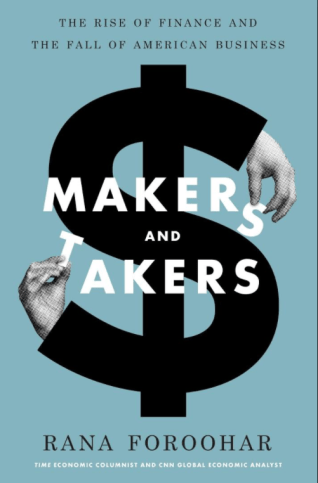
One point which is worth stressing from the outset, Ms Foroohar is not anti-capitalist. She is one of a growing number of people who are supporters of free market capitalism but who are very concerned with the way it is evolving. As she states at the outset, Ms Foroohar is “…not in favour of a planned economy or a move away from a market system. I simply don’t think that the system we now have is a properly functioning market system.”

She begins by considering the way finance has expanded dramatically over the past 40 years and particularly how it has shaken off the shackles of post 1929 depression. One example is emblematic of the way banking has moved away from a highly regulated sector is a piece of legislation called Regulation Q. This prohibited banks from paying interest on current accounts and controlled the level of interest that could be paid on other accounts. Its purpose was to “prevent banks from competing too vigorously with one another … which might in turn push them into the sort of risky investments that had precipitated Black Tuesday in 1929.” The aim of this and other regulations like Glass Steagall was to ensure banking remained a “safe boring utility”.

This regulatory framework remained robust and effective throughout the 30’s, 40’s and 50’s. In the 1960’s however things began to change. Ms Foroohar illustrates the shift of the sector through the history of National City Bank which ultimately became CitiCorp, the classic too big to fail bank. Specifically she charts the career of Walter Writson the Chief Executive of Citibank/Citicorp from 1967 to 1984, one of the most influential commercial bankers of his time. In essence he wanted to move banking out from being a low risk, low profit, highly regulated sector to something much more glamorous.

Writson’s actions, in terms of challenging regulation, dreaming up increasingly complex products to get around the rules, increasing the leverage of the bank and changing the compensation structure were things that would be repeated across the sector undermining the commitment to regulation so that bit by bit it was repealed with Jimmy Carter deregulating interest rates (Regulation Q) in 1980 and then critically Bill Clinton repealing Glass-Steagall in 1999.

The result was an explosion in banks turnover and the development of increasingly sophisticated financial products and derivatives. This led to increasing  profit levels which in turn drove a series of behaviours to protect and develop those profits which were more or, increasingly, less legal. Even the activities which were perfectly legal changed the risk profile of banking and its relationship with the businesses it was supposed to be encouraging and generated enormous systemic risk which exploded in 2007/08.

Whilst the inherent risks of fractional reserves and complex debt instruments like Collateralised Debt Obligations, made famous by the credit crunch, are important, the less legal side of the industry should not be overlooked. It is a staggering fact the  industry paid £139bn in fines between 2012 and 2014 for: rigging Libor, insider trading and a great deal more (and of course this is just banks within the USA in a 3 year period!). In the massively profitable finance industry however the view seems to be that fines are simply another cost of business.

Over the period that the finance “takers” were in the ascendancy at the same time the business “makers” were under attack. The growing importance of finance was leading to the development of what some have called “quarterly capitalism”. This meant that stock price was everything and it had to move upwards every quarter. The heroes of shareholder value, like Jack Welch of General Electric (Manager of the Century according to Fortune magazine), came to be seen as the models for business leadership. These were people whose interest in engineering was more financial than mechanical. Ruthless cost cutting, getting rid of jobs and reducing investment in R&D to feed the ever demanding stock market.

Those businesses which did not employ the right staff to do this internally were targeted by what used to be called corporate raiders but are now more politely called “shareholder activists”. These individuals, like Carl Icahn, buy sufficient shares in companies to replace existing management with more aggressive mangers who will take the “hard decisions”, cut cost and increase shareholder returns. They may also sell off valuable assets or break up the company to extract value.

This might be seen as the kind of process that Schumpeter described as “creative destruction”, getting rid of the dead wood. However, a growing body of evidence suggests that the stripping out of value is actually undermining the economy not making it more efficient. Evidence is emerging that private companies, i.e. those that have not gone to the market and become public have better track records of investment in R&D, staff and capital and more critically long term profitability.

Public corporations are bizarrely now borrowing to fund shareholder dividends and share buy backs thus artificially pushing up the value of the remaining shares. Why borrow to do that? Like Apple, to avoid having to bring the massive pile of cash from profit you have made abroad back to the States where you would have to pay tax on it.  According to Foroohar corporations have invested around 10% of every dollar they borrow into their company and 90% into shareholder payouts. This means the role of stock markets has reversed. Instead of wealthy individuals investing in new productive capital, rather, companies have been making payouts to the wealthy individuals. This might be morally objectionable but more importantly it does not provide for sustainable capitalism. This is cannibalistic capitalism, its eating itself.

Over the years another phenomenon has emerged consistent with the old adage, if you can’t beat them join them. GE probably the most significant engineering company in the world, decided the finance department should become a profit centre. It created GE Capital which was to all intents and purposes a bank but not registered as one. Not just any bank, in 2013 the Financial Stability Oversight Council declared GE Capital to be a systemically important financial Institution and thus subject to Federal Reserve oversight. What could have made them come to this snap decision? Because in the 2007/8 crash it was bailed out by the American taxpayer to the tune of $139bn.

Ms Foroohar’s book explores the way “financial speculation is playing a greater and greater role in fueling volatility in commodities…”.  Since 2000 there has been a fiftyfold increase in dollars invested in commodity linked index funds. Several things are pointed to as having pushed this: Goldman Sachs creation of a commodity index fund; deregulation of commodity markets; the credit crunch that scared people out of stocks; and the $4.5bn QE exercise. This financialisation means that businesses now have to compete with their banks for commodities. If this sounds weird it’s because it is and one example makes the point.

Goldman Sachs bought up thousands of tons of aluminium which it then controlled the supply of. By doing this of course they were able to control the price and thus increase the value of their investment and any commodity trades that they had done in relation to aluminium. Whilst this was an issue for Coke Cola, in that it put up the price of their cans, the wider speculation in commodities had much more significant effects.

In 2003  big investors were putting $13bn into commodity index trading, by 2008 it had risen to $260bn. Over the same period the price of 25 commodities including cattle and heating oil increased by 183%. When asked whether institutional investors were contributing to food and energy price inflation the unequivocal answer given by Michael Masters, a hedge fund manager was “Yes”. This means speculators were gambling with products that meant people ate or starved, and many starved.

Ms Foroohar addresses the fact that many of the people and institutions that have been involved in this process of financialisation have benefited spectacularly with astronomical reward packages and profit levels. She goes on to review how they spend hundreds of thousands of dollars to avoid paying tax on their enormous earnings. She also looks at the phenomenon of the “revolving door”. This is the process whereby elected officials and appointed civil servants, charged with regulating the financial sector, move into their posts from the very sector they are regulating and move back into the sector when they retire from public life. She suggests the opportunity to sit on the Board of a large financial institution may colour the view of regulators whilst they are doing their job in the public sector. Whether this is true or not is increasingly beyond the point. Many Americans think it is true and that is what matters.

Financialisation is  one, if not the, most significant trends that has occurred over the past 30-40 years. Ms Foroohar’s claim is that it has sucked the lifeblood out of Main Street America, undermined investment in innovation and productivity and thus the future of the nation. Putting finance back in its place will not be easy. It means empowering the makers which would involve a genuine and major shift of power. Ms Foroohar sets out a sensible programme of reform. My concern is that people rarely give power back it is usually taken from them and the result of that is not always sensible. Lets hope this time it will be different.


Takers and Makers: The Rise of Finance and the Fall of American Business: R Foroohar. Crown Business 2016