The Intelligence Lark

The loss of Mr Grayling to the Chair of the Intelligence and Security Committee (ISC) puts me in mind of the old radio comedy “The Navy Lark” about the hapless crew of the Royal Navy Frigate HMS Troutbridge. In the show Ronnie Barker was the voice of Naval Intelligence and answered the phone with a gormless drawl, “This is intelligence speakin’.”

Mr Graylings involvement in government to date has not been an unqualified success. It is fortunate that the man who gave a contract for boats to a company with no boats was not around at the time of Dunkirk. This is a man who can make a mitigated disaster unmitigated with no appearance of noticing.

He remains a member of the Committee so the actions of Julian Lewis, working with the opposition parties, to take the Chair can only be seen as “damage limitation”. However the whole affair is fascinating as an insight into the approach to government of this administration.

They clearly adhere to the arithmetic, elective dictatorship view of democracy. A view which goes beyond seeing elections as giving the government the right to implement its’ policies within the framework of consent, which includes the rule of law and a whole series of checks and balances. Rather a view, most clearly exhibited by President Trump, that once elected, the whole panoply of state power must bend to the will of the executive.

The Justice and Security Act 2013 states, “A member of the ISC is to be the Chair of the ISC chosen by its members.” (my emphasis) Given it is statutorily given to the members of the Committee to decide who amongst them should be Chair one may assume the intention of the legislators at the time was not to place it within the gift of the Prime Minister.

To try and whip this decision is a clear attempt to undermine the intention of the statute and betrays, at the very least, a nonchalant attitude to the rule of law. To then withdraw the whip from a member of the Committee who had the temerity to get elected within the terms of reference of the Committee and the statute is a cack handed compounding of the offence.

It betrays an obsessive compulsion for control combined with a complete lack of political sensitivity. It has all the hall marks of Prime Minister Johnson’s chief advisor and it is worrying.

Mr Cummings seems to sacrifice politics to efficiency and confuses efficiency with what he wants, when he wants it. Unfortunately, politics is not a science or a game of chess, it is an art. The numbers do not always add up, even when you have a majority, and the chess pieces have minds of their own.

Steering the ship of state cannot be easy. It almost certainly requires constant attention. Attention to the big picture, taking the ship towards its destination, but also the instinctive attention to the details which matter.

This latest fiasco is a spectacular own goal, either of his own making or that of Chief Petty Officer Cummings. Why on earth would you risk political capital in providing Chris Grayling, of all people, with a sinecure which he is ill qualified to fill? He now looks as if he is losing control because he tried to control something he should not have done, what is more it is not even apparent that he needed to.

Worse the machinations look like an attempt to control the committee just at a time when it is about to deal with a report into Russian interference in the last election. A report the PM has been sitting on for months. This inevitably raises questions about whether there is something in the report which justifies the manipulations?

Sub Lieutenant Phillips was an amiable buffon, guiding HMS Troutbridge in to harbour with the technical precision of “Left hand down a bit” but almost always ended up crashing into the harbour wall with an “Ooh nasty!” Sadly it appears the Sub Lieutenant is at the helm again.

The Rulers’ Law

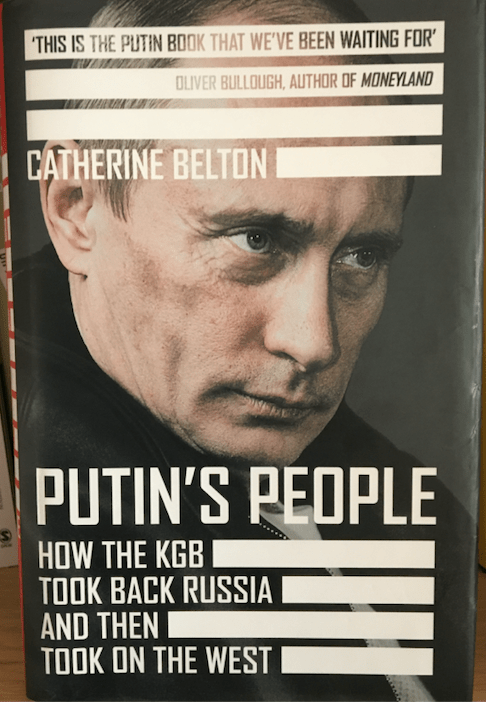
Former FT Moscow correspondent Catherine Belton’s recent Book “Putin’s People” chronicles the rise to power of Russia’s President. It provides a fascinating insight to the form of State Capitalism put in place by Putin and his former KGB colleagues over the past 20 years.

Central to this process has been the transformation of Russia’s legal system into a pliant arm of the Kremlin. For long it had been subject to local corruption due to the very low pay of Russian judges. However, what Putin has done is incorporate the judiciary into the state, no longer providing an independent assessment of facts and guilt versus innocence but rather a step back to Soviet era “telephone law”. In practice the whole of the legal system is at the behest of the political elite and more specifically Putin.

The key shift to this was the trial of Mikhail Khordorkovsky, at one point the richest man in Russia, a beneficiary of the first moves to a market economy under Boris Yeltsin. The trial lasted 11 months and, according to Belton, “…created a precedent for the country’s judiciary to be turned into an extension of the long arm of Putin’s siloviki.”*

The three female judges were accommodated by the Kremlin in a sanatorium 50 kilometers outside of Moscow, all expenses paid, while they wrote their verdict. When one of the judges refused to go the sanatorium under police guard Vladimir Kalanda, a deputy in the presidential administration spoke to the chairwoman of the Moscow City Court to make sure her subordinate complied. The official reason for this was to ensure they would not be bribed by representative of Khordorkovsky.

Surprisingly, the judgement was almost an exact summary of the prosecution. In truth it involved the retrospective and partial implementation of laws to ensure conviction and resulted in a sentence of 10 years hard labour. An appeal was submitted and after a number of delays was heard in a single day due to concerns that the statute of limitation might apply to some of the counts against Khordorkovsky. It took the judges a matter of minutes to reject the appeal.

Oddly enough, following this Russian oligarchs were very careful to ensure they did not upset Putin and indeed when asked to jump for him only asked how high. And he did ask them to jump or rather treated their wealth as an extension of the states available for him to direct as he thought fit.

In short Putin converted a nascent independent judiciary into a shield and sword to overwhelm any opposition, appropriating assets and incarcerating oponents at his pleasure.

Of course he has a different take on the matter and argues that the courts act according to law and he cannot interfere in their independent prosecution of those he falls out with. In short, he lies.

Belton’s book provides plenty of evidence to support this degradation of the rule of law into rulers law. Whatever the limitations of the British legal system and whatever bias to wealth and power it contains, the situation is categorically different to one where the Executive becomes, rather like Humpty Dumpty, able to say the law “…means just what I chose it to mean – neither more or less.”

All this is truly frightening and undermines two foundational principles of democratic societies. First the rule of law and its application without fear or favour to all citizens equally. No one is above the law. The second principle, is the separation of powers and the independence of a professional judiciary. One which stands separate from the Executive and indeed can hold it to account if it breaks the law.

Obviously, there has not been a long tradition of any of this in Russia. Neither before the 1917 Revolution nor after in the Soviet Union. On the collapse of the latter there was a brief period when these principles seemed to be gaining ground. However, they were under challenge from the moment Putin came to power in 2000. The judiciary came under increasing pressure and after the trial of Khordorkovsky in 2005 it was really game over.

In the west of course we believe the two principles mentioned above are well and truly secured in democracies such as the United States. Or we did. From the very start of his term in office President Trump took his Twitter scythe to undermine the judiciary by attacking judges and courts for rulings he disagreed with and used his powers of appointment to attempt to take control of it from within.

His track record on Attorneys General illustrates a restless search for someone that will meet his exacting requirements. Most Presidents seem to have around three Attorneys General. FD Roosevelt managed with four in his exceptional twelve year 3 term presidency. George W Bush had the most with 3 acting and 3 full Attorneys General. That of course was in his 8 years in office.

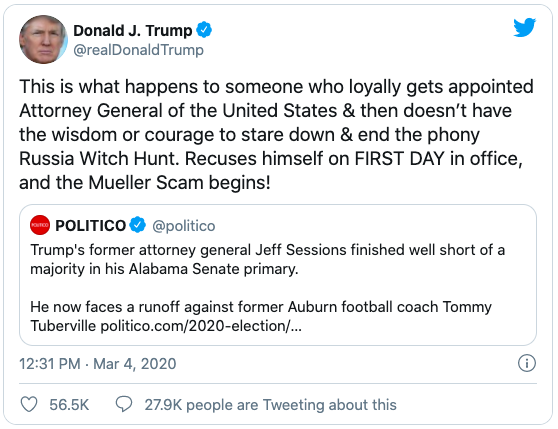
President Trump had gone through three acting and one full Attorney General in just over two years before settling on William Barr in February 2019. His first full appointment was Jeff Sessions who made the school boy error of recusing himself from the inquiry into Russian involvement in the 2016 Presidential election campaign of Donald Trump. From that moment on he was a dead man walking, openly ridiculed and berated by the President in public.

After he had left office the President made clear what he saw as his shortcomings. In essence these were his failure to Protect Trump by closing down the Mueller Inquiry or the “Russia Witch Hunt” as he called it.

With William Barr he seems to have discovered an Attorney General that does understand the legal immunity which attaches to the office of President. Mr Barr has assiduously attempted to ensure the President is protected from the distracting attentions of Federal Prosecutors.

As soon as he took office Mr Barr inserted himself into the Stormy Daniels investigation of campaign fund violations. Ms Daniels was paid $130k for her silence about an alledged affair with candidate Trump in the run up to the 2016 election. His personal lawyer Michael Cohen was jailed for 3 years for making the payment on behalf of “Individual One”, President Trump.

Following Mr Barrs review of matters the Federal case investigating the liability of “Individual One” drifted for months and then was wound up with Federal Prosecutors confirming no further action on this matter would be taken against any other individuals.

Mr Barr also insisted that any other cases in any Federal Prosecutors Office relating to the President needed to be reviewed by a hand picked team in his office.

When the Mueller Inquiry finally reported to Mr Barr he initially tried to prevent its release to the public providing a letter to Congress with his own rather contentious summary of what he believed it concluded. It attempted to set the tone about exonerating the campaign and the President.

Mr Barr holds the radical view that whilst in office not only can the President not be charged with any breaches of the law but that neither does he have to respond to investigations into such breaches. According to him the President does not have to provide congress with documents even if they are supported by a subpoena.

Not only has Mr Barr used the law to shield his boss but he has also used it as a sword, setting up criminal inquiries into the actions of law offices in relation to the establishment of the investigation into Russian attempts to support Trump in the 2016 election.

His latest moves have been to replace the US Attorneys in Washington DC and both the Southern and Eastern Districts of New York. What all these Districts have in common are ongoing investigations into President Trump and the Trump organisation. Geoffrey Berman, Attorney for the Southern District, denied he had resigned when Mr Barr announced this one Friday evening. This forced Mr Barr get the President to remove Mr Berman.

No doubt the estimable Ms Kayleigh McEnany, the Presidents indefatigable press Secretary, can confirm that all this is perfectly normal and there is nothing to see here. But there is. Incredibly what we see is a process undermining the independence of the judiciary with frightening parallels with what has happened in Russia.

Fortunately there are signs of push back. Last week the President lost two cases in the Supreme Court which struck down definitively and in terms the notion that the President is above the law.

In the Southern District of New York the State prosecutors office have picked up the case dropped by the Federal Prosecutors office into the Stormy Daniels hush payments which they believe breach a range of State campaign finance laws. The State Prosecutors do not answer to Mr Barr and importantly State laws are not subject to Presidential pardon.

There is hope the attack on the rule of law in the States will be overcome. However no one should underestimate the strength of that attack or the risks it creates if even partially successful. By far the most effective way to defeat this is by the US public rejecting candidate Trump at the polls in November. Experience to date, however, indicates President Trump will do all he can to transform The Rule of Law into The Rulers’ Law to secure victory. The 2020 US election is not for the Presidency, it is for democracy.

*Siloviki = Putin’s inner circle of ex KGB colleagues.
Italian mafia bonds sold to global investors | Financial Times

Italian mafia bonds sold to global investorsInstruments were backed by front companies charged with working for the ’Ndrangheta organised crime group International investors bought bonds backed by the crime proceeds of Italy’s most powerful mafia, according to financial and legal documents seen by the Financial Times.

In one case, the bonds — backed in part by front companies charged with working for the Calabrian ’Ndrangheta mafia group — were purchased by one of Europe’s largest private banks, Banca Generali, in a transaction where consulting services were provided by accountancy group EY.

About €1bn of these private bonds were sold to international investors between 2015 and 2019, according to market participants. Some of the bonds were linked to assets later revealed to be created by front companies for the ’Ndrangheta.

Source: Italian mafia bonds sold to global investors | Financial Times


Ed Northern Comment. “If money goes before, all ways do lie open.”

Black Lives Matter

With the death of George Floyd “Black Lives Matter” became a global rallying cry for all those against racism. It was a simple statement encapsulating opposition to racism’s historical roots and its contemporary practice both individual and institutional.

Inevitably it would not be long before an attack on its credentials was forthcoming. Leading the charge, just as inevitably, was President Trump who in a tweet denigrating the painting of the logo on 5th Avenue which he claimed would “further antagonise New Yorks Finest” called Black Lives Matter a “symbol of hate”.

Kayleight McEnany, the Presidents Press Secretary, attempted to redefine the racist attack against a phrase with overwhelming national and international support by suggesting the President had “only” meant to refer to the “Greater New York BLM” whose president Kayleigh claimed had said “if this country does not give us what we want that we will burn down the system”, Her response “I call that a pretty hateful statement”.

One cannot envy the job of defending the indefensible. However, the steely Ms McEnany whose resting state is passive aggressive, with emphasis on the aggressive, does it without blinking. I have no idea whether she believes what she says but you have to admire her ability to project absolute certainty and confidence defending the incoherent ramblings of a rather dim man loaded with every prejudicial “ism” one can think of.

However, whatever her personal views, her attempt to paint the BLM movement as a hate filled threat to democracy, and that therefore the BLM moto should be rejected is in effect an attempt to undermine a powerful symbol of anti-racism. It should be rejected out of hand. The phrase has a palpable strength which comes from its simplicity, directness and moral truth. A truth which has been brutally suppressed for more than 400 years.

It is difficult to get one’s head inside the moral universe that existed when slavery was a major component of the the growing world economy in the 17th, 18th and 19th Centuries. As long as I can remember it has appeared self evident to me that slavery was, and is, an abhorrent practice. The dreadful treatment and brutalisation of fellow human beings seemed beyond understanding. The International Museum of Slavery in Liverpool charts the unspeakable trade and I thought I had a clear understanding of the whole awfulness of the business

However its still came as a shock to me when I read in Thomas Picketty’s excellent book “Capital and Ideology” that on the abolition of slavery it was the owners and not the slaves who were compensated. Even in a world where racism is still a major problem it is difficult to believe this was thought to be a morally reasonable solution.

Picketty provides an informative summary of the African slave industry, how it was “abolished” and compensated, and the the nature of the debates at the time in Britain, France and the US. Those debates were structured, according to Picketty, by the proprietarian view of the word which came to dominate over this period. In this view property rights were fundamental, tantamount to sacred and could not be challenged even if the property in question was another human being.

Ironically the power of this world view can probably be seen more starkly in the arguments of the abolitionists than the defenders of slavery. In France a dedicated abolitionist, Alexander Moreau de Jonnes saw it as axiomatic that the, “…masters of slaves must be compensated by an indemnity…” and that it was also obvious, “…the slaves, who will derive immense benefit from it, should naturally and necessarily…” fund the indemnity, ie. compensation.

Alexis De Tocqueville (the same) came up with what he saw as a sensible compromise whereby the government would pay half the cost of the indemnity whilst the slaves would pay the other half.

In the event the compensation was paid by the French state as was the case in Great Britain. The compensation provided to the 4,000 UK slave owners at the time was £20m, or 5% of UK’s national income at the time. If the compensation was converted into 5% of the national income of 2018 it would amount to €20bn, or €30m per slaveowner.

This enormous payment by the state meant an increase in the public debt which was funded by families on modest or average incomes in a highly regressive tax environment where most taxes were on consumption and trade. Crudely the poor in Britain compensated the rich in Britain for their slaves.

Talking of public debt it is worth considering the case of Saint-Domingue, now Haiti. This island had a population of which 90% were slaves. That demographic probably accounts for the fact that abolition there was the result of a slaves revolt. However, whilst they might be able to overwhelm their local oppressors they had to succumb to the demands of a French state for compensation of their former owners under threat of invasion.

In 1925 France recognised the independent Haiti following a promise by its government to pay 150 million gold francs (roughly €40bn in todays money) compensation to slave owners. This amounted to 300% of national income. The entire amount had to be paid within five years, so Haiti was required to borrow the money from French banks at about 5% pa and repay it over time. A very long time.

From 1849 to 1915 the French creditors managed to extract 5% per annum of the whole of Haiti’s national income. From 1915 to 1934 America occupied Haiti to restore law and order during which the French banks ceded the rest of their loans to the US. The 1825 debt was not finally wiped from the loan books until the early 1950’s. So the slaves of Haiti spent a century and a quarter paying compensation to their owners. Now that is what I would call “pretty hateful”.

The more you study black history the more shocked you are. Furthermore, abolition was little more than a step forward, a shift from de jure oppression to de facto oppression. In France, the UK and most egregiously in the US abolition was accompanied by new laws which ensured the exploitation and degradation of back lives could continue unabated.

In relation to black lives there is no neutral. There are no subtle distinctions to be made around Black Lives Matter. It is a motto for a race. A race which has experienced oppression in ways it is almost certain no one in a white skin can even imagine, particularly those from states with a colonial heritage. Oppression which appears to be part of the very fabric of reality. So ubiquitous as to be almost invisible to those not subject to it except for the most egregious examples of physical abuse.

There is only one legitimate response to the motto Black Lives Matter. Unequivocal agreement and support. No ifs, no buts, no clever distinctions.