We lost. It is too early and raw for a postmortem. We now have to move on. I have been wrong in the past and I am sure I will be wrong in the future. I fervently hope I am wrong this time and that Brexit will not involve an acceleration of the decline of the UK, or a kick in the teeth for those who voted for it. The signs however are not good.
There has been a distinct shift in the rhetoric of late from the leading Brexiteers. The sunlit uplands of freedom to negotiate trade deals with queues of states around the world has faded. Liam Fox says we should not be obsessing about Free Trade Agreements. Mr Gove accepts that things will be “bumpy” but the real benefit of Brexit will be that we have taken back control, politicians, like him, will have no EU bureaucracy to blame for things. We need to remember that.
However, the ground is already being laid for blaming those unscrupulous Europeans for any pain that may come out of the negotiations over the next 11 months. They will be acting out of fear, ignorance, stupidity, bureaucratic arrogance,… being foreign! If we cannot retain the benefits of membership without the responsibilities where’s the fairness in that?
Democracy has provided PM Johnson with a large majority. A lot of those unprincipled MP’s who would not vote for something they felt would damage the interests of their constituents have been replaced by their constituents with those who swore an oath of loyalty to “get Brexit done’.
To be absolutely clear we should not blame democracy. Democracy is not a guarantee of good government it is an insurance against tyranny.
The country has voted to take back control. We now need to keep a close eye on where it has been taken to and what is done with it. We will be watching Mr Gove, and, as he says, the EU no longer provides a convenient hiding place.
Politics and Economics
(45) How to reform today’s rigged capitalism | Financial Times
Opinion Capitalism
How to reform today’s rigged capitalism
We must address weakened competition, feeble productivity growth, high inequality and degraded democracy
MARTIN WOLF Add to myFT
via (45) How to reform today’s rigged capitalism | Financial Times
Northern Comment – This is one of many articles from people who wish the ends but not the means. Those who analyse the problem superbly well, e.g. inequality, but hope/believe, that it can addressed by some kind of rational process. I wish! Sadly, I think those that “have” think it is nothing less than they are due. Rational argument is unlikely to win. Irrational violence is more likely to be the ultimate arbiter. Just hope this happens somewhere else.
IFS Green Budget
Sometimes a single chart encapsulates a whole policy agenda. The one below from the independent Institute for Fiscal Studies looks at the impact of one of Boris Johnson’s proposals to radically overhaul personal taxes. There are two major proposals.
The first is simply to increase the higher rate threshold (the level of earnings you must have in order to pay higher rate tax) from £50k per annum to £80k. A straight tax give away to the better off.
The second, and the subject of the chart below, is to raise the point at which National Insurance contributions start. This, they claim, is in order to help the poorest in our society. The dark green bars in the chart shows the government must believe those with most money are the poorest.
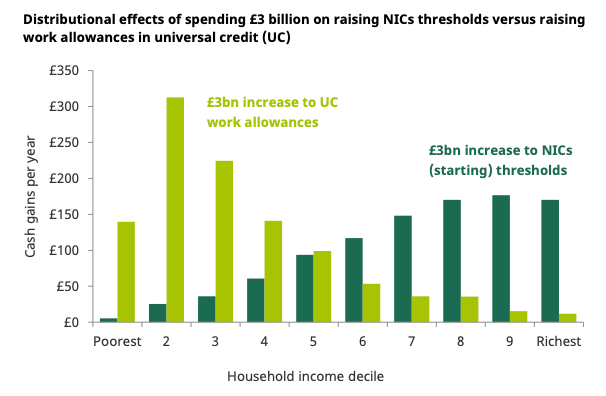
The chart also looks at an alternative way to boost the incomes of low earning families by boosting the work allowance in Universal credit. This is shown in the lighter green colours. Clearly, the IFS seems to have a view of who are the poorest in society which more closely aligns to that of people here on planet earth.
It seems caring Conservatism doesn’t care any more.
Constitutional Crises
Two of the foundational democracies in the Western world, both ironically containing united in their name, the United States of America and the United Kingdom are in the midst of constitutional crises. Here, where we famously have an unwritten constitution, the Supreme Court has declared the Prime Ministers prorogation of Parliament void. In the US, the country with probably the most famous written constitution in the world, the House of Representatives has begun impeachment proceedings against the President. In truth they are both responses to a similar issue.
In both countries there are leaders in power who are happy to override or ignore constitutional conventions and practices in the interests of getting things done i.e. delivering Brexit, or getting my way building a wall.
Boris Johnson has decided the country has expressed a clear view it wants to leave the European Union and therefore he is justified to do “whatever it takes” to secure this. More than three years on from the referendum, one indecisive election, two Prime Ministerial resignations, one year of unedifying Parliamentary manoeuvring, including three unsuccessful votes on a withdrawal deal, it is not surprising Mr Johnson can tap into a national mood of frustration.
A decisive strategy for dealing with the impasse must surely be welcome. The problem is Mr Johnson has been more decisive than strategic.
Mr Johnson has not attempted to build a consensus, or even a majority, in either his own party or Parliament, or thought of attempting to lance the boil with another referendum. He has in effect said the Parliamentary system is not working and so I will circumvent it. I will ignore Parliamentary sovereignty in order to return sovereignty to Parliament. Taking at face value what Mr Johnson says about his earnest desire to avoid a no deal Brexit, whatever was in his mind, proroguing Parliament and removing the whip from 21 tory members who voted against him looked like a concerted attempt to circumvent the democratic process. The Supreme Court seems to have viewed the latter in that light. So far so bad
However, when the news of the Supreme Court’s decision provides a cheap opening laugh in a speech to Business leaders in NewYork and the PM uses the opportunity to say how profoundly he disagrees with the Judges decision you have to be worried it is not just hubris that’s the problem. This concern is reinforced when there is talk of a “Constitutional Coup” and Number 10 start briefing about an election fought on a “people against the establishment” ticket. An establishment composed of the members of the Supreme Court and Jeremy Corbyn. You only have to say it out loud!
Across the Atlantic, after two years of continuous challenge the Democratic majority in the House of Representatives has eventually moved to impeach the President. The straw that broke the resistance of the Democratic leadership arose out of a whistleblowers complaint which has still to be provided to the Chairman of House Intelligence Committee.
Despite its not having been provided there seems to be a clear picture emerging the issue revolves around a conversation between President Trump and the Leader of the Ukraine, Volodymyr Zelensky. It is alleged Mr Trump tried to pressure Mr Zalensky into providing political dirt on Joe Biden (current frontrunner in the Democratic primaries) and of his son. It is further alleged that military aid, approved by Congress, was used as a bargaining chip.
In truth, it is difficult to keep up with the “high crimes and misdemeanours” of the current President of the United States. Appointing a secret foreign agent to the post of National Security Advisor; using his office to secure financial advantage for himself and his family; lying about his business dealings in Russia; paying $280k in hush money to women he had affairs with; refusing to release his tax returns; lying daily about everything from the economy to the weather; denigrating the free press and the judiciary. This is just a brief list of some of his deplorable actions. They contain a mix of offences against the the constitution, the constitutional separation of powers, the conventions of political behaviour, and black letter State and Federal laws.
Whether the impeachment action is successful will depend on whether the current whistleblowing issue gains traction with the public. If not the President could likely shoot someone on 5th Avenue and the Republican Senate would still back him.
Whatever the outcome of Brexit or impeachment, on both sides of the Atlantic we have leaders surrounded by small groups of ideologues determined to get their way whatever the cost. They don’t just challenge those who disagree with them, whether press, politicians or judiciary, they denigrate them as anti-democratic traitors. In doing this they are undermining the foundations of constitutional practices within which democracy has operated for over 100 years.
Whilst it is important leaders project confidence it is always a worry when they claim certainty. Here the Prime Minister claims he knows what the British people want based upon a referendum held three years ago. The President has a view that when he was elected he became boss of US Ltd. He thinks his authority runs across all arms of government including the judiciary and legislature. They should accept what he says and do as they are told. That includes locking up his opponents e.g. “crooked Hilary”.
What is happening on either side of the Atlantic is similar and profoundly dangerous. When you mess with precedents as a politician your self interest might tell you what goes around comes around. If the precedents don’t constrain you then they may not constrain the opposition when they move into power, as they will at some point. But worse if you undermine conventions and ignore precedents you strike at the credibility of the rules of the game. If this undermines public faith you may create a wholly different scale of problem.
The Supreme Court has blown the referees whistle and cried fowl. A sensible leader in a democracy would treat this seriously and temper their behaviour. Politics with rules is very demanding, difficult and frustrating, without them it’s war.
 northerncomment