The Brahmin Left – Educational Elitism

Thomas Picketty’s latest book, Capital and Ideology, provides a stimulating analysis of contemporary political issues. These are always grounded in detailed historical research which explore how social, economic and political drivers of the past have shaped the nature of current political practices with a strong emphasis on the role of ideas.

One interesting issue he addresses is that of the Labour Party’s evolution in the post war period. It provides a challenging perspective on the collapse of the red wall and the alienation of working class voters over recent years. The issue of immigration and the lack of an effective narrative to address many traditional labour voters concerns is often cited as one of the causes of this loss of support.

The distance between the party and its voters seemed apparent in the unguarded comments of Gordon Brown, recorded during the 2010 election campaign, about a labour supporter, Gillian Duffy, who he called a bigot after she had questioned him on immigration and “people on benefits”. To dismiss the lady as bigoted was seen by many as illustrative of the views of an out of touch metropolitan elite who no longer had any real understanding of the problems faced by the people they were supposed to represent.

Clearly there are a number of historical forces at work in this apparent divorce of Labour’s political elite from its base. Picketty would be the first to accept and indeed insist on this. However, he points to a specific driver which he feels has played a major part in the evolution of this divide. Education and a concomitant commitment to a meritocratic view of equality.

Picketty sees the structure of political debate and division evolving over the post war period and resolves this evolution into two broad eras. Firstly, the period from 1950 to 1980 which he characterises as “classist”. In other words a battle between advantaged, right,  and less advantaged, left,  social classes. The heyday of the bipolar party system with Labour the party of the workers, and Conservative the party of the owners. The left / right model which this represented has, over the years become less relevant but continues to shape many debates in ways which are counterproductive in Picketty’s view. 

From 1990 to 2020 he perceives the terms of political debate having moved to one which is more about competing elites. These elites coalesce into two broad groupings around the traditional parties. One, Labour, supported by the more highly educated, the other, Conservative supported by the wealthiest and most highly paid.

Picketty’s analysis of the structure of political affiliations in the UK is situated in a much broader consideration of social democratic politics across West and Eastern Europe, the USA and some non-western countries including India in the post war period. He never lacks ambition.

He looks specifically at the level of education of voters for parties of the left and parties of the right using a variety of survey sources. His findings across the piece for left of centre social democratic parties are similar to those for the Labour Party in the UK. Broadly he claims that in the classist period, from 1950 to 1980, the vote for left wing parties was significantly lower amongst the 10% of the population with the highest levels of education than amongst the 90% of the population with the lowest levels of education. The size of the gap between these two diminished over the two decades from 1950 such that in the 1990’s and 2000’s the vote for Labour amongst the 10% of the population with the highest levels of education increased and became significantly higher than those voting for the party from the 90% of the population less well educated.

In parallel with this a meritocratic theory of inequality was adopted. Equality of opportunity was seen as the key which critically meant developing better access to education for the working class. The 1960’s saw the expansion of the Universities following the Robbins Report and the expansion of Polytechnics promoted by Anthony Crossland. Essentially, the aim was to level up the playing field of education to allow working class students to have better and more equitable access.

Through the late 1960’s and 70’s this obviously benefited a significant number of Labour supporters who went on to become senior members of the Labour Party with a very positive view of the beneficial effects of education. Consistent with this was a positive view about their own meritocratic progress. This, according the Picketty, has meant over the years Social Democratic Parties including Labour have “come to be seen as increasingly favourable to the winners in the educational contest while they have lost the support they used to enjoy among less well-educated groups in the post war period.”(712)

The problem with a view that focuses on formal access to education as the key driver of equality fails to take account of the many, less obvious, barriers that exist for individuals from low income families. Picketty feels that the loud support for a meritocratic starting point ignores the facts on outcomes at the end of the race. 

Picketty refers to what he sees as an “astonishingly prescient” work by the sociologist Micheal Young, The Rise of Meritocracy”. This was a dystopian novel in which British society is increasingly stratified on the basis of cognitive capacity which is closely related to social origins. In the novel the Tory Party become the party of the highly educated and dominate the “technicians” in a world where science has decreed that only one third of the population is employable. Picketty sees elements of the novel coming to pass but it is the Labour Party which has become the representative of the educational meritocracy, or in Picketty’s short hand the Brahmin left.

There is much in Picketty’s analysis that can be challenged but his limpid exposition is exemplary and provides a clear target for those who wish to challenge him. His analysis of the mistakes and failures of social democratic politics is much more wide ranging and I will come back to it in the future. His thesis about the Brahmin left as part of it is worthy of consideration and should at the very least provoke wider debate which is sorely needed, as what is not in doubt is the alienation of many traditional Labour voters.

Taxing Times Ahead

A new book on taxation, Tackling the Tax Code, published, (free) in the United States by the Brookings Institution has things much needed to inform debate on this side of the Atlantic. As we emerge from lock down its economic consequences are beginning to become apparent, and they are vast. Enormous sums have been pumped into the economy by the government to prop up employment, sustain the health service and fight the Covid-19 virus.

An enormous bill has been accumulating on the balance sheet of the government and the Bank of England one which will have to be paid at some point. When and how are questions which will soon dominate political debate.

There are two ways in which you can reduce debt. First, you can cut your expenditure so that more of your income can be devoted to reducing the debt. This is what we tried in relation to the debt arising  out of the 2008 credit crunch. A decade of Austerity. Easy to understand because of analogies with household debt even if some believe the analogy involves a category error between national and household debt.

Whether another decade of Austerity is politically acceptable or even possible is a moot question. At the moment politicians do not seem to be promoting that line. Of course if they do not it rather calls into question the TINA argument about the need for the first decade. However, the expenditure side of the debate is for another time.

An alternative to reducing expenditure is increasing your income. How does the Government do this? Through taxation. Over the past few decades the direction of taxation policy has been remorselessly down, particularly for those on the highest incomes. C-19 and the subsequent recession is going to challenge that trend. If it is to change then there are a number of issues which need to be addressed. These need to be debated publicly for they have enormous consequences for all of us.

Which brings me back to the book. This is firmly focused on the US tax system but many of the issues and opportunities identified could equally be applied in the UK in fact some of the issues require multi-national responses in a global economy.

The book looks at the existing taxation system in the US and how it has evolved in recent years and particularly how income from taxation has gone down following tax cuts by GW Bush and D Trump. It then looks at how taxation should be raised in a fair and progressive manner.

One of the key principles the authors of the book promote is that taxation should be distributed fairly and progressively. Those with the broadest shoulders should take the heaviest load. Given the enormous concentrations of wealth allowed to build up over recent decades there is consideration of how this might be taxed including proposals for a much more effective inheritance tax for the wealthiest in the country. This would have the double benefit of raising revenue and reducing inequality which some believe is becoming a genuine drag on the economy.

In a similar vein there is also a proposal for a tax on financial transactions. This would mean that every time shares, bonds or fancy derivatives were sold they would be subject to a small charge. The proposal is 10 basis points or 1 tenth of 1 percent. Sounds like a small number but they estimate it could generate $60bn per annum when fully operational. Given that most of the wealth of very wealthy people is stored in financial instruments the costs of this would be mainly on the broadest shoulders. 

More specifically the book looks at adopting a Value Added Tax (VAT). Clearly this is something we have already. What is interesting however is the discussion about how that should be adjusted through transfers to low income households to reduce the regressive impact of such a tax.

More effective taxation of multinational companies (MNC’s) is also called for. This to ensure that under current laws they pay what they are supposed to and that incentives to off-shore production and relocate profit centres are eliminated. This is combined with proposals to promote a global approach to MNC’s which will address the race to the bottom of tax reductions to attract corporate HQ’s. Changing accounting principles to tax according to location of turnover as opposed to HQ would transform the behaviour of corporates and enable all sovereign governments to more effectively ensure corporates pay their fair share.

Resourcing the revenue authorities appropriately is also something called for. Interestingly in countries around the world where there have been homilies about the need to act prudently they have almost all reduced the resources of the organisations whose job it is to raise the revenues that have been publicly approved. Given they raise much more than they cost there is clearly no prudential reason to do this.

Taxation is complex and in the main very dry, however it is the engine of civilisation. It provides the resources to educate, heal, protect, support and sustain civilised society. It is something we should not leave to the politicians or the technicians. There are basic issues of equity which need to be addressed in order to create a fair, transparent and progressive taxation system. If we do not militate for that you can be sure something much worse will be put in place. Something that reinforces inequality rather than reducing it.

The Tax Code:  Efficient and Equitable Ways to Raise Revenue. Ed J Shambaugh and R Nunn. Brookings 2020.


Seeing your “R’s”

It seems to becoming clear that in order to transition out of lock down a strategy of testing, tracing, isolating and quarantining (TTIQ), at scale, needs to be adopted. What is interesting is how “the science”  around all this in the UK seems to evolve, almost in lock step, with the availability of the resources to implement the science. This helpfully means the Government can pretty much always do the right thing at the right time.

But how much testing needs to be done? To address this I guess one question is, what is testing for? From a lay persons point of view it seems to me there are broadly three purposes to testing.

First, a clinical one. This is about testing to identify which people, exhibiting serious symptoms are actually infected with Covid-19. The outcome of this being critical in determining the way the patient is managed.

Another clinical reason for testing is to check those managing the disease, working closely with patients and caring for the most vulnerable are not infected and thus in danger of spreading the disease. Ideally, I guess you would want to test front line staff perhaps once a week to ensure they are not working whilst infected but asymptomatic.

With these types of testing you would expect the ratio of positive to negative results as likely to be high. Essentially you are using self selected samples of most at risk people and therefore most likely to prove to have the disease. As of 9.00am on 30 April roughly 690k people had been tested and of those 170k tested positive which is almost 25% of those tested.

The second purpose for testing we might call epidemiological. It is about trying to understand the progress of the disease, its prevalence and spread, where the hot spots are etc. How effective this testing is will probably be critical to the design and success of any transition out of lock down.

This is what I take Pillar 4 of the testing regime to be partly about.  Currently the numbers devoted to this are very low, just short of 10k out of the 690k tested to date. It may be that fancy sampling techniques means this is sufficient. However none of these random tests have so far proved positive so to a lay person this suggests a larger sample may be needed.

Given the 25% ratio between sampling and disease in the self selected groups mentioned above and the zero infection rate in the Pillar 4 sample you suspect there must be a Goldilocks sample size and structure that gives more useful information. One suspects  the size of Pillar 4 sample is currently being determined by availability of tests rather than statistical design.

The third role for testing  is “R” management. This is about running a “wack a mole” programme of early identification of potential carriers and trying to break the chain of infection, of which they are a link, as soon as possible.

We know when we come out of lock down the disease will still be with us, lurking in the community. Success will be about managing not eliminating infection. Keeping the “R” as low as possible, so those who contract the disease and require critical care do not overwhelm the NHS. Or indeed take up all available resource thus increasing the collateral, non Covid-19, mortality rate.

In lock down “R” was controlled by the radical separation of people. Confining them within their homes. The less opportunity people have to interact at all the less opportunity for the disease to spread. This does appear to have been effective  but it is incredibly disruptive economically, socially and also, as time goes by, on people’s mental and physical health.

Having applied the hammer of lock down to get the “R” down to something below 1 we now need to look for more sophisticated ways of managing the spread to keep the “R” in check without lock down. Presumably when the R is above a certain level the only way to control it is through lock down. But when you get it below a certain level (something below 1) the progression of the disease is at least susceptible to less disruptive forms of management.

Social distancing protocols will be important in this but it is impossible they will be as effective as lock down so the virus will inevitably begin to spread again. This is where TTIQ at scale comes in, breaking the chain of infection as soon as the mole emerges into the light.

Ideally of course you would like to track it and intervene before it fully emerges into the light. To do this you would have to test everyone at least once a week to keep absolutely on top of the disease. That is 66m tests per week, 3.4bn tests a year. Mmm, probably not.

In the absence of this fanciful ideal what you need is a very agile and fast regime of TTIQ which responds immediately to individuals with even minimum symptoms, ideally supplemented with some large scale randomised tests to try and get ahead of the disease.

This means having significant numbers tests available and Test and Trace teams. Their job would be to go out as soon as someone identified as symptomatic, even if mild flu like symptoms, and test them. If the test was positive isolating those individuals and then tracing all of their contacts over, say, the past two weeks and ensuring those most at risk are tested and quarantined. For this, speed is obviously of the essence, as every day an infected person is not isolated they are spreading the disease.

TTIQ is foremost a logistical challenge. You need teams of well trained individuals with excellent interpersonal skill. Able to instantly respond to cases in the community, test the person, identify, trace, meet and test all their high risk contacts. Harvard Global Health Institute estimated an average of 10 tests of contacts per infected person.

Given all this how many Test and Trace teams would you need? That has to be a function of how many suspected cases are identified in the community per day. And how many cases a team can manage effectively per day. These are a couple of questions journalists might like to ask.

A related issue is the number of tests available to be used by the Test and Trace Teams. We should be up to 100,000 per day by now. Is that enough? In a recent blog, “Dancing out of lock down” I talked about research coming out of Harvard Global Health Institute suggesting a minimum number of tests as being of the order of 152 per 100k population. Which for the Uk seemed to work out at around 100k tests.

Whether this is right or not remains to be seen. An alternative estimate of the numbers needed comes from Tomas Pueyo who has now written a series of articles on the progress of Corvid-19 and how it is being managed. His latest is precisely about how to do testing. Initially I was cautious about Mr Pueyo’s credentials on this issue, however, over time I have found his common sense approach much more informative and convincing than the carefully honed statements of the UK press briefings.

Mr Pueyo argues sampling needs to be such as to ensure the proportion of positive outcomes is below 3%. This is what those countries which seem to have managed the disease well have done with early mass testing. Whilst I see the logic of his argument I guess this must be sensitive to the stage of the disease and thus general level of infection in the population. However, given all countries are probably at an early stage in this pandemic this is probably not a fatal criticism at the moment.

In the absence of statistically significant random testing identifying the level of “R” must involve working back from hospitalisation and death rates and some, no doubt, very clever epidemiological statistical manipulation.

The problem with this is you are looking backwards at the “R” rate which existed some days previously, and days matter. Fast and effective Test and Trace teams will not stop transmission of the disease but they may ensure, together with social isolation protocols, that its progress is reduced and the “R” kept within what the NHS can manage until we get a vaccine.

Throughout this blog so far I have talked about “the” “R” as if there is a single infection rate. This is not the case. Whilst the “R” in the general community seems to be managed by lock down it does not seem to be anywhere near as well managed in those communities that are locked in care and nursing homes and those locked up in prisons.

Urgent action needs to be taken to support these communities or what is a tragedy for those that live there, their carers and their families will become an ongoing source of infection in the wider community. We need to be able to see and address all the “R’s”

If increased resources are not supplied to these current hot spots, and a combination of social distancing and TTIQ do not slow the disease down enough, over time it will accelerate and we will have to resort, once again, to the blunderbuss which is lock down.

The World Health Organisations advice on managing this disease was “testing, testing, testing”.  As the resources become available “the science” will show this is right and we will begin to do the “right thing at the right time” and see our “R’s”. The sooner the better.


The State of Taxes

If taxes buy civilisation you can understand President Trump’s lack of interest in paying them. However, it is an indictment of contemporary democracy that someone running for office can characterise tax avoidance as being “smart”. There is a pervasive problem about the attitude towards taxation in many western democracies. The vast bulk of the population seem to be resigned to the fact that for them they as inevitable as death but that somehow for the rich it is an optional sport.

There is a growing literature on this issue making clear the scale of the problem and the urgent need for reform. Reform which closes loopholes and ensures tax authorities have the support and resources they need. But also reforms which ensure income and wealth is effectively traced, not hidden away in secrecy regimes. And where progressive rates of tax are consistently levied on all forms of income.

One work which has looked at this problem in in detail in the United States is “The Triumph of Injustice: How the Rich Dodge Taxes and How to Make them Pay” by Emmanuel Saez and Gabriel Zuckman. It provides an incisive overview of taxation policy and practice from the start of the 20th Century to the current day.  Drawing on a century of tax data from a range of sources it analyses the total tax burden paid by groups from the very poorest up to the multi billionaires. It looks at Federal, local, sales and property taxes. It also includes payroll deductions for things like Medicare which are compulsory and effectively hypothecated taxes.

Using this data it outlines the levels of basic income inequality, how this was reduced by progressive income tax in the middle years of the 20th Century but how, since around 1980, that process has been reversed.  It explores the role of secrecy jurisdictions or tax havens in undermining the taxation of corporations and high net worth individuals. It also looks at the industry of tax avoidance that has grown up, ironically as tax rates have come down.

The results are sobering. In the period since 1980 the amount of income captured by the top 1% in the US has grown spectacularly from 10% of national income to 20%. This is the result of two processes which interact. Firstly, differential salary increase rates where higher incomes increase at higher rates than lower incomes. Secondly, lower effective taxation rates on higher incomes. 

The results of this process are illustrated by Saed and Zuckman with a wealth of data. They begin by looking at the current distribution of incomes in the US. To obtain some kind of a base line they start with the nations GDP, make a couple of technical adjustments and divide the figure by the total adult population  to get to an average  $75,000 per adult. However, averages tend to hide at least as much as they reveal. So the next step is to look at how the income is distributed amongst various groups.

Four groups are identified: the working class or the bottom 50% of the adult population; the middle class, the next 40%; the upper middle class, the next 9%; and the rich, top 1%. Taking the figures for 2019 the average income for members of each of these groups was as shown in Table 1.

Table 1 Average Income by Population Group

Table 1 Average Income by Population Group


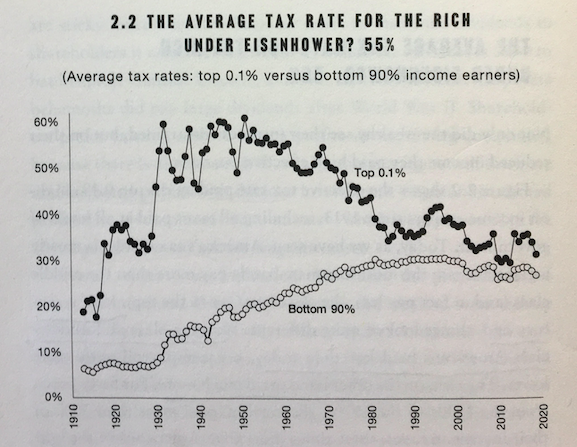
The second issue relates to the level of taxation applied to these various groups. What Saed and Zucman show is that over time this has come down, so that now the amount paid by those on the top 0.1% of incomes is very close to that paid by 90 % of the population. Indeed they show that the 400 highest earners in the US paid lower effective tax rates than the bottom 50% of earners.

The graph below, taken from their book, shows how effective taxation rates for the top 0.1% has evolved over the course of the 20th Century in comparison with that of the bottom 90%. There are three things to take away from this chart. Firstly, at the start of the last century and through to the late 1970’s taxation was essentially progressive with the richest paying a rate at least twice as much as the vast bulk of the population. Secondly, from 1980 taxation rates became essentially flat.  In other words the rate of taxation on fortunes and pittances were not that far apart. Third, from the start of the 1930’s through to the late 1970’s the average rates charged on the top 0.1% were high not just in comparison to the 90% but also high in absolute terms.

The high average rate which takes account of all taxes, some of which are regressive, was driven by some vey high progressive Federal rates. In 1944 the top marginal rate of the Federal income tax was 94% on incomes of $200,000 or more, equivalent to a salary today of £6m. 

One of the key conclusions Saez and Zukman want to drive home is that rates of taxation are not cast in stone. It is not a case of ” ’twas ever thus.” Far from it. There were times when taxation rates were very high and when avoidance was minimal. The low levels of taxation on the rich are the result of conscious political decisions coming out of contested belief systems. They could be changed.

One of the arguments against change is that such high rewards are needed to ensure a growing economy and rising GDP. However the average growth rate for the period of high taxation and lower inequality was much better than that for the period since 1980 since when growth rates have slowed. Some will argue the two things are not necessarily connected. Happy to concede that but of course it means that high progressive taxation wont necessarily undermine growth going forward.

Saed and Zukman look at what can be done in a world where sovereign states compete with one another to tax corporations less and less, and where the absence of progressive taxation, amongst other things has allowed inequality in wealth to sky rocket. They address the need to treat all forms of income  uniformly, so income from financial assets (the main source of income of the rich) is taxed at the same rate as income from employment. They explore a wealth tax and how this might work and they look at the scale of resources which could be brought into support public services that have been starved of resource for the past decade.

The timing of this book could not be better. Once Covid-19 is brought under control there will be an enormous bill to pay. That bill, like the bill for the Wars of the 20th Century needs to be shared in accordance with ability to pay. Expect much more debate about taxation in the coming years. Hopefully it will become clear that smart people pay taxes, and that smart rich people pay higher taxes than smart poor people. And the benefit of that is civilisation for all people.

The Triumph of Injustice: How the Rich Dodge Taxes and How to Make them Pay. Emmanuel Saez & Gabriel Zucman. WW Norton and Co. 2019.