
The Principle, the Agent and the Company

Over recent years executive pay has become an increasingly thorny issue. From the 1980’s onwards a growing body of thinking saw executive pay as being the vital spur to entrepreneurial growth but that levels of pay current at the time were not adequate to this. It was important to increase the level of incentive to senior managers and particularly CEO’s so they were appropriately incentivised.

In parallel with this there was a concern about how such incentives could be structured so as to align the interests of executive agents with those of the principal owners. How to align the owners long term interest in the growth of the company with the short term interests of the managers to inflate profits today.

The way around this principal/agent dilemma was to provide stock options. These were options to buy shares in the company at a point in the future at a discount to the current price. If the Executives increased the value of the company its share price would increase thus increasing the value of their share options when exercised.

The development of this theory is explored in Tom Bergin’s excellent new book Free Lunch Thinking. He charts the rise of the theory to the status of common sense and then explores problems raised by reviews of how executives actually perform when their pay is thus inflated.

His point is that the evidence about executive performance does not seem to confirm that it improves with greater pay. His first point is a generic one about the relationship between corporate performance generally and senior pay. He points out that between 1945 and 1970 corporate earnings in the US grew at the highest rate they have in the country’s history. This was a period when CEO’s were paid “like bureaucrats”, eg. in 1965 CEO’s were paid c20 times what the average worker was. By 2018 this ratio had increased to 278 times average earnings, however corporate earnings had declined.

Another problem was the link between successful management and share price. Theory would have it that the share price is the product of a multiple of the earnings of a company. However, the work of economist Robert Shiller who analysed share prices and earnings over a century discovered that the share price was far more volatile than the earnings multiple model would suggest.

For a number of other reasons Bergin finds the link between pay and performance to be tenuous at best. Generally his point is that the agent/principal problem is not sorted by increased pay channeled through share options because the link between performance and reward is not nearly so clear. If principal owners want their executive agents interests to be aligned with the success of their company ever higher pay levels and share options might not be the best way.

This picture seems to cohere with everyday experience that some people are highly motivated and some are not. The correlation of that to pay is not always obvious and any causal link is even more difficult to confirm both in terms of direction and strength.

A major assumption in this model is that the interest of principals and the companies they own are synonymous. The principal wants their company to be a success. This may have been the case in the 19th Century in private companies where all the shares were owned by an individual or family. But in an era of rapid trading the principal may have a fractionally small period of ownership and very little interest in the future success of the company.

An interesting example of this is provided by Shell’s annual accounts for the year 2019. Shell is a fossil Fuel company. In recent years the need to move away from fossil fuel use has become increasingly apparent and increasingly urgent. Given this you might think the company, with an eye to the future, would be devoting substantial resources to a move away from fossil fuels and towards alternative energy sources.

The accounts reveal however that in the year to 2019 the company invested $962m on Research and Development which might include work on renewable energy, but more than twice that amount, $2,354 billion was spent on Exploration which one might assume relates to the search for fossil fuels as we know where the sun and the wind are.

Despite the fact that it faces what many would see as an existential challenge the company feels it has got too much cash. In 2018 it launched a $25 billion share buyback programme and in the 2019 report its CEO was pleased to announce that $14.75 billion of that programme had been achieved by February 2020.

Given the longevity of Shell, which started out in the 19 century importing antiques and sea shells from the Far East, and its scale, its revenues were just under $345 billon in 2019, there are doubtless many long term investors in the company like pension funds. Will they, however, have the same level of commitment to the future of the company as its founder Marcus Samuel, or will they simply shift their investments elsewhere? And for the more frequent traders will there be any interest at all in the long term future of the business over its short term cash flow and share concentration?

Aligning the interests of the agent with the principal has been a long term concern of companies with professional management. What might have been missed is the problem of aligning the interests of both the principal and the agent with the long term interests of the company.
Rethinking Economics

There are a number of really excellent books around at the moment where the assumptions of both classical and neo-liberal economics are reviewed and challenged. Northern Comment has considered some of these in earlier posts on the Dismal Science. One of the really excellent books on this is Doughnut Economics Kate Raworth.

It is a root and branch critique of some of the basic tenets of Econ 101 and comes up with a model of economics that put people at the centre or rather in the ring of the doughnut. The model sets economic theory in the context of a finite planetary system. It does not simply bracket out as “externalities” issues which have existential implications for the habitability of planet earth.

As part of a Coursera MOOC there is a link to a lecture that Kate Raworth gives which is an excellent overview of her thinking on economics. It is a solid overview of the discipline and some of the more pernicious applications of a fundamentalist interpretation of the laws of economics. Worth watching.

The Ricardian Science of Political Economy

This morning’s In Our Time was about one of the founding fathers of economics, David Ricardo. Part of the programme dealt with his theory of comparative advantage which is still taught in economics departments today and is a founding pillar of the benefits of free trade. His exposition of the theory used as an example the economies of Spain and England.

In his thought experiment he assumed that Spain’s economy had an advantage in the production of wine and England in the production of wool (avoid thoughts of hot sun and wet grass). He then applied some made up production numbers assuming no trade.

Then using these “magic numbers” and some algebra he demonstrated the total amount of wine and wool produced would be increased if the two countries traded with each other.

It was interesting in two respects.

Firstly, in his exposition used maths to demonstrate the truth of his theorem. This sat well with his broader drift away from the economics of Adam Smith which were always set within a political and social context. Ricardo wanted to identify the natural forces driving the economy stripped of any moralistic assumptions of what ought to be the case.

This may have been the first steps towards trying to make economics a science, a process that later economists pursued even more self consciously as they aimed to achieve the successes of the physical sciences and notably physics at the start of the twentieth Century.

The second respect was the “random” choice of Portugal, wine, England and Wool. In fact this trade had been subject to a treaty for circa 100 years which was much to the detriment of Portugal. In essence producing a commodity, wine has much less potential for the development of a manufacturing industry than the production of wool and all its potential for spin offs (ignore pun).

I doubt Ricardo was engaged in some Machiavellian plot to create an intellectual theory to justify advantageous terms of trade. He may have been one of the first to consciously or otherwise provided an intellectual framework to justify terms of trade which advantage the strong and disadvantage the weak.

The theory of competitive advantage may well be true, and the sum total of wealth may well be increased by trade. However, the question that needs to be asked is, cui bono? To whom does that additional wealth go? Increasing global GDP is all very well but it needs to think how this will impact on real people. Specifically, following Ricardo, wine makers in Britain and sheep farmers in Spain. The fact that “the economy” is better off is of little comfort to them.

In Our Time is consistently interesting and stimulating. The link above takes you to this episode, it is worth a listen.

Age Inflation

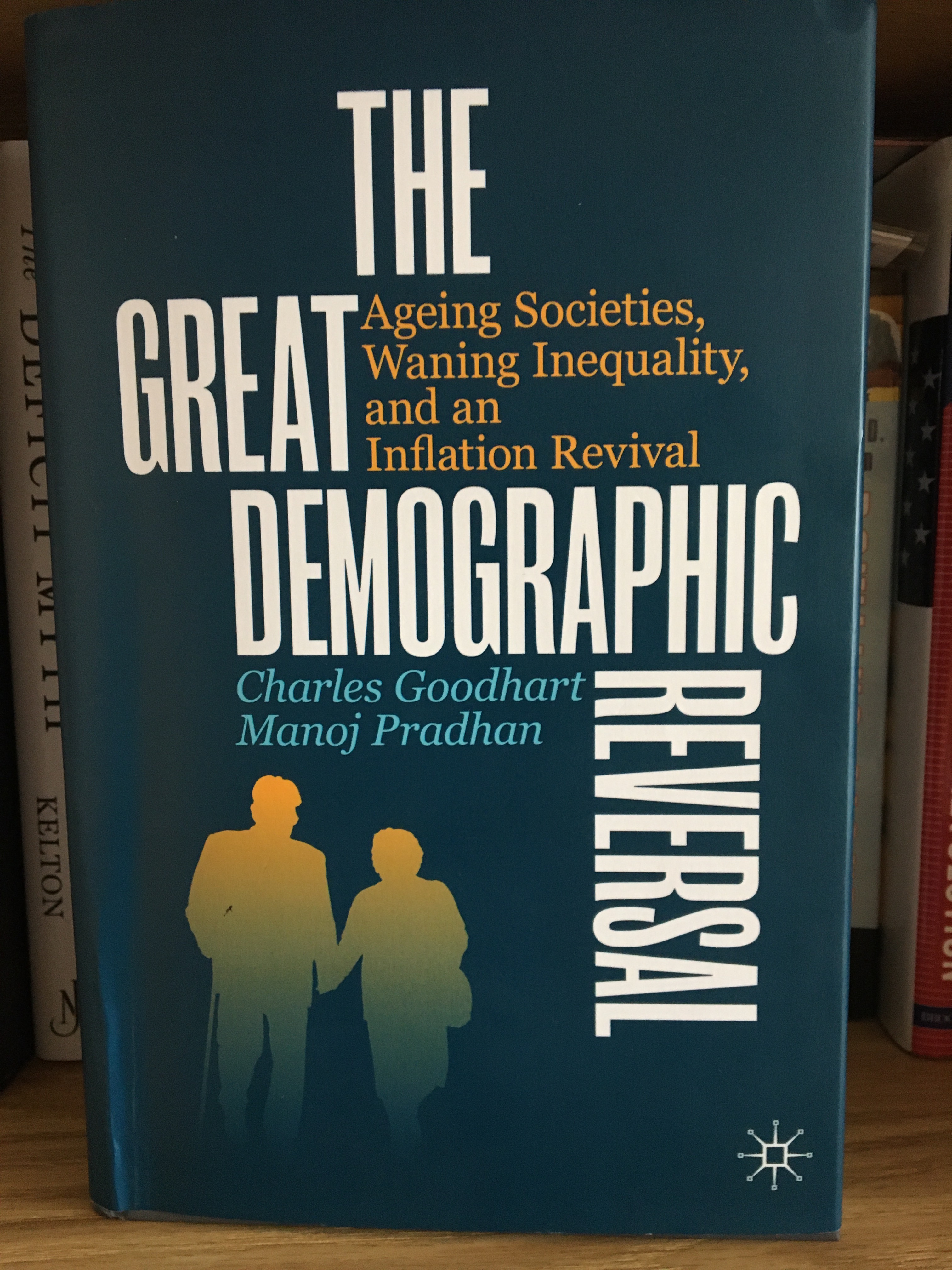
“The Great Demographic Reversal” is an immensely stimulating book by Goodhart and Pradham which amongst other things predicts a shift in the balance of power between capital and labour, reductions in levels of intra-state inequality and, worryingly for highly indebted nations, the return of higher nominal interest rates and higher inflation.

The predictions run counter to what seems to have become a prevailing view about the state of the world economy distilled into the concept of “secular stagnation”. This model, discussed elsewhere on this site, focusses on many of the same drivers as Goodhart and Pradham. An ageing population, increasing dependency ratios, a glut of savings, changes in the capital intensity of growth industries all leading to a paucity of demand for capital for investment. The demand for money is thus reduced pushing down its cost ie. interest rates. These things are also presented as part of the explanation for the aneamic productivity growth rates in advanced economies and a whole lot of other ills.

Goodhart and Pradham have a different take on these issues. They share the view that a demographic sweet spot in critical economies around the world has combined to create a benign low inflation and low interest environment. But looking forward they analyse how that national sweet spot is turning sour and is set to impact the evolution of the global economy.

In essence, they see that over the past thirty years China has proved to be a massive engine of deflation which it has exported around the world. Its insertion into the global economy through its membership of the World Trade Organisation in 2001 effectively increased the supply of cheap labour into an increasingly integrated globalised capitalism. This sucked in jobs from the advanced, relatively high wage, economies of the world and pumped out cheap manufactured products.

This meant a decline in demand for workers in manufacturing jobs in the West, a consequent reduction in their bargaining power leading to wage stagnation and or unemployment. This reinforced a shift towards service industries with a generation of baristas and deliveroo employees on minimum wages only able to remain fashionable because of the rock bottom prices provided by the House of Primarnia with its Asian manufactured clothing.

However, the positive demographic is being replaced by negative trends in both the East and the West. In China and many parts of the West population structures are shifting towards the elderly end of the bell curve. What is more the tail on the elderly end is being pushed out as people are living longer. This has a number of interacting consequences on society and the economy.

Firstly, there is the increasing demand on health and social services as the old and very old members of the population create increasing levels of demand for support. Goodhart and Pradhan have an excellent chapter on the health and care challenges of an ageing society.

Second, their living longer puts increasing strain in terms of national and private pension requirements. Responses to these may including raising the retirement age, reducing levels and or benefits, and closing final salary schemes. Whilst some element of all these have occurred in the UK there is a limit how far these things can be taken if not for moral, then for reasons of electoral arithmetic. Old people vote.

In summary both of these factors create significant levels of demand on public finances just at a time when the dependancy ratio, ie. the ratio of those who are economically inactive to those working and paying taxes is getting worse.

Not only is this happening in many advanced economies it is also happening in China. The dependency ratio there is moving in the same direction and labour availability is set to reduce over the coming decades. This will, over time switch off the deflation machine.

In parallel with all this is the shift in political sentiment away from globalisation linked to an increasingly populist rhetoric. Goodhart and Pradham make the point that this will have a doubly negative effect. Controls on immigration will exclude the labour required by the economy to improve the dependency ratio. It will also limit the importation of inflation reducing cheap imports.

Watchers of the Global economy may respond to the predictions of this book by pointing to Japan. A nation which has gone further along the demographic ageing curve than any other advanced economy. There is little sign of inflation or increasing nominal interest rates after the best part of three decades of economic stagnation and a national debt which, as a percentage of GDP, is 1.6 times worse than the current UK position, c260% plays c100%.

Goodhart and Pradham have a chapter on this and provide, to a laypersons point of view, a convincing explanation of why Japan’s experience cannot be seen as a prediction of the future impact of demographic changes globally. Not least because they were able, and did, take maximum advantage of the demographic sweet spot of their neighbour to import deflation.

The book does not simply explain the likely trajectory of the world economy based sole on demographics. They outline what significant challenges this creates but they look at a whole host of other factors as well including the rise of indebtedness in the non-financial corporate, household and public sectors. They also talk about the misalignment of management incentives with investment needs negatively impacting productivity growth. Goodhart and Padhan are clear that, whilst, ageing is inevitable its economic and social consequences are not. They depend on policy actions.

The final chapter of the book points to a number of actions that might be taken to start to address the issues of indebtedness, productivity and inequality. They see tax increases as inevitable but have interesting proposals about how they might be structured in the most equitable and effective way possible.

They explore the benefits of a land tax and a carbon tax . They also look at ways to reduce the differential tax benefits of debt over equity through an Allowance for Corporate Equity or a Destination-based Cash Flow Taxation (DBCFT). Both of these are mechanisms to push corporates to rely more on equity than debt which may be critical if the authors are correct about the likely direction of interest rates. They also talk about reforming the incentive structure for corporate managers which, currently, positively promotes the loading on of debt, excessive cost reductions particularly in relation to R&D, and the buy back of equity in order to push up the Return on Equity (ROE), all of which increase the benefit corporate managers derive from share incentive schemes.

At 218 pages this book deals with an enormous topic with a mix of close technical discussion of things like the Philips curve and the Non Accelerating Inflation Rate of Unemployment (NAIRU) and very easy to follow logic. It is definitely swimming against the tide of much current thought about the prospects for inflation and interest rates. However, much of what it has to say makes sense as a strategy for addressing some of our current problems of productivity whether or not the demographic time bomb is as powerful or as pervasive in its impact as they predict.

In the interests of full disclosure, as a pensioner the issue of inflation is close to my heart, and wallet, however, I recommend this book for anyone who wants to read an accessible and interesting analysis of the possible evolution of the global economy over the next few decades.

The Great Demographic Reversal: Ageing Societies, Waning Inequality, and an Inflation Revival. C Goodhart, M Pradham. Palgrave Macmillan. 2020