Why Trump must stay in the race.

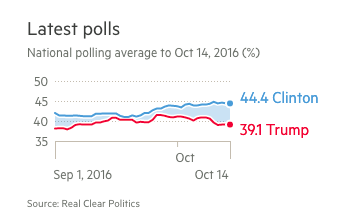
At first sight the suggestion it is important Donald Trump stay in the campaign to become the next President of the United States might seem crazy. Why might one want a bigoted, misogynistic, demagogue to remain a contender to become the most powerful person in the world. The first, and in truth the most important, reason is the fact that it looks now as if hscreen-shot-2016-10-15-at-12-54-25e will lose. The FT US Election 2016 graph of the latest polls shows Mrs Clinton with a 5% lead and describes support draining away from Trump as the revelations about his views on women continue to emerge. So it looks like a Clinton victory is becoming more and more likely which ought to be good news. However, I fear there is no good outcome for this election
It is clear that for many Mrs Clinton is just the  least worst candidate. Pew Research in the States  shows that for each candidate a third of those intending to vote for them are doing so  simply to stop the other candidate getting elected. If Mrs Clinton wins it is going to be difficult to claim a ringing endorsement when the main reason 32% of her supporters give for voting for her is because she is not Donald Trump. This cannot be a good outcome for a process to identify the most powerful person in the world.

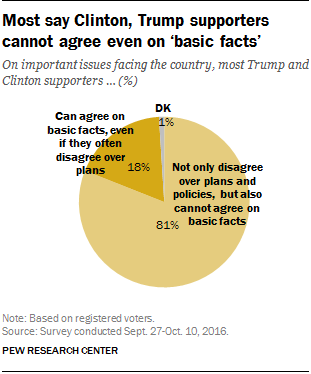
What has also become clear through the course of the campaign is the widening gulf between the supporters of the two main parties. Supporters for the two candidates not only disagree over screen-shot-2016-10-15-at-13-28-25policies, they cannot agree on basic facts. They appear to inhabit different worlds with little in common but everything contested. What is more, everything contested in  a very aggressive, not to say vicious, way. Compromise is not possible nor even thinkable. It is this which creates stalemate in the American system.
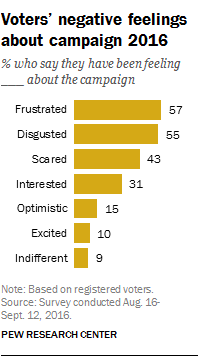
Worst of all is the fact that for a majority their overwhelming attitude to the whole Election is one of frustration or disgust. This is worrying in the extreme.screen-shot-2016-10-15-at-13-28-42 It is possible that people are going to start agreeing with the first part of Winston Churchill’s famous dictum on democracy being the worst form of government. Democracy can be remarkably robust when it rests upon  a foundation of internal social cohesion. Then the electoral process is a pragmatic way of conferring legitimate authority for a period of time. Take away the foundation of social cohesion and democracy becomes an arid arithmetic formula for arriving at a decision about who gains the levers of state power. To be a successful democratic nation its citizens need to have a common understanding of some foundational issues and a high degree of tolerance. At the moment tolerance is in short supply in  the States and the glue of the American dream seems to be dissolving.
All this brings me back to the issue of why I think Donald Trump needs to remain in the campaign. I fear that if he were to drop out then two things would happen. First, the die hard Trump supporters would develop a  rhetoric of the stolen election blaming the liberal media for giving credence to false accusations, there is evidence of this already and worse it is emanating from Trump himself. Second, those now saying they will vote for Mrs Clinton in order to prevent Trump getting elected might simply walk away. This may result in a President being elected on an historically low popular turnout. In circumstances like this the real loser will be democracy as some will believe their man has been swindled and others will have but tepid support for the victorious candidate.

Let me be clear I think that Hilary Clinton is by far the preferable candidate and she is focused on the kind of liberal issues which need to be addressed in the States.  However there are some more fundamental issues about growing inequality and the dominance of Wall Street over Main Street which are the issues which are exciting the citizens of the United States, her own supporters as much as those of Donald Trump. If these are not addressed it may be the US simply becomes ungovernable.

The grandees of the GOP seem to have calculated Trump is a lost cause and will lose the election they are therefore turning their attention to the race for the Senate, where 34 seats are up for grabs, aiming to increase their current majority. All this means 2017 may well be another year of paralysis on Capitol Hill further undermining support for the political system and by association democracy. Inequality will increase, the living standards of the majority will continue to stagnate and the grounds will be laid for a far more radical solution to be proposed by a demagogue with more traction. More Marine Le Penn than Nigel Farage. The fact that someone as obviously phoney and inappropriate as Donald Trump could get so far in the process is a clear sign that something fundamental is broken at the heart of American democracy. Radical change is needed which will mean a real shift in power. Those that have it are not likely to support this. They need to be careful however as the alternative may end up being worse, even for them.

We can only hope that some in the States remember the second part of Churchill’s dictum that democracy is the worst form of government… apart from all the others.


Time for a new model pension fund rescue — FT.com

Whatever the solution, the problem is critical. If rising bond prices and poorly designed pensions are not to create yet more inequality, poverty and anger on the part of those who feel abandoned by capitalism, it is more vital than ever to work out a model for pensions that is fairer than DC, and more practical than DB.

Source: Time for a new model pension fund rescue — FT.com

Brexit – What a Mess!

Political elites around the world have been infected by an inability to provide genuine and convincing leadership. This partly because of examples of personal ambition or plain greed getting in the way of rational governance but it is much more to do with a far more insidious and profound undermining of concern for the big issues of politics.

It is thirty years since the “big bang” in the City of London, this, emblematic of a global process of financialisation and deregulation. Everything, being given a monetary value, traded and then gambled through more and more “sophisticated” derivatives.

The idea that there is something called society or that the economy is anything other than a series of rational, utility maximisers with perfect knowledge seek personal advantage has been undermined if not destroyed.

Politicans when they looked to set up the European Community had a rather greater vision. They had just come through two “Great” wars which had devastated a continent and killed millions of men, women and children. They knew that there were things that were more important than the price of bonds and derivatives. No one worries about the LIBOR rate in the cemetery.

I am not suggesting the past was a land where politicians were noble, selfless guardians of the greater good of humanity. Men’s motives have roots deep and complex. Neither am I suggesting that a well functioning economy is not vital for a good society. However I am arguing that there are some profound political issues which have been increasingly marginalised. Issues about who gets what and why have been parked on the basis that all boats rise as the productivity tide come in and what is there to worry about if living standards are increasing.

This model probably always had a limited life but when the tide is no longer rising, all the little boats in the harbour are stuck in the mud and the only ones gaining are those in the ocean going yachts the prospects for the future are grim.

We now have a set of politicians on the remain side of the argument who are reaping the discontent they have sown over the past thirty years. The everyday disparagement of the European Union, the failure to challenge a world-view which sees all current evils through the prism of immigration, an unwillingness to accept that being filthy rich is not a sign of being one of the elect and that inequality is eroding national solidarity.

Worst of all a failure to make a case for the European Union that is more than, it is the least worse future. Europe clearly has its problems, the democratic deficit being a key one. But the same politicians who rail on and on about faceless unelected bureaucrats would go apoplectic if you said ok we want to elect them. Europe needs radical reform, Britain should be at the heart of that process holding up a vision of a better future which is more than simply a more efficient economy. For many people “the economy” is a mythical beast. Which, bites them when there is a recession and does very little for them when there is a boom.

Whilst the remain side are reaping the seeds of discontent, the out campaign are busy sowing a more virulent strain of the crop. If they win I fear we are all in for a bad harvest.

The Hidden Wealth of Nations

Recently read a really interesting book on the issue of the moment following the leaking of the Panama papers. It is by Gabriel Zucman and in a very concise and clear 116 pages sets out the scale of the problem of tax havens, how they operate and what might be done about them.

He estimates on a conservative basis that some 8% of personal financial wealth amounting to $7.6 trillion is held in tax havens. By way of comparison the UK’s total GDP is about $2.5 trillion. Also this does not take any account of income that is hidden by corporations.

Zucman looks at the history of the growth of private banking in Switzerland at the centre of much of the operations that utilise other tax havens to make as opaque as possible who owns what and where it should be taxed. He addresses a number of myths about Swiss banking and illustrates that any reform predicated on the goodwill of the bankers is doomed to fail as it has done in the past.

He goes on to contrast the European Union’s Savings Tax Directive (STD) which he believes to be essentially flawed with the United States approach through the Foreign Account Tax Compliance Act (FATCA) (where is that final T?). Whilst FATCA might not be perfect it is having an impact and has much to recommend it.

Essentially if banks do not themselves let the US tax authorities know what holding US citizens have in their overseas accounts then the US will impose a 30% tax on all interest and dividends payments from the US to that bank. They can also levy substantial fines. To ensure bankers apply FATCA they encourage whistle blowers to let them know of abuses. What is more they pay them handsomely. Bradley Birkenfield an ex-employee of UBS was paid $104m for revealing the non-compliant activities of his former employer.

Whilst FATCA is a real step in the right direction Zucman identifies three other things that should be done on a global scale to address the problem of very wealthy people hiding their wealth from the tax man.

Firstly, he proposes a worldwide register of wealth that would be a public record of the beneficial owners of stock, share and bonds and ultimately all derivatives. In fact national and regional registers of stocks and shares already exist however they are private documents. By bringing them into a single, public register it would make visible the financial wealth of all individuals.

Secondly he recommends that sanctions against tax havens should be proportional to the losses that they impose on other countries. This is in essence what FATCA does with banks. By doing this the economics of being a tax haven break down.

Finally, he recommends that international taxation agreements should be amended for corporations. In essence this would mean taxation of multinationals should derive from their consolidated profits. So if Starbucks sells 50% of its products in the US and employs 50% of its people there and has 50% of its plant then it should pay 50% of its tax there. This gets around the issue of having transfer-pricing arrangements where subsidiaries, providing services based in tax havens, charge large fees to the US subsidiary thus reducing its tax bill their, shifting it to the lower rates in the tax haven.

It would also address the nonsense that a company like Apple with $500bn in the bank borrows money in the US to pay dividends because if it repatriated the profits from abroad they would be subject to tax.

Others have suggested that individuals should have a strict liability to inform the state of all their wealth and income. If they fail to do so and thus hide wealth from the state then they forfeit the right to state protection for that wealth. If it is found then 100% of it is immediately confiscated, and to assist the process anyone who reveals the existence of the wealth can claim 50% of it as a bounty. I do like something that is clear and simple.

We have had years of fine words about what we are going to do about tax evasion and tax havens it is time something started to happen. The governments seems to have two responses first “well Labour did nothing about it”. So what. Labour aren’t in power. Second, the Prime Minister has been spearheading the issue in Europe. Well the tax deals done so far with large multinationals suggest he might want to get his spear out over here.

The first step might be to appoint a few tax inspectors to replace those that have been made redundant since the government came to power. They are an unusual part of the government machine in that they bring in vastly more in tax than they cost. Surely austerity demands we maximise our income. What business, even one wanting to save money would sack people collecting more than they coast to employ?

If the MP’s expenses scandal was anything to go by, the press will probably have more interesting revelations to bring out of the 11m+ documents over the coming days and weeks.

Now is the time to push our politicians to do something significant about tax havens and tax evasion. If you want to get a good overview of the issue in a short but well argued book this is it.

The Hidden Wealth of Nations: The scourge of tax havens. G Zucman. The University of Chicago Press. 2015.