AC/DC – After Covid-19 / Deep Change

Covid-19 is having an impact on peoples lives and the economy unseen outside of war time. Untimely deaths, isolated from loved ones; radical isolation; family separation; economic stagnation. These are just some of the most obvious negative effects of a virus no one had heard of four months ago.

Given the speed of the transmission of the virus it is doubtful we have seen anything like the worst of it yet.  Developed nations with effective state infrastructures and sophisticated health care systems have not been able to keep up. The UK and the US face many more deaths before this scourge is brought under control.

Unfortunately, in developing nations the situation is likely to be much worse. As I write there is something like 50k deaths attributed to Covid-19 around the world, and given issues about recording this is probably an under estimate. The harsh reality is the ultimate death toll is more likely to be in the hundreds of thousands or even millions than in the tens of thousands.

Given all this it may seem premature to start thinking about what happens after Covid-19 however, I am confident there are those who are very much focused  on exactly that. They will not want to waste a crisis nor will they want to pay for it. I do not think we should give them a free run.

As we battle with Covid-19 it is teaching us some profound lessons. Ones which we should not allow to be lost or spun to the advantage of a minority at the expense of the majority. What are some of theses lessons?

First, how unprepared we were as a nation and a world for a pandemic that we have had a century to prepare for and numerous warning shots (SARS, MERS, Ebola etc.) to prompt us to take seriously. 

Second, the importance of those whose work is fundamental to maintaining and keeping open the essential arteries of society. People often on low or minimum pay: long distance lorry drivers, local van delivery drivers, supermarket checkout assistants, carers, nursing staff; first responders of all sorts. During the crisis we have all literally applauded these workers and we should not forget our debt to them AC.

Third, what a flexible and yet limited science economics is. TINA (There Is No Alternative) is lost, society is found and we have stumbled into a forrest of magic money trees. Debt is not  problem, we will do what it takes. Efficiency, with its low stock levels and just in time global supply chains are not all upside. What rational utility maximiser would expose themselves to a deadly virus for minimum pay? 

Fourth, when the role of the state has been rolled back through a radical programme of Austerity and tax cuts it has little capacity to respond to sudden shocks.

Five, hundreds of thousands of people are now being thrown onto a benefits system that is not fit for purpose.  You can understand why there are delays in answering calls when there is such a massive increase in demand in a short space of time. However, why claimants should have been routinely expected to hold on the line for an hour as the new system of Universal Credit was being rolled out over the past decade is inexplicable and inexcusable. As a brighter light is shoe on the benefits system we should start to address the basics of what amount of money people should have when they are unable to work in a rich civilised nation. At the moment it is shamefully and comparatively low.

Last but by no way least, who will pay? When the bills start to come in how will the debt be serviced? We have all been in this together and we all need to to come out together. Equity, demands those with the broadest shoulders need to contribute most to the cost. This means an industry whose role is to reduce taxation is not acceptable. It cannot be right that those who build fortunes by hiding their incomes and avoiding their taxes expect to be paid interest on money they lend to governments from those fortunes. 

We must not accept that the longer term impact of Covid-19 is continued Austerity with a capital A. There are questions about the levels of inequality and public financing which need to be addressed which take account of the interests of the many not the few. After Covid-19 we need the depth of change we achieved after World War 2 when national debt was 200% of GDP but we built a social state and established the NHS.


Covid-19 & Imperial College Report

The government’s pivot from a strategy of mitigation to a strategy of suppression this week was caused by the work of the MRC Centre for Global Infectious Diseases analysis led by Prof Neil Ferguson. The report in question is the Centre’s 9th report on Covid-19. Twenty pages long there is some very impressive statistical analysis but the argument and the conclusions are clear for any lay reader.


It considers the pros and cons of both mitigation and suppression strategies for dealing with Covid-19. Spoiler alert, it comes down very much on the side of suppression given the likely level of deaths of the mitigation strategy, 250k. In essence this is mainly due to the health system being overwhelmed before any benefits of herd immunity begin to appear.


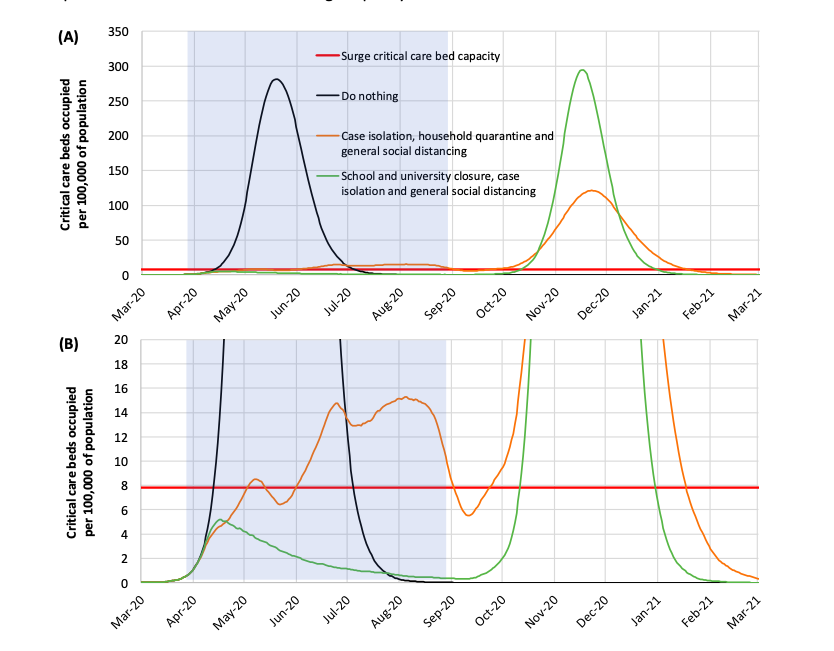
I recommend anyone not yet convinced of the need to take seriously the advice of the government on radical social distancing to read the report. Specifically I suggest you contemplate Figure 3 from the report shown below.

The key thing to look at here is the red line at the bottom of graph (A), as expanded in the lower graph (B). This is the critical care bed capacity in the system.  The black, green and orange lines are what happens given different social distancing responses. Black is that colour for a reason. If we do nothing then the NHS will be overwhelmed with cases and have nowhere near the capacity to meet demand. This will therefore mean some 250k+ Corona virus patient deaths. I am not sure  whether this addresses collateral damage ie. those patients that ordinarily need a critical care bed but will not be able to get one because they are full of Covid-19 patients.

The orange and green lines show differing levels of social distancing. We have moved from being “advised” to being “told” by the PM that we should move to what the green line requires. I suspect the next step will be “instruction” backed with sanctions.

The aggressive suppression strategy clearly manages to keep the cases of corona virus requiring critical care within the capability of the system. However, it does assume the social distancing measures last until September, a touch longer than the PM’s optimistic timeframe. 

The down side of the suppression strategy is that it slows/prevents herd immunity and thus when the measures are relaxed the virus takes off again. Does, therefore, suppression simply delay the inevitable? No. Critically what suppression does is buy us precious time. Time to build critical care capacity: beds; staff; PPE; ventilators etc. Time to build testing capacity both in terms of scale but also the ability to test for those that have had the virus and are well. Finally, time to identify a vaccine, although this is clearly many months away at best.

The strategy seems to be the “Hammer and Dance” one set out by Tomas Pueyo’s in his article, referenced in my last post. This involves Hammering the virus with aggressive social distancing. The aim being to get the infection rate from something like 2.4 persons to 1 or below. In other words  the number of people an infected person passes the virus on to falls from 2.4 to 1.

Then infections will start to reduce and the Dance begins as critical care facilities gain capacity social distancing restrictions can be relaxed. As soon as the rate of infections start to build again the restrictions need to be reapplied, however, by then it may be possible to target them more effectively through the use of much more wide spread testing. A touch of 2 steps forward and one back. Or perhaps more like  like the fair ground game “Whack a Mole” where moles pop up in random places and you have to whack them back down.

If you want to get a reasonably good picture of the likely evolution of the disease and the key factors driving its spread the Imperial College Report is well worth a read.

Stay safe 


Cash – COVID-19 Virus

“Turnover is vanity, profit is sanity, but cash is reality”.

There are plenty of unprofitable businesses in the world some with very high turnovers, but there are none without cash. Some businesses have mountains of cash like Apple and Amazon, tucked away in low tax regimes. Obviously they are “smart” businesses avoiding paying taxes to states that waste the money on things like universal healthcare. I wonder if all those tax dodgers are immune to COVID-19?

However I digress. In the last budget, that was six days ago when the world was a different place, the Chancellor announced a £12bn package of measures to support business. This morning on the Today Programme that amount was dismissed as a rounding error for the scale of support needed.

The need is not for tax relief next month  it is for cash, today or tomorrow. The reason for this is that so many businesses in the hospitality industry operate on very tight cash margins. Once day to day operating costs are covered the money coming into the business during a month provides the cash to pay for the salaries and the tax bills at the end of the month, and if you are lucky an element of profit. If halfway through the month, say on the 16th, the Prime Minister tells all your customers they should not go into your pub, restaurant, hotel, theatre etc then it is very likely by the end of the month you will not be able to pay your salary or tax bill.

HMRC can be as understanding about late payment of tax as they want, staff will either sue for their wages, or walk out, or both. In any of those scenario’s its game over for the business.

This is what will happen to hundred of businesses around the country and thousands of staff, possibly millions as it is clear other industry sectors are beset by the same basic cash problem. The scale of the problem is enormous.

Providing cash to keep businesses afloat when there are no customers, for one, two or six months is a mind boggling number. So big it may be dismissed out of hand. But then on the other hand the alternatives are not great.

Firstly, there is a logistical problem. In the space of a couple of weeks hundreds of thousands could be being made unemployed. The DWP are wrestling with Universal Credit, and losing. They will be overwhelmed with demand for from new claimants. The transfer payment bill will go through the roof.

Although the social security bill will balloon, as people move from low wages of circa £300 per week (most hospitality workers are on minimum wage) to unemployment benefit of around £70 per week the impact on demand in the economy will be immense. Causing other businesses to contract or collapse creating a vicious circle of decline, further reducing tax revenues and further increasing transfer costs.

The level of discontent this will generate in a population restricted to their homes does not bare thinking about.

COVID-19 is not just infecting people it is infecting the economy. More specifically it is attacking cash, the life blood of all current economic life. The only way to insulate against this is an enormous transfusion of  new cash into the economy. As Jim O’Neil suggested on the Today Programme we need Quantitative Easing for people. Others have called it helicopter money, after the notion that you empty sacks of money out of helicopters. The idea being to put effective demand into the hands of consumers, the vast majority of whom will spend all of it and thus stimulate the economy.

There are some very radical proposals kicking around at the moment. If people thought the last budget was a radical spend budget for a Tory government, they ain’t seen nothing yet.

(Declaration of interest – The writer part owns a small restaurant)

What a difference a day makes!

On Sunday I posted about a likely shift in gear as the government responded to a growing chorus of concern about the scale of the response to COVID-19. I agonised over sharing a link to an article by Tomas Pueyo which painted a rather bleak picture and was urging radical action on social distancing immediately. I did not want to contribute to a growing sense of unease. Little did I know.

I have more confidence now and believe yesterday was merely an introduction of what is to come and that by the end of the week legislation will be in place to enforce a much more rigid programme of social distancing, nay social isolation.

The report from Imperial College London has focused policy makers minds with its projections of a quarter of a million deaths unless radical action is taken to slow the spread of the disease. This would overwhelm the NHS and involve medial staff making live or die decisions.

There were a number of criticisms one could make about yesterday’s speech and it is easy to snipe from the sidelines. however phrases about what we are “going to recommend” do not help. And suggesting what people do is too weak. There may not be the legislation to back up clear instructions at the moment but that should not prevent them from being given and it is a matter of days, maybe hours, before that legislation is in place.

Two things are absolutely clear:

  1. Social distancing should be taken really seriously. No social gatherings at all. There is plenty of guidance on this. One practical piece of advice, have a soap dispenser that you have to step over to get into your home. As soon as you come in from outside wash your hands before you touch anything. The virus can remain on surfaces for 72 hours+
  2. Isolated individuals and families, particularly the elderly, who do not have local support will need help from their neighbours. Such help is the right thing to do from a moral point of view but also from a public health point of view. If people are infected  and hungry they will go out. Unless they are critical hospitals will not be interested. There is not the infrastructure of public social care support to help them. It is going to come down to neighbours to help them maintain the isolation.

Yesterday was tantamount to a declaration of war. Like all wars it depends upon public servants to be won. Sometimes that is the soldier, this time those on the front line are doctors, nurses and a range of other healthcare workers. We should not however forget the private sector workers who are on the front line particularly those operating the supermarket tills and transport staff who interact with the hundreds of members of public every day.

What is crystal clear now is that time is of the essence, and no longer should we underestimate what a difference a day makes.