Why Are We Waiting?

If you want to read one book on climate change, which provides a balanced and comprehensive overview of the topic this is it. Nicholas Stern has been engaged in the issue for decades. In 2006 he produced “The Stern Report: The Economics of Climate Change” reviewing the economic implications of moving to a low-carbon global economy. The authority of the writer comes across from the start and builds as you read the book, which, for those that did woodwork, is not without its challenges.
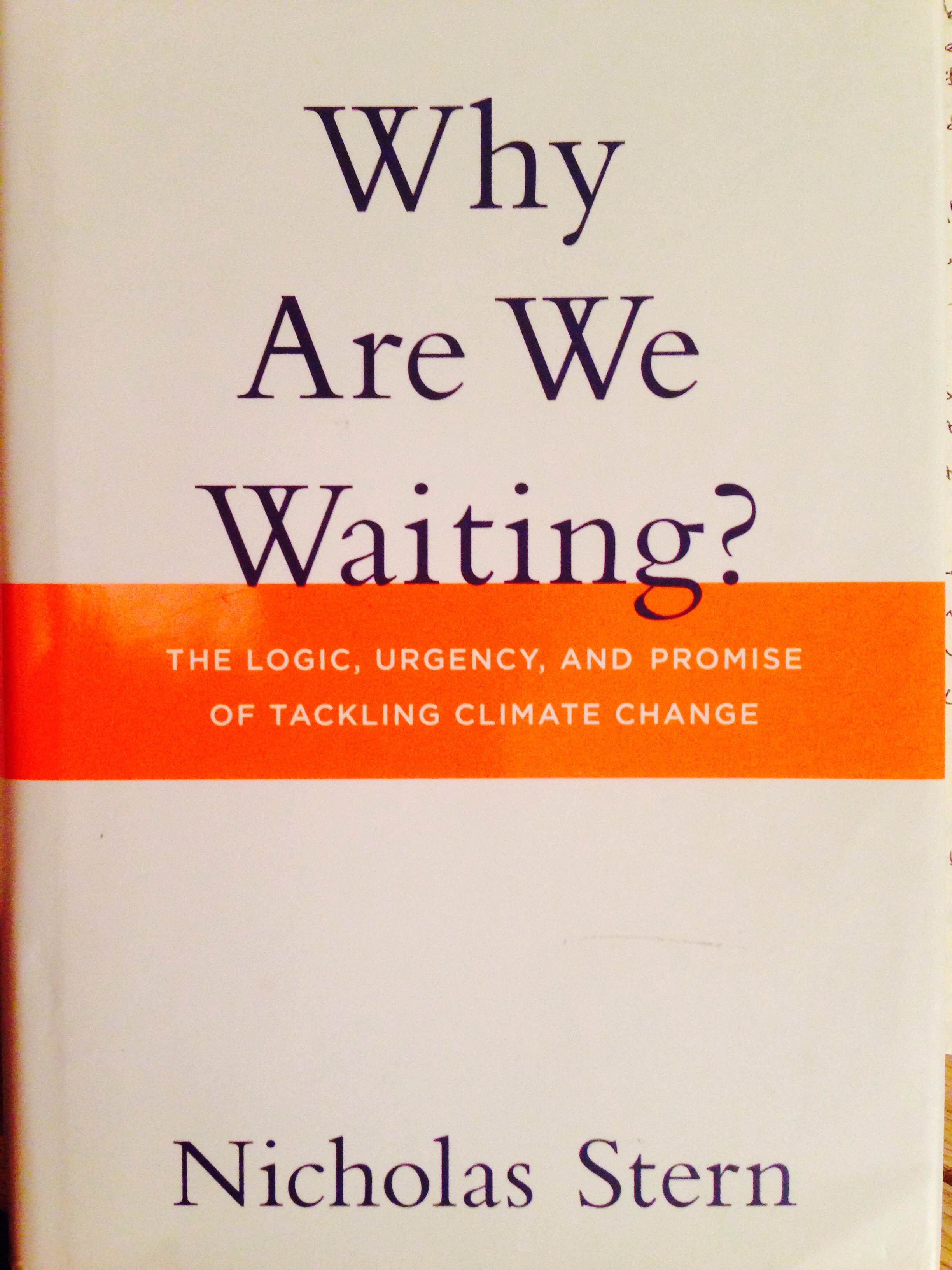
IMG_1258The book came out just before the 2015 Conference of the Parties (COP21) in Paris. It set out a new approach to the global management of climate change moving away from top down, legalistic targets to an approach premised more on, effective measurement of emissions, individually set voluntary targets and regular review of these to establish more ambitious ones. In essence this seems to have been a recognition of the political reality that a) the US Senate would block any Treaty ratification and b) many of the emerging economies were unlikely to sign up to something that undermined their economic growth.

The title of the book aims to challenge the current complacency around the issue of climate change. Stern sees the next two decades as fundamental to determining whether the world can create a viable response to the threat of global warming. The reason for this is a combination of demographic, economic and infrastructure changes that are set to occur over the next twenty years.

Demographic projections between now and 2050 suggest the world’s population will grow from something over 7bn to just under 10bn. What is more, 70% of that population will live in cities compared with 50% now. Many of these people will be in the rapidly expanding emerging economies, notably China, whose growth is hugely energy resource hungry.

These mega trends have enormous investment and resource consequences, which, are intensified by the fact that the existing infrastructure of many developed nations is dilapidated and also requires significant investment. This means over the next twenty years there will have to be massive investment in developing new cities and improving existing ones.

How this investment is undertaken and its results will structure the world’s energy demands for the rest of this century and beyond. This is fundamental as the science makes clear we are now close to the limit of CO2 equivalent gasses (CO2e) that we can put into the atmosphere without creating an existential challenge to the future of the human race.

Currently, the world emits about 50bn tonnes of CO2e gasses annually. If we want to constrain the global temperature increase to no more than 2 degrees Celsius we need to reduce emissions significantly. Specifically by 2035 we need to be <35bn tonnes and by 2050 down to <20bn tonnes. Whilst the specific path might vary this level of reduction reasonably represents the scale of the challenge. A challenge magnified of course by the growth in the world’s population and in its wealth.

The book is well documented and provides a brief history of the underlying science relating to the impact of CO2e gasses on global warming. It charts the ups and downs of the international policy response since the establishment of the Intergovernmental Panel on Climate Change in 1988.

The arguments in the book are very balanced. Stern is not one for “sexing up” the evidence. He genuinely believes it speaks for itself. He is meticulous at presenting the positive progress that has been made in some areas. Indeed he thinks this is vital in convincing people the issue is something that can be addressed, as well as must be.

His emphasis, however, is urgency. He explains how the nature of the problem is such that it conspires to undermine effective policy action. Its scale, the risk and uncertainty surrounding it, the delays in consequences and the “publicness” of greenhouse gas emissions all undermine an appreciation of what is a clear and present threat.

The notion of the “publicness” of greenhouse gas emissions is worth a word. By this Stern means it does not matter where the emissions come from, it is the cumulative total which matters, and its main impact will not be distributed on the basis of who has contributed most to the problem. This raises enormous questions of equity given that the largest contributors to the problem to date have been the, rich, developed nations of the Northern hemisphere and, per head, this remains the case. Ironically the, poorer nations in the Southern Hemisphere, who to date have contributed least are those likely to face the earliest significant consequences of change.

It is partly because of this that one, if not the, key theme of Stern’s book is the need to link the issue of climate change and poverty reduction. As he puts it “… the two defining challenges of our century are overcoming world poverty and managing climate change.” If you think solving world poverty sounds a bit idealistic reflect on the following. The current level of global CO2 emissions is 7 tonnes per person. If we want to keep global warming to 2 degrees Celsius this needs to come down to 2 tonnes per head by 2050. Currently China, the largest national emitter of CO2, emits the equivalent of 9 tonnes per person. The United States on the other hand emits 20 tonnes per person.

People living in grinding poverty, or even at standards which are half those of a small minority of the planets population are unlikely to worry about the impact of climate change if those that have been the “winners” to date are not seen to be doing a lot of the heavy lifting. The eradication of global poverty is no longer just a moral issue it is tied to the long-term sustainability of the planet.

There is a technical section of the book which looks at the models used to predict the impact of climate change. Stern feels there are some fundamental flaws to some of these models. He argues, “The basic problem is that they have assumed underlying growth plus only modest damages from big increases in temperature, plus very limited risk.”

Because they ignore some significant “tipping point” risks and issues like potential migration patterns they lead to overly optimistic conclusions. So, for example, some of the models assume 2% annual growth and 20% damages from climate change over time. These end up showing the world to be 6 times better off economically even with 8% temperature increase. So the economy is fine, it’s just that all the people are dead.

The book is written in a very clear and persuasive manner. There are no flights of emotional rhetoric, no avoiding difficult questions. The evidence is laid out systematically and rigorously. Mr Stern clearly believes in the power of rational argument, which is much to his credit. I would be very loath to question his grip on international policy development. If I have one concern it is that he may underestimate the strength and resolution of those with a material interest in rejecting the risks associated with climate change.

Unless there is a massive technological breakthrough on carbon capture and storage the reducing CO2e emissions path set out above is probably the only viable way to limit the increase in global temperatures. The implications of this are that somewhere between 65% and 80% of the known fossil fuel reserves currently in the ground have to stay there. That is a lot of pain. Pain, which would be felt by some of the most wealthy and thus powerful people on the planet. I am not sure how far rational argument will go along that line.

I started by suggesting that if you only want to read one book on climate change “Why are we waiting?” should be it. I would conclude by saying don’t read one book on climate change, read two. Read Nicholas Stern in conjunction with Naomi Klein’s “This Changes Everything”. Stern and Klein have very different views about who will play the leading role in addressing the issue of climate change. For Stern the private sector has to be mobilised. For Klein it is an effective state energised by local activism. Whatever their differences they are both attempting to inject a much-needed level of urgency into the issue of climate change. They both provide insight and illumination. A Kein/Stern synthesis would be tremendous until then the effort of reading two substantial books will not be wasted both are excellent in their different ways.

Nicholas Stern. Why  Are We Waiting. MIT Press 2015

Other People’s Money

“Don’t tell him your name Pike” Capt. Mainwaring.

Capt. Mainwaring is one of the hero’s of this book. John Kay remembers back to a time when bank managers were boring but trustworthy. When they took seriously the duty of care they acquired with other people’s money and spent tiScreen Shot 2015-10-16 at 17.14.40me understanding the needs of their clients and customers. This model of bankers as pillars of the local community, a touch fuddy duddy but completely reliable lasted well beyond the time of Mr Mainwaring.

When I left University and was seeking a mortgage I met a clone of Mr Mainwaring at my bank, the Midland. He asked me all kinds of difficult questions about what I spent my money on, why I had a history of overdrafts, whether he could see the budget he assumed I had produced to demonstrate to myself that I could afford owner occupation, what my prospects were. God he was a pain, and God did he irritate me, and God was he right! This was the early 1980’s.

That bank manager was probably one of the last of the breed, in 1986 we had the big bang which aimed to release all the pent-up creativity of the financial industry. Old-fashioned bankers who wanted to understand exactly how clients were going to repay them were to become a thing of the past.

For those that have not kept up with the changes John Kay’s book is an excellent guide. If, like me, you still thought the role of banks was to take in deposits from lots of people and then lend that money out to businesses that needed help starting up or expanding, think again. If you thought that the bank of England created money by printing notes and pressing coins, think again.

Mr Kay examines how financial services have exploded over the past 30 years and whilst some of that has been positive we are now in the position of having “too much of a good thing”. In fact we have a critical area of the economic system which is generating instability and risk. More than this we have a process where a service, finance, has begun to transform the operation of the wider economy and society. A process of “financialisation” which undermines much which is valuable and creates enormous benefit for the few and enormous risk for the many.

Let us go back to the role of the bank to illustrate the scale of the issue. According to Mr Kay “Lending to firms and individuals engaged in the production of goods and services – which most people would imagine was the principal business of a bank – amounts to 3 percent of the total.” The vast bulk of banks balance sheets nowadays are the claims financial institutions have against each other. But what are these claims?

They are trading positions (or what you and I might call bets) on fixed income securities, currencies and commodities. JP Morgan’s exposure to derivatives of this kind is around $70 trillion. Have in mind that the annual Gross Domestic Product of the world is about $70 trillion. Deutsche Bank has $55 trillion worth of derivatives exposure. Against this it has deposits, the savings of people like you and me, of $577 billion and it lends money to customers of $397 billion. These are big numbers but they mean that what you and I think banks do amounts to 1% of their activities.

Mr Kay identifies 4 key functions of the finance industry: i) a payments system, cheques, ATM’s, bank transfers etc.; ii) “intermediation”, matching borrowers to lenders; iii) enable individuals to manage personal finance across lifetime and generations; iv) help individuals and businesses to manage risk. He then goes on to explore how modern finance does in relation to each of these. In each case we end we conclude that the financialised world is not serving us well.

If we take matching lenders to borrowers banks do provide an important “intermediation” service. Historically they did this by taking in lots of small deposits which people wanted instant access to and converting these into long-term loans. They could manage this trick because a) they had money invested by the owners and b) in practice not all those that deposited money with the bank would want it back at the same time. This meant they only needed to keep a fraction of the money deposited and invested on hand to pay out to those who happened to want it back.

In the mid 19th century it was typical that banks owners would have invested equity equal to 40%/50% of the banks total investments. This meant of course that 40%/50% of the loans that they made could go wrong and the depositors money would still be safe. However, banks decided they could be more efficient and create more profit if they pushed the logic of this along a bit.

By the start of the 20th Century the typical level of equity had dropped to around 25%. (See Admati and Hellwig) Post big bang however they went for it and did two things. First of all took the view that if a banks purpose is to lend money and it wants to expand then it needs more money. If depositors like you and I were not providing enough then they needed to go to the wholesale money markets and borrow big chunks from institutional and large-scale investors. They therefore borrowed a lot more, although still on short terms, but they did not increase the equity reserves.

In the run up to the financial crisis according to Admati and Hellwig the debts (deposits and wholesale borrowing) of many large banks financed 97% of their assets. What this means is, if more than 2% of its loans go bad the bank is insolvent. You might try going to a bank with a start up business and ask to borrow 97% of the costs, putting 2% in yourself. The banks would consider such a prospect as unfundable. So why are they fundable? Because you and I, as taxpayers, have been providing an implicit, and since 2007/08 explicit, guarantee to those that invest in banks.

One key outcome of the explosion in financial services has been the incredible growth in credit. As Mr Kay makes clear some credit is a good thing. When an economy is growing new businesses require credit to get up and running and to expand their activity. At these times and expansion of credit is a good thing. Indeed in times like this credit may well grow faster than the economy as a whole. It is important to appreciate the causal relationship however. Banks argue that the supply of credit will push growth. It may be of course that in reality growth pulls the supply of credit.

Everything is fine if credit is going into new productive investments creating new products and services that the public want. In the current economy however the demand for investment in new businesses is changing. New high-tech businesses do not have huge capital requirements. Google needs no factories or heavy equipment. Indeed many of the existing large businesses in the world fund their growth needs from internally generated cash.

Investors want good returns and security, a combination that seems contrary to economic theory. One way to square this circle is to invest in existing assets like houses and leverage your investment with borrowed money. So now around 70% of traditional bank lending is to purchase homes. Credit expansion fueling demand can be created by the stroke of a pen or more like the tap of a keyboard. Building houses to create supply is a much more complex and time-consuming business. The result asset price bubbles.

The investor appetite for this kind of business was insatiable in the early part of this century and led to the creation of asset-backed securities. This involves banks bundling mortgages together and “securitising” them. In other words selling the income stream that all the mortgages generated to a third-party, possibly another bank.

This basic asset backed security can then be “structured” and transformed into a collaterals debt obligation (CDO) which pays different rates of return to different investors from different slices of the asset. The purported purpose of all this financial jiggery-pokery was to diversify risk and to place it with those best able to manage it. And then to spread the problem a little further those with CDO’s would take out a Credit Default Swap (CDS) which insured them against defaults on the asset.

Now go back to what all this financial pile of crockery is standing on. A mortgage. Had it been just on my mortgage, taken out after I have been through a third degree interview with Mr Safe who pretty much knew every creaky corner of my finance and prospects then probably 2007/08 may not have happened. However, because there was such demand and so much innovation Mr Safe was long gone. Mortgages were no longer treasured and provided, they were marketed and sold. The third degree was replaced with the mirror test. You placed a mirror in front of the mouth and nose of the applicant and if it went misty they passed.

However high you build the pile and however sophisticated it is, if the underlying asset is worthless everything above it is.

The financialisation of the world since the mid 1980’s has transformed it in many ways, some subtle, some the opposite. Mr Kay’s book guides you through the changes with the insight of someone who really understands what has happened and applies very bright common sense to an area of very murky cleverness. The critique is withering and the implications revolutionary. His prescription for this illness is not ever more detailed regulation. As he puts it “too big to fail is too big.” What is needed is structural change to transform the drivers and incentives of individuals’ actions. The Wolves of Wall Street need to be repelled by the Home Guard of Warmington on Sea. Capt. Mainwaring might not be cool but he is trustworthy.

John Kay. Other People’s Money: Masters of the Universe or Servants of the People? Profile Books 2015

Reading Lolita in Tehran

Azar Nafisi taught English literature at the University of Tehran in the period immediately after the overthrow of the Shah. Her passion for literature is palpable throughout the book and her commentaries on Lolita, the Great Gatsby, Jane Austen and Henry James are informative and a genuine aid to appreciation. However, it is the way literature is juxtaposed with the progress of the revolution that is so fascinating and stimulating.Screen Shot 2015-09-03 at 18.02.15

Structured around recollections of her teaching and a women’s book club she sets up she describes a range of characters and their different experiences as the Islamic Fundamentalists become ever more powerful.

From the early days of the revolution where diverse political groupings of students argued on campus about the direction the new regime should take to later as the fundamentalists came to dominate and close down any challenge to the new orthodoxy.

It charts the way the veil was transformed from a voluntary expression of religious faith into a compulsory symbol of political oppression. Worse it makes clear this was a very specific form of male dominated political oppression. The accounts of the treatment of women whilst in one sense are not a surprise they still remain shocking. What also comes across is the hypocrisy that accompanied some of the worst excesses of the male guardians of the faith.

To be clear this is not an anti-Muslim book, far from it. What it is against is the totalitarian suppression of the individual and the denial of the right to freedom of expression. Totalitarianism does not grow out of Islam rather it traduces the Muslim faith to rationalise and legitimate its actions.

The way literature is shown in the book to be both the product and symbol of individual freedom and liberty is impressive. As the fundamentalist faction gains prominence and power, the condemnation of western literature as decadent becomes ever more strident. Certain books become more and more difficult to obtain and then banned. It is interesting how powerful literature is perceived by totalitarian regimes of all stripes as they attempt to control and ultimately destroy it.

Throughout the novel Ms Nafisi shows how literature can illuminate areas of life. She draws on Nabakov’s, work “An Invitation to a Beheading”. This Kafkaesque novel is about an individual condemned to death for “gnostical turpitude” which seems to consist of failing to blend in with those around him. Clearly, fundamentalist religion cannot cope with “gnostical turpitude” or, what amounts to the same thing, individuals. What Ms Nafisi brings out is the desire of totalitarian regimes, not just to impose external compliance but secure internal surrender.

Scarves and the veil become compulsory, shaking hands with a male who is not your brother or father is an outrage indeed looking into their eyes is the same. Imprisonment, torture and rape, stoning to death, disappearance and shooting were the very real tools of oppression. Within this incredibly repressive environment, the book club and literature become a way to cling to internal freedom, a way to avoid surrender.

This is a tremendous book which illuminates one of the major events in recent history with the light of individual human experience, with emphasis on the individual.

Published in 2015 By Penguin Classics.


Post script. I have used the term Islamic Fundamentalism in the above. As I wrote it I felt uncomfortable. Putting the two terms together seems to me to demean the former and provide a false veneer of acceptability to the latter. Fundamentalism in all its forms is first and foremost about power and only secondarily about whatever vehicle it uses to legitimise that power. I fear the two terms probably have to remain combined but I think it is important to always be clear that they are actually radically separate

The Price of Civilisation – Jeffrey Sachs

This is an excellent book by someone with the pedigree to be taken seriously. He is currently the Director of the Earth Institute and Professor of Health Policy and Management at Columbia University. He has been named by Time magazine as one of the 100 most influential leaders in the world.

The book provides a critique of the  economic crisis facing the USA at the moment. He sees this crisis having a moral root in “the  decline of civic virtue amongst America’s political and economic elite.”  Sachs documents the declining prosperity of middle America and the scale of growing inequality with a wealth of statistics. At a time when one in eight Americans depends on food stamps the wealthiest one percent of American households enjoy a higher total net worth than the bottom 90 percent. In relation to incomes the top one percent of earners receive more than the bottom fifty percent.

Sachs provides a critique of the demonisation of taxation and big government by successive administrations. This radical liberal position meant that other key issues were neglected specifically the rise of the internet; of a new economically dynamic Asia and an evolving ecological crisis. The book charts the shift in US policy over the course of the 20th Century away from a belief in the potential for positive intervention by the state as evidenced by the New Deal in the 1930’s and the War on Poverty in the 1960’s to a situation where Washington was seen as the enemy. Cutting back regulation, privatising public services, cutting taxes. These were the new orthodoxy pursued by governments of both Democratic and Republican persuasion.

Sachs refutes some some of the key assertions of the extreme liberal consensus about, for example, the negative effect of high taxation. He points out that in the period 1955-1970, the top marginal tax rate in the US was 82% and GDP growth was 3.6% whilst in the period 1981-2010 the top marginal tax rate was 39% and the growth in GDP was  2.8%. He claims that the causes of the relative decline in the position of the US has been more to do with the process of globalisation than the processes of allegedy big government.

The book describes the growing polarisation of opinion in the states between the Sunbelt and Snowbelt. Sachs points to the irony of the fact that the states most opposed to big government are, in fact, net recipients of Federal spending.

Sachs, identifies a number of forces which have undermined the effectiveness of the political system. Weak national parties, the corporate financing of the political process, a process of globalisation which has undermined the power of labour groups. All these have led to the rise in power of what Sachs calls the corporatocracy unchallenged by either of the two main parties. Challenge by the citizenry is undermined by the advent of the media saturated society where people spend their working days tied to a computer screen and then come home to spend their leisure time glued to a range of leisure screens creating  a “…technology-rich, advertising-fed, knowledge poor society.”

Having analysed in some details of the problems of contemporary America Sachs goes on to provide a programme of change to renew American democracy and and redistribute wealth to pay for civilisation. It is not a revolutionary programme of confiscation, rather he proposes that overall tax rates in the states be raised so that they are comparable with overall tax rates in Europe. This increase in taxation should be accompanied by a shift of resource away from the federal government towards the individual states to support increase investment in education, early childhood development, infrastructure and a range of other headings to improve productivity.

In parallel with the fiscal reforms he proposes a series of reforms of government to overcome the problem of “corporatocracy” which he sees as the capture of the state by big business. His proposals here would make some blanch, things like, public funding for political parties; free media time allocated according to criteria other than who can pay for most; statutes to prevent Federal employees from taking lucrative jobs in the private sector for a minimum of three years after they leave office and banning campaign contributions from lobbying firms. The aim being to transform America from being the best democracy that money can buy to a political system with its roots in a thriving and diverse civil society.

Sachs might be seen, in some quarters, as a hopeless idealist however it is clear that the US has a number of long term issues which at some point are likely to force radical change. Its political system is paralysed by a polarity, the vehemence of which is incredible given the substantive areas of agreement. Its inequitable distribution of wealth which is getting worse and worse. The state of its public infrastructure. As critique and proposal Sachs’ book is well worth a read.

The Price of Civilisation – Economics and Ethics After the Fall. J Sachs. Published by Bodley Head 2011.