The State of Taxes

If taxes buy civilisation you can understand President Trump’s lack of interest in paying them. However, it is an indictment of contemporary democracy that someone running for office can characterise tax avoidance as being “smart”. There is a pervasive problem about the attitude towards taxation in many western democracies. The vast bulk of the population seem to be resigned to the fact that for them they as inevitable as death but that somehow for the rich it is an optional sport.

There is a growing literature on this issue making clear the scale of the problem and the urgent need for reform. Reform which closes loopholes and ensures tax authorities have the support and resources they need. But also reforms which ensure income and wealth is effectively traced, not hidden away in secrecy regimes. And where progressive rates of tax are consistently levied on all forms of income.

One work which has looked at this problem in in detail in the United States is “The Triumph of Injustice: How the Rich Dodge Taxes and How to Make them Pay” by Emmanuel Saez and Gabriel Zuckman. It provides an incisive overview of taxation policy and practice from the start of the 20th Century to the current day.  Drawing on a century of tax data from a range of sources it analyses the total tax burden paid by groups from the very poorest up to the multi billionaires. It looks at Federal, local, sales and property taxes. It also includes payroll deductions for things like Medicare which are compulsory and effectively hypothecated taxes.

Using this data it outlines the levels of basic income inequality, how this was reduced by progressive income tax in the middle years of the 20th Century but how, since around 1980, that process has been reversed.  It explores the role of secrecy jurisdictions or tax havens in undermining the taxation of corporations and high net worth individuals. It also looks at the industry of tax avoidance that has grown up, ironically as tax rates have come down.

The results are sobering. In the period since 1980 the amount of income captured by the top 1% in the US has grown spectacularly from 10% of national income to 20%. This is the result of two processes which interact. Firstly, differential salary increase rates where higher incomes increase at higher rates than lower incomes. Secondly, lower effective taxation rates on higher incomes. 

The results of this process are illustrated by Saed and Zuckman with a wealth of data. They begin by looking at the current distribution of incomes in the US. To obtain some kind of a base line they start with the nations GDP, make a couple of technical adjustments and divide the figure by the total adult population  to get to an average  $75,000 per adult. However, averages tend to hide at least as much as they reveal. So the next step is to look at how the income is distributed amongst various groups.

Four groups are identified: the working class or the bottom 50% of the adult population; the middle class, the next 40%; the upper middle class, the next 9%; and the rich, top 1%. Taking the figures for 2019 the average income for members of each of these groups was as shown in Table 1.

Table 1 Average Income by Population Group

Table 1 Average Income by Population Group


The second issue relates to the level of taxation applied to these various groups. What Saed and Zucman show is that over time this has come down, so that now the amount paid by those on the top 0.1% of incomes is very close to that paid by 90 % of the population. Indeed they show that the 400 highest earners in the US paid lower effective tax rates than the bottom 50% of earners.

The graph below, taken from their book, shows how effective taxation rates for the top 0.1% has evolved over the course of the 20th Century in comparison with that of the bottom 90%. There are three things to take away from this chart. Firstly, at the start of the last century and through to the late 1970’s taxation was essentially progressive with the richest paying a rate at least twice as much as the vast bulk of the population. Secondly, from 1980 taxation rates became essentially flat.  In other words the rate of taxation on fortunes and pittances were not that far apart. Third, from the start of the 1930’s through to the late 1970’s the average rates charged on the top 0.1% were high not just in comparison to the 90% but also high in absolute terms.
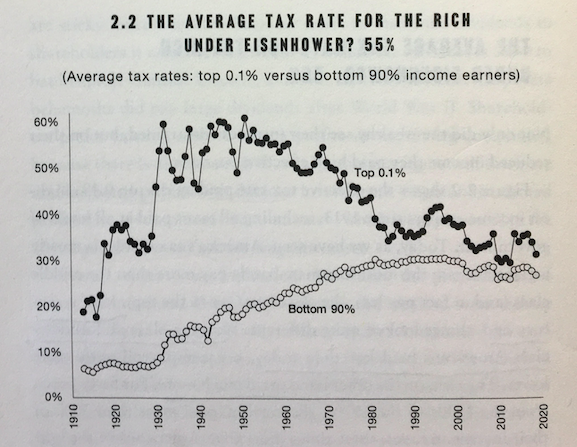
The high average rate which takes account of all taxes, some of which are regressive, was driven by some vey high progressive Federal rates. In 1944 the top marginal rate of the Federal income tax was 94% on incomes of $200,000 or more, equivalent to a salary today of £6m. 

One of the key conclusions Saez and Zukman want to drive home is that rates of taxation are not cast in stone. It is not a case of ” ’twas ever thus.” Far from it. There were times when taxation rates were very high and when avoidance was minimal. The low levels of taxation on the rich are the result of conscious political decisions coming out of contested belief systems. They could be changed.

One of the arguments against change is that such high rewards are needed to ensure a growing economy and rising GDP. However the average growth rate for the period of high taxation and lower inequality was much better than that for the period since 1980 since when growth rates have slowed. Some will argue the two things are not necessarily connected. Happy to concede that but of course it means that high progressive taxation wont necessarily undermine growth going forward.

Saed and Zukman look at what can be done in a world where sovereign states compete with one another to tax corporations less and less, and where the absence of progressive taxation, amongst other things has allowed inequality in wealth to sky rocket. They address the need to treat all forms of income  uniformly, so income from financial assets (the main source of income of the rich) is taxed at the same rate as income from employment. They explore a wealth tax and how this might work and they look at the scale of resources which could be brought into support public services that have been starved of resource for the past decade.

The timing of this book could not be better. Once Covid-19 is brought under control there will be an enormous bill to pay. That bill, like the bill for the Wars of the 20th Century needs to be shared in accordance with ability to pay. Expect much more debate about taxation in the coming years. Hopefully it will become clear that smart people pay taxes, and that smart rich people pay higher taxes than smart poor people. And the benefit of that is civilisation for all people.

The Triumph of Injustice: How the Rich Dodge Taxes and How to Make them Pay. Emmanuel Saez & Gabriel Zucman. WW Norton and Co. 2019.



The Joint Stock Company

If you want to understand more about how India became part of the British Empire you should read William Dalrymple’s “The Anarchy”.  The book is a panoramic survey of the diplomatic intrigues, rampant duplicity and naked aggression used to divide and conquer the Mughal Emperor’s power and that of the various Mughal principalities.

My reason for reading this book was a desire to know more about the East India Company (EIC) and particularly whether, as one of the first joint stock companies, it provided lessons for current corporate governance issues. What shocked me was the extent to which the creation of the British Empire in India was in fact the work of the EIC.  “The Anarchy” charts the actions of the EIC from its creation in 1599 to its effective nationalisation in  1859. In its two and a half centuries the company went from an organisation negotiating commercial privileges with Mughal princes to a colonial power with its own navy and a security force (army) of 200,000 troops, more than the British army of the time.

I had mistakenly assumed the British State had opened up India to trade, supporting  and defending private sector organisations like the EIC. Clive of India I took to be a member of the British army who paved the way for British commerce. Someone who was Knighted for his service to the Crown. Just shows how wrong you can be.  In fact Clive was always an employee of the EIC and was rewarded for his services with an enormous fortune looted (a term originating in India, which I use advisedly, meaning “theft”) from the Indian nations making him one of the richest men in Europe.

Whilst I never bought into the imperial story of Britain bringing civilisation to the Indian sub-continent I had never appreciated how thoroughly the rampant exploitation of the vast area was done by the private enterprise of the EIC. A company which many members of the British parliament had substantial shareholdings in. Explaining, perhaps, a certain reticence when it came to considering stories of brutality as highly profitable commercial transactions were transformed into outright theft. Illustrative of the rapine behaviour is the fact that Powis Castle, the home of Clive’s son, contains the Clive Museum which has the largest collection in one place of Mughal artefacts from India. Larger even than that in the National Museum in Dehli.

There is no doubt the battle for supremacy in India was a physically demanding and dangerous business. Dalrymple’s book provides an even handed description of acts of bravery and cowardice, loyalty and treachery, honour and deceit on both sides of the battle. The European battle tactics, genuine bravery, modern cannons and pure luck all played a part in the ultimate success of the EIC. But victory transformed highly profitable trade to outright pillage. This in turn led to the degradation of the existing state and at times major famine. Unbound avarice with little thought for the future eventually undermined the viability of the EIC. As profits declined moral outrage grew oddly enough.

Putting aside belated outrage what lessons are there from the history of the EIC for today. Clearly one is about effective regulatory oversight. If you rely on the moral character of shareholders to curtail the drift from entrepreneurial energy through commercial sharp practice to sharp knifed theft then you need to hope that the returns remain modest. NINJA loans in the US, in the first years of the 21st Century were little short of outright theft. When billions of pounds are at stake peoples morals flex and bend and, in the absence of independent challenge, break.

Another lesson is the danger of scale posed by private companies. As the exploitation of India grew more and more aggressive, in every sense, the returns of the EIC grew in lock-step providing the resources in dividends and outright bribes to suppress the demands for closer parliamentary oversight. By the late 18th Century the EIC generated almost half of Britains trade, it had become “too big to fail”.

It was at this point that the risks of unregulated exploitation started to crystallise. In 1772 large debts, increasing military expenditures and declining revenues from over-exploited regions meant the company was running out of cash. A dividend maintained at 12.5% probably did not help matters. In July of that year the Directors applied to the Bank of England for a loan of £400k, a fortnight later they needed another £300k by August they needed another £1m. In total, close to £200m in todays money. Inevitably these unprecedented requests for cash raised questions as to how a company generating so much wealth for its employees could go bust or as Mr Dalrymple puts it, “…the contrast between the bankruptcy of the Company and the vast riches of its employees was too stark not to be investigated.” Similar to the Parliamentary questions concerning the remuneration of Carllion Directors after they went bust building the Royal Liverpool Hospital, for example.

The Government did investigate and indeed Clive was brought to the House to defend himself which he did with vigour. And the man who “earned” something in excess of £234k (£260m in todays money) in 16 years in India, apparently without laughing, said he was, “… astonished by my own moderation.” In the end Parliament found in favour of Clive, clearing his name by a vote of 155 to 95.

This is a really well written book which compels attention and provides real insights into the values and attitudes of the time, good and bad. It is a powerful testimony to the power of the financial innovation which is the joint stock company, and what it could achieve. It speaks to the importance of effective corporate governance but also for effective external regulation. It confirms that whilst shareholder value is a necessary component of corporate purpose, on its own it is far from sufficient.

The parallels with many of the current debates around large corporations are clear. Those who do not learn from history are condemned to repeat it. This book provides lessons our politicians would do well to learn. I wish I was optimistic they would.


Losing Earth

Reading this book you feel the United Nations ought to identify the crime of humanicide and turn to the book for its first list of suspects. It provides an account of how the issue of anthropocentric climate change was brought to the attention of politicians in the decade from spring 1979 to November 1989. What is shocking is the fact that the basic science was clear right from the start of the period. Indeed governments and the fossil fuel industry had been doing research into the issue for some considerable time before that and had come to the conclusion that fossil fuels were set to have a significant impact on climate if they continued to be burned at the rate they were.

At the start of the period the engagement of the coal, oil, motor and other industries seemed to be a genuine search for the truth. The problem was once they found it. They didn’t like it.

It tells a tale of how a few determined individuals, mainly scientists and environmentalists worked diligently to inform and then push to action politicians and policy makers. It charts the ups and downs of a process where two steps forward in scientific confirmation were pushed one step back, sometimes three steps, by doubt sowing special interests.

One of the three step back was the year Ronald Reagan was elected President. On taking office he increased coal production on Federal land, deregulated surface coal mining and appointed Anne Gorsuch as administrator of the Environmental Protection Agency. An “anti regulation zealot” she cut the Departments staff and budget by 25%. The parallels with the actions of the current President of the United States are remarkable.

Whilst the basic science and the trajectory of change was clear, the evidence of change in actual weather patterns, which voters could see, was not there in the early 1980’s. The scientists were aware this would not become apparent for “ten or twenty years” however they were also aware that if action was not taken immediately it would require far more dramatic change later, leave a legacy of negative environmental effects and in the worst case scenario simply be too late.

The book has numerous examples of issues which dogged the debate about climate change at the time and have continued to do so through the 1990’s, the 2000’s and 2010’s. In an early meeting of experts convened to provide policy proposals a public health scholar called Annemarie Crocetti made the following point, “I have noticed that very often when we as scientists are cautious in our statements, everybody else misses the point, because they don’t understand our qualifications.” This is a problem which the scientific community are still grappling with. The carefully calibrated language of IPCC reports does not chime with the existential nature of the threat they are reporting nor does it communicate the urgency of the issue they believe exists.

Another issue was how scientific results were spun to avoid what was regarded as precipitate action. The Changing Climate Report mentioned above was published in October 1983. Its preface made clear that action was required immediately, before all the detail could be confirmed with certainty as by then it would be too late. This is not how the Report was presented at the launch press conference. Its authors, the very people that had written the stark warning argued the opposite, no need for urgent action. The accompanying press release confirmed the no action needed story and of course this is what the press picked up. How many journalists read 496 page reports? Quite why a group of scientists provided a gloss which contradicted the findings of their report is not clear.

A rather sinister and worrying answer may be the direct intervention of the White House in the science. James Hansen of the NASA Goddard Institute for Space Studies was one of the scientists who had been working to convince politicians of the importance of CO² emissions throughout the 1980’s. In 1989 he was asked to provide evidence to a Congressional Committee chaired by one Albert Gore.  As a public employee he had to submit his evidence to the Office of Management and Budget for review prior to publication at the Committee. When his paper came back it had been amended to change significantly the strength of the conclusions. 

Hanson wrote to Congressman Gore and explained what had happened. He then went to the Committee and read the paper as censored by the Bush administration. Al Gore then questioned him about contradictions in the paper. Through a series of questions and answers the attempted censorship was revealed. At one point Hanson explained that he appreciated the need for the White House to review the policy statements of employees but went on to say, “…my only objection is being forced to alter the science.”

I certainly had not appreciated quite how well settled the science was as far back as the early 1970’s. Reading this book  and seeing how the denigration of experts, “alternative facts”, “fake news”, doubt funding were all used to undermine science back then. If it was a scandal then, how much more so now, 30 years later, when every prediction made in the early 1970’s has only been proved wrong in being too optimistic.

It would be wrong to say that political elites around the world have done nothing on climate change over the past 40 years.There has been real progress in alternative energy development and greater fuel efficiency. There has also been a whole lot of lip service about the rights of future generations. However, there is an enormous gap between ambition and reality. There is also an enormous lack of real political leadership.

When we consider the amount of political energy and time given to Brexit over the past 3 years to secure Britain’s future inside or outside of Europe you might have thought a similar level of effort would be worth expending on humanities future inside or outside of planet Earth.

If the 1980’s was the decade we could have stopped Climate Change we now face the decade where we may have to mitigate the devastation it will inevitably wreak. If we stopped all CO²e emissions tomorrow climate change would continue for centuries to come however its impacts would be significantly less than if we fail to act. Whereas change commenced in the 1980’s might have been a very inconvenient process we now face a quantum difference in the scale of the challenge. It needs to be a much more abrupt, radical and consequently painful process. A process which will involve adaptation to problems which are already inevitable. And a process which will require dramatic and profound changes to our behaviour to prevent compounding problems which may make the world effectively uninhabitable.

Those purveyors of doubt in the 1980’s have much to answer for. However, with the scale of scientific consensus that has built up over the intervening years with every fresh piece of evidence confirming the basic thesis it is inexcusable for anyone, much less political leaders, to deny the existence of the problem. Everyday their culpability grows.

It is time that the International Criminal Court started to arraign those guilty of recklessly committing actions likely to result in the crime of humanicide. Call Donald Trump, Leader of the United Fossil Fuel Purveyors of Doubt.


“The Decade We Could Have Stopped Climate Change”: Losing Earth. Nathaniel Rich, Picador, 2019.

A tale of two people.

The political turmoil in the States has thrown up the best of people and the worst of people. James Comey’s autobiographical reflection on leadership presents a picture of the both.

Obviously, autobiography is a partial view, which it would be foolish to accept uncritically. Reassuringly perhaps, the self Mr Comey is willing to reveal to us is not without fault. He confesses to weaknesses, sins of omission and commission including bullying a fellow student when at University and lying about playing basketball in high school.

He makes no claims to infallibility, indeed quite the contrary recognising that key decisions he has made in his career may have been wrong. He appreciates how difficult it is to understand how motives shape decisions consciously or unconsciously particularly his own. If there is one thing he is keen to convince the reader, it is that, in his professional career he has always tried to act in good faith according to the law and the Constitution of the United States. He presents himself as a fallible human being but a deeply patriotic person who aims high in his professional behaviour.

The book considers the events and people in his life he believes shaped him as a leader. Whether or not he genuinely absorbed those influences and lived up to the high standards he describes only those he led would be able to answer. However his descriptions of what good leadership looks like are compelling and worth reading.

Whilst the leadership style of President Trump is not addressed directly until the end of the book one cannot but feel the first 210 pages create, consciously or not, a sharp point of contrast. Its elements include the ability to listen actively, to seek out the opinions of others and see the value of those that contradict your own. It understands the difference between intelligence and judgement. Intelligence being the ability to “…master a set of facts.” Judgement on the other hand being the ability to “…say what those facts mean and what effects they will have on other audiences.”

Comey, a Republican voter, describes what he thinks are characteristics of good leaders but his examples  are absent of partisan bias. He describes characteristics and behaviours of President Obama he thinks are important including a good sense of humour which he believes to be a good indicator of a persons ego. The ability to laugh at someone else’s joke reveals a degree of self confidence in a willingness to look a little silly as you laugh and an appreciation of others.

Central to Comey’s view of a good leader is personal confidence. Being comfortable in your own skin, knowing yourself, including your weaknesses as well as your strengths. Such confidence facilitates the ability to be humble. To recognise that a good leader does not have to pretend infallibility, rather they recognise others may have more to offer on certain matters and indeed provide better insight into an issue. A good leader blends confidence and humility in a mutually reinforcing whole.

Comey is clear a leader cannot take respect it has to be earned. Earned through consistency of words and actions. Living the values you espouse. He understands that as a leader you are constantly under scrutiny. Some will be willing you to exhibit actions which contradict your words, the vast majority will be looking for examples of what you value. Your words and actions are signposts, you constantly have to take care are pointing in the right direction.

Access to truth, for Comey is seen as fundamental to good leadership. Loyalty of those around you means having people who will challenge you with vigour when they think you are making a mistake. Helping you discover the uncomfortable truth as opposed to reassuring your convenient prejudice.  Loyalty expressed through flattery magnifies errors when whatever “the boss” says is agreed to as right. This is the loyalty offered to  the Mafia boss.

There are lots of textbooks on leadership but if you want a passionate guide from someone who at the very least has occupied some very senior leadership positions you could do a lot worse than read this book. Comey sets the bar high and from his autobiography you do get the impression he measured himself against it. He clearly reflected a lot on leadership and thought deeply about it.

And then of course there is President Trump. Clearly, the fact that President Trump sacked him will have shaped Mr Comey’s views about the man. However, the manner of his sacking, reported live on TV speaks volumes to the leadership style of the man who now ‘leads the free world”.

In summary, Comey was in the FBI’s Los Angeles field office speaking to a room full of staff when he saw the news of his sacking being reported on the TV screen running across the back of the room. Once it had sunk in that this was not a joke he got onto his assistant back in Washington who had been given a letter which she scanned and emailed to Comey which fired him with “immediate effect”.

If Comey had been guilty of some act of gross misconduct this would have been a shocking and deplorable way to handle his dismissal. The ostensible reasons in the advice given by the Deputy Attorney General Rod Rosenstein were, ironically, about his handling of the Hilary Clinton email investigation which had been conducted 6 months previously, before Trump had been elected to the Presidency.

Whilst this manner of sacking might seem unprofessional it does not plumb the depths of the sacker. The issue of how Comey would get home arose. The Deputy Director of the FBI, Andrew McCabe, who had suddenly become the Acting Director of the agency, decided it was appropriate to return Mr Comey to Washington in the official plane with his security detail.

Millions saw the return of the sacked Director live on TV, including, it seems, the President. Many would have thought this national coverage of his return a public humiliation. It was, but seemingly not enough for the President. The next day Trump rang the new Acting Director and asked how Comey had been allowed to use the official plane to get back to Washington. When McCabe explained he had authorised it, “The President exploded.” He ordered that Comey should never again be allowed into any FBI property anywhere. This meant his staff had to box up his personal effects and take them to his home.

Are we at the bottom yet? No. The Deputy Director’s wife had once run unsuccessfully as a democrat for the Virginia state legislature. Apparently in his fury with McCabe Trump asked “Your wife lost her election in Virginia, didn’t she?” When McCabe replied “Yes, she did.” Trump said “Ask her how it feels to be a loser.”

Confidence, humility, judgement? No. Petty, spiteful, vindictive? Yes.

In the epilogue Comey manages to maintain a sense of optimism. Whilst he deplores those who stand silent and provide tacit assent to Trump’s outrageous behaviour, he believes after the forest fire which is the Trump presidency the United States will refocus and restore the balance between the executive, legislative and judicial arms of government. We can only hope his optimism is well founded.

Having read this book I think about the lift test. Would I want to be stuck in a lift with Comey. He sounds genuine and interesting so the answer is yes. If it were Trump? I’d jump.


A Higher Loyalty: Truth Lies and Leadership. James Comey. Flatiron Books 2018