There are a number of really excellent books around at the moment where the assumptions of both classical and neo-liberal economics are reviewed and challenged. Northern Comment has considered some of these in earlier posts on the Dismal Science. One of the really excellent books on this is Doughnut Economics Kate Raworth.
It is a root and branch critique of some of the basic tenets of Econ 101 and comes up with a model of economics that put people at the centre or rather in the ring of the doughnut. The model sets economic theory in the context of a finite planetary system. It does not simply bracket out as “externalities” issues which have existential implications for the habitability of planet earth.
As part of a Coursera MOOC there is a link to a lecture that Kate Raworth gives which is an excellent overview of her thinking on economics. It is a solid overview of the discipline and some of the more pernicious applications of a fundamentalist interpretation of the laws of economics. Worth watching.
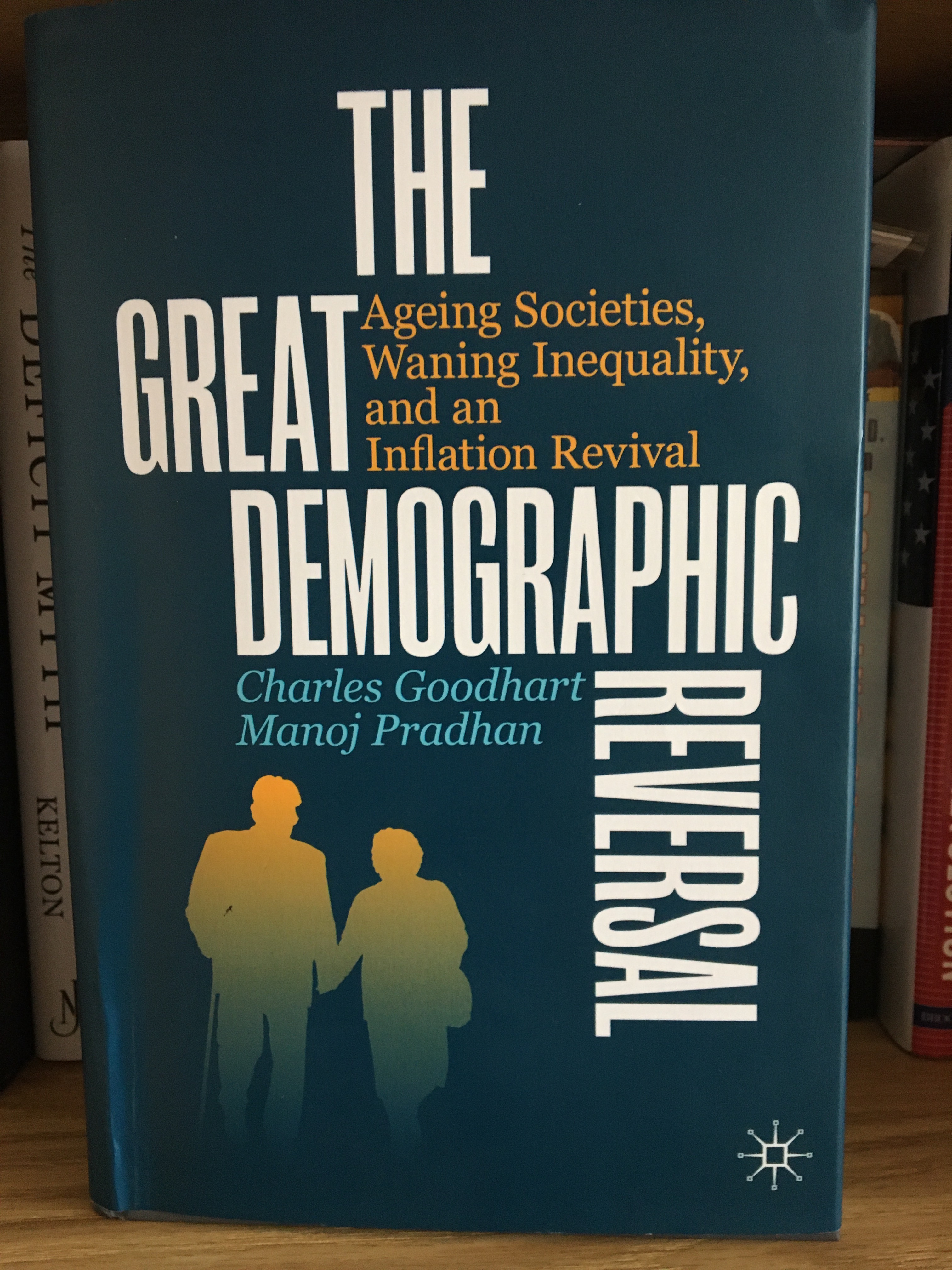
“The Great Demographic Reversal” is an immensely stimulating book by Goodhart and Pradham which amongst other things predicts a shift in the balance of power between capital and labour, reductions in levels of intra-state inequality and, worryingly for highly indebted nations, the return of higher nominal interest rates and higher inflation.
The predictions run counter to what seems to have become a prevailing view about the state of the world economy distilled into the concept of “secular stagnation”. This model, discussed elsewhere on this site, focusses on many of the same drivers as Goodhart and Pradham. An ageing population, increasing dependency ratios, a glut of savings, changes in the capital intensity of growth industries all leading to a paucity of demand for capital for investment. The demand for money is thus reduced pushing down its cost ie. interest rates. These things are also presented as part of the explanation for the aneamic productivity growth rates in advanced economies and a whole lot of other ills.
Goodhart and Pradham have a different take on these issues. They share the view that a demographic sweet spot in critical economies around the world has combined to create a benign low inflation and low interest environment. But looking forward they analyse how that national sweet spot is turning sour and is set to impact the evolution of the global economy.
In essence, they see that over the past thirty years China has proved to be a massive engine of deflation which it has exported around the world. Its insertion into the global economy through its membership of the World Trade Organisation in 2001 effectively increased the supply of cheap labour into an increasingly integrated globalised capitalism. This sucked in jobs from the advanced, relatively high wage, economies of the world and pumped out cheap manufactured products.
This meant a decline in demand for workers in manufacturing jobs in the West, a consequent reduction in their bargaining power leading to wage stagnation and or unemployment. This reinforced a shift towards service industries with a generation of baristas and deliveroo employees on minimum wages only able to remain fashionable because of the rock bottom prices provided by the House of Primarnia with its Asian manufactured clothing.
However, the positive demographic is being replaced by negative trends in both the East and the West. In China and many parts of the West population structures are shifting towards the elderly end of the bell curve. What is more the tail on the elderly end is being pushed out as people are living longer. This has a number of interacting consequences on society and the economy.
Firstly, there is the increasing demand on health and social services as the old and very old members of the population create increasing levels of demand for support. Goodhart and Pradhan have an excellent chapter on the health and care challenges of an ageing society.
Second, their living longer puts increasing strain in terms of national and private pension requirements. Responses to these may including raising the retirement age, reducing levels and or benefits, and closing final salary schemes. Whilst some element of all these have occurred in the UK there is a limit how far these things can be taken if not for moral, then for reasons of electoral arithmetic. Old people vote.
In summary both of these factors create significant levels of demand on public finances just at a time when the dependancy ratio, ie. the ratio of those who are economically inactive to those working and paying taxes is getting worse.
Not only is this happening in many advanced economies it is also happening in China. The dependency ratio there is moving in the same direction and labour availability is set to reduce over the coming decades. This will, over time switch off the deflation machine.
In parallel with all this is the shift in political sentiment away from globalisation linked to an increasingly populist rhetoric. Goodhart and Pradham make the point that this will have a doubly negative effect. Controls on immigration will exclude the labour required by the economy to improve the dependency ratio. It will also limit the importation of inflation reducing cheap imports.
Watchers of the Global economy may respond to the predictions of this book by pointing to Japan. A nation which has gone further along the demographic ageing curve than any other advanced economy. There is little sign of inflation or increasing nominal interest rates after the best part of three decades of economic stagnation and a national debt which, as a percentage of GDP, is 1.6 times worse than the current UK position, c260% plays c100%.
Goodhart and Pradham have a chapter on this and provide, to a laypersons point of view, a convincing explanation of why Japan’s experience cannot be seen as a prediction of the future impact of demographic changes globally. Not least because they were able, and did, take maximum advantage of the demographic sweet spot of their neighbour to import deflation.
The book does not simply explain the likely trajectory of the world economy based sole on demographics. They outline what significant challenges this creates but they look at a whole host of other factors as well including the rise of indebtedness in the non-financial corporate, household and public sectors. They also talk about the misalignment of management incentives with investment needs negatively impacting productivity growth. Goodhart and Padhan are clear that, whilst, ageing is inevitable its economic and social consequences are not. They depend on policy actions.
The final chapter of the book points to a number of actions that might be taken to start to address the issues of indebtedness, productivity and inequality. They see tax increases as inevitable but have interesting proposals about how they might be structured in the most equitable and effective way possible.
They explore the benefits of a land tax and a carbon tax . They also look at ways to reduce the differential tax benefits of debt over equity through an Allowance for Corporate Equity or a Destination-based Cash Flow Taxation (DBCFT). Both of these are mechanisms to push corporates to rely more on equity than debt which may be critical if the authors are correct about the likely direction of interest rates. They also talk about reforming the incentive structure for corporate managers which, currently, positively promotes the loading on of debt, excessive cost reductions particularly in relation to R&D, and the buy back of equity in order to push up the Return on Equity (ROE), all of which increase the benefit corporate managers derive from share incentive schemes.
At 218 pages this book deals with an enormous topic with a mix of close technical discussion of things like the Philips curve and the Non Accelerating Inflation Rate of Unemployment (NAIRU) and very easy to follow logic. It is definitely swimming against the tide of much current thought about the prospects for inflation and interest rates. However, much of what it has to say makes sense as a strategy for addressing some of our current problems of productivity whether or not the demographic time bomb is as powerful or as pervasive in its impact as they predict.
In the interests of full disclosure, as a pensioner the issue of inflation is close to my heart, and wallet, however, I recommend this book for anyone who wants to read an accessible and interesting analysis of the possible evolution of the global economy over the next few decades.
The Great Demographic Reversal: Ageing Societies, Waning Inequality, and an Inflation Revival. C Goodhart, M Pradham. Palgrave Macmillan. 2020
As we enter what some are predicting will be a new Roaring ’20’s, as economies “bounce back” from CovEcon-19, it is instructive to look back to the original “Roaring ’20’s”. As now during the second decade of the 20th Century short selling was one of the sophisticated financial products individuals could speculate with.
If you have not come across short selling it is a kind of financial alchemy that transforms base metal, failing companies into sources of golden profit. This process of transmogrification has the following 3 basic steps.
Step 1 You “borrow” a share in the base company (Base Co) paying a rental fee for it for a fixed period of, say, six months. Assume for this example that the stock market value for a share in Base Co. is £100 when you borrow it. Also assume you pay rent at £0.50p per month for the 6 months therefore total cost of borrowing the share is £3.
Step 2 Immediately sell the share you have borrowed for £100. Now you have cash £100 but no shares, an obligation to pay £3 in rent and to return the share in six months.
Step 3 At the end of the six month period buy a share in Base Co at the prevailing stock market price. This step is where the magic happens… you hope.
What you hope is that the share price will have gone down in the course of the six months so that you can buy the share at less than it was worth when you borrowed and sold it.
Assume you are a clever alchemist and the share at the end of six months has halved in value and therefore only costs £50 to buy. In these circumstances you have made a profit of £47 which is arrived at as follows: £100 – (£50+£3) = £47 Result “Happy Days!”
Of course, you might be a poor alchemist in which case the value of the share you have to purchase at the end of 6 months may have gone up to say £150. Now you are down on the deal: £100 – (£150 + £3) = -£53 Result “Ouch!”
If the share price remains at £100 for the six months you have to go into the market and buy them at that price to give them back so you are £3 down on the deal.
Of course you may have increased your investment in this process by borrowing money and buying more shares. This increases your profit but also your loss depending on whether you are a good or bad alchemist. This has the effect of changing the “Ouch!” into an “Aagh!” and the “Happy Days” into “Yipee aye ay”
“Isn’t all this just like gambling? What commercial benefit does it produce in the real economy?” I hear you ask. My instinct is the answers are “yes” and “none”. If that all sounds on the shady side, consider the following.
Between, September 23 and November 4 in 1929 a Mr AH Wiggins, variously President, Chairman of the board and Chairman of the governing board of the Chase bank on Wall Street short sold 42,506 shares of the bank he was the President, Chairman etc of. He was a successful alchemist as he borrowed and sold ahead of the Wall Street crash and purchased and returned when the shares had fallen significantly in price.
As Chase bank’s shares continued to tumble he acquired another 43,506 of Chase shares from an affiliate of the bank, partly financed by a $6.6m loan from his employer – Chase bank! As the bank’s shares continued to collapse he again repurchased at a much reduced price and made a $4m profit on the transactions.
Mr Wiggins was later questioned about whether he felt it was right as a senior employee of the bank he should make a profit out of speculating in its shares using money loaned to him by the bank. Mr Wiggins answer was that by lending the money to employees and allowing them to speculate in its shares the bank was encouraging its staff to have an “interest” in the company.
When asked whether short selling created the right kind of “interest” in the company he thought it doubtful!
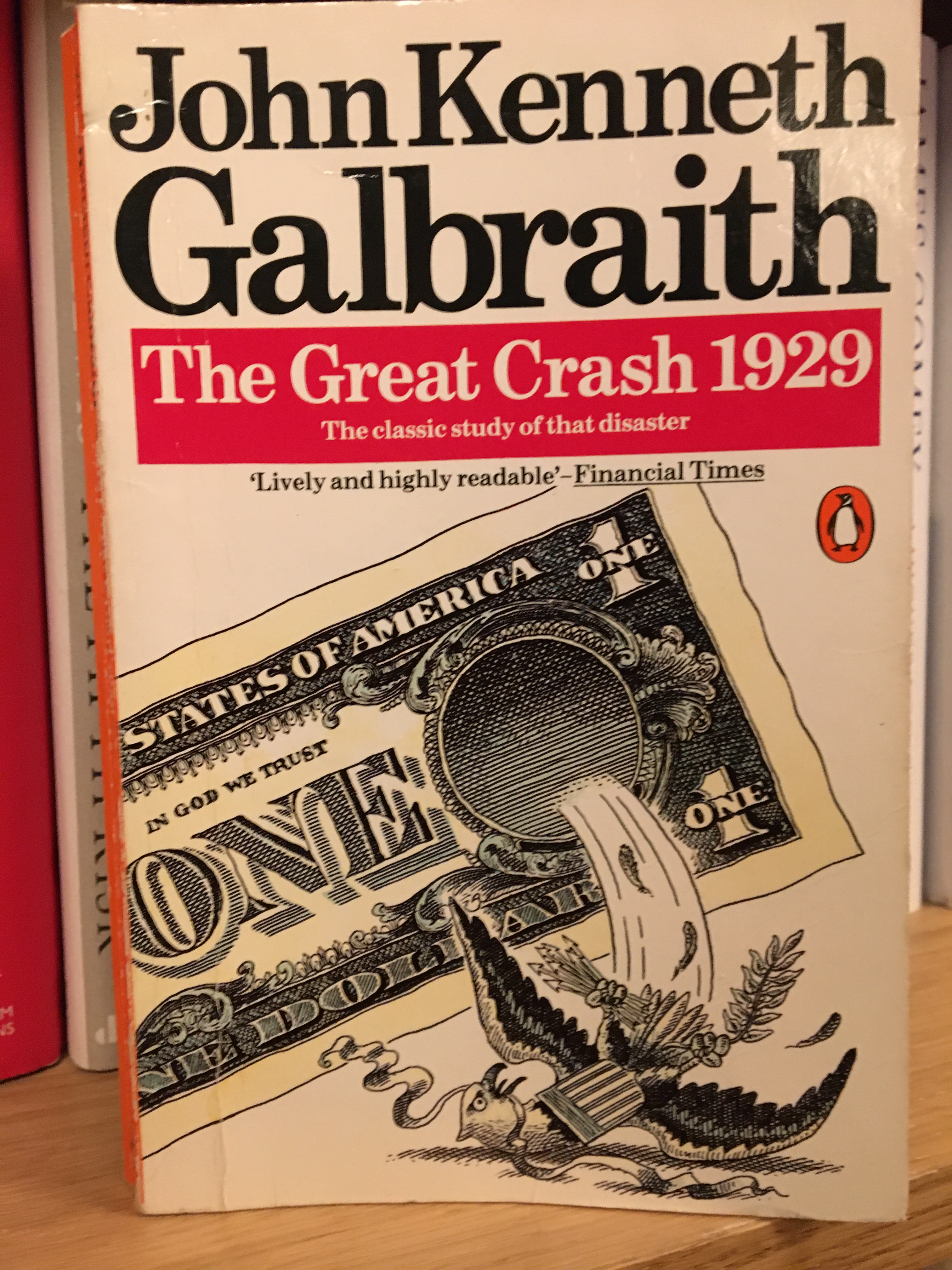
Mr Wiggins story is recounted in JK Galbraith’s incisive and witty analysis of “The Great Crash of 1929”. Reading it you see haw egregious practices of the past have been replaced by egregious practices of the present. The parallels with both 2008 and now are instructive.
The Roaring Twenties were a period of excess with growing inequality, enormous optimism about the benefits of capitalism and the rejection of the need for red tape regulation. If we do have an economic bounce back we just need to remember how those Roaring Twenties ended. We should try not to fall into the same trap.
Whilst there are far more regulatory conditions to be met on short selling now as compared with the original Roaring ‘20’s, the question has to be asked why is it allowed to take place at all? What is the commercial benefit in the real economy?
On the negative side, it certainly does not help target companies if large hedge funds are gambling against their success or even survival. Also it creates “immoral hazard” in that powerful financial interests have a strong motive to undermine the company in whatever way they can and certainly have no interest in its success.
I would welcome explanations of the benefits of short selling. I suppose Schumpeterian capitalists may see short selling as a way to weed out the weak quicker than normal share sales. It perhaps provides a hedging mechanism for large funds to manage their risk exposure to moves in the market.
However, to the extent that large enough funds may be able to create a self-fulfilling prophesy it starts to look like a one way bet which may destroy perfectly good companies who are experiencing a difficult patch.
Short selling looks more like it operates for the participants who play casino capitalism rather than those looking to ensure the efficient allocation of investment. For Wall Street over Main Street.
The events around GameStop shares and Robinhood’s purported desire to democratise finance gives a poke in the eye to the Goliath hedge fund managers and their short selling activities. It is difficult not to derive a certain satisfaction from this. However, it is probably not the best way to reign in value destroying speculation.
The thousands of day traders who have bought the shares of GameStop at over inflated prices are clearly not looking to make money, they are looking to take revenge on those powers which seem to determine much of their future and face little if any risk themselves. I suspect in the mix are a number of very savvy investors who are making money on the upward price of the shares.
The motives of many who are participating in this action are definitely on the money, even if their money is not. The financialisation of the economy has gone on for far too long. Reform is needed and effective regulation of Wall Street must be a part of this. Only the state can ultimately achieve an economic environment driven by values which works for the many and not just the few. The Biden administration has a lot on its plate but this needs to be addressed if the despair that fuels anger and division is to be overcome and unity achieved.
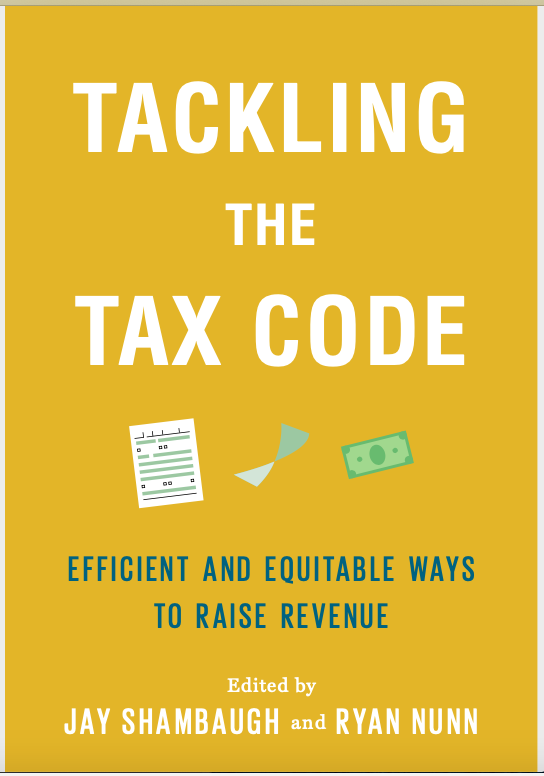
A new book on taxation, Tackling the Tax Code, published, (free) in the United States by the Brookings Institution has things much needed to inform debate on this side of the Atlantic. As we emerge from lock down its economic consequences are beginning to become apparent, and they are vast. Enormous sums have been pumped into the economy by the government to prop up employment, sustain the health service and fight the Covid-19 virus.
An enormous bill has been accumulating on the balance sheet of the government and the Bank of England one which will have to be paid at some point. When and how are questions which will soon dominate political debate.
There are two ways in which you can reduce debt. First, you can cut your expenditure so that more of your income can be devoted to reducing the debt. This is what we tried in relation to the debt arising out of the 2008 credit crunch. A decade of Austerity. Easy to understand because of analogies with household debt even if some believe the analogy involves a category error between national and household debt.
Whether another decade of Austerity is politically acceptable or even possible is a moot question. At the moment politicians do not seem to be promoting that line. Of course if they do not it rather calls into question the TINA argument about the need for the first decade. However, the expenditure side of the debate is for another time.
An alternative to reducing expenditure is increasing your income. How does the Government do this? Through taxation. Over the past few decades the direction of taxation policy has been remorselessly down, particularly for those on the highest incomes. C-19 and the subsequent recession is going to challenge that trend. If it is to change then there are a number of issues which need to be addressed. These need to be debated publicly for they have enormous consequences for all of us.
Which brings me back to the book. This is firmly focused on the US tax system but many of the issues and opportunities identified could equally be applied in the UK in fact some of the issues require multi-national responses in a global economy.
The book looks at the existing taxation system in the US and how it has evolved in recent years and particularly how income from taxation has gone down following tax cuts by GW Bush and D Trump. It then looks at how taxation should be raised in a fair and progressive manner.
One of the key principles the authors of the book promote is that taxation should be distributed fairly and progressively. Those with the broadest shoulders should take the heaviest load. Given the enormous concentrations of wealth allowed to build up over recent decades there is consideration of how this might be taxed including proposals for a much more effective inheritance tax for the wealthiest in the country. This would have the double benefit of raising revenue and reducing inequality which some believe is becoming a genuine drag on the economy.
In a similar vein there is also a proposal for a tax on financial transactions. This would mean that every time shares, bonds or fancy derivatives were sold they would be subject to a small charge. The proposal is 10 basis points or 1 tenth of 1 percent. Sounds like a small number but they estimate it could generate $60bn per annum when fully operational. Given that most of the wealth of very wealthy people is stored in financial instruments the costs of this would be mainly on the broadest shoulders.
More specifically the book looks at adopting a Value Added Tax (VAT). Clearly this is something we have already. What is interesting however is the discussion about how that should be adjusted through transfers to low income households to reduce the regressive impact of such a tax.
More effective taxation of multinational companies (MNC’s) is also called for. This to ensure that under current laws they pay what they are supposed to and that incentives to off-shore production and relocate profit centres are eliminated. This is combined with proposals to promote a global approach to MNC’s which will address the race to the bottom of tax reductions to attract corporate HQ’s. Changing accounting principles to tax according to location of turnover as opposed to HQ would transform the behaviour of corporates and enable all sovereign governments to more effectively ensure corporates pay their fair share.
Resourcing the revenue authorities appropriately is also something called for. Interestingly in countries around the world where there have been homilies about the need to act prudently they have almost all reduced the resources of the organisations whose job it is to raise the revenues that have been publicly approved. Given they raise much more than they cost there is clearly no prudential reason to do this.
Taxation is complex and in the main very dry, however it is the engine of civilisation. It provides the resources to educate, heal, protect, support and sustain civilised society. It is something we should not leave to the politicians or the technicians. There are basic issues of equity which need to be addressed in order to create a fair, transparent and progressive taxation system. If we do not militate for that you can be sure something much worse will be put in place. Something that reinforces inequality rather than reducing it.
The Tax Code: Efficient and Equitable Ways to Raise Revenue. Ed J Shambaugh and R Nunn. Brookings 2020.

 northerncomment