Happy Christmas

Despite being an atheist I still enjoy and feel it is right for us to celebrate Christmas. Anything which promotes goodwill and peace on earth gets my vote however naive I fear it may be. At the very least it does make people think, however briefly, or even cynically, about what might be. It is also an opportunity to reflect on how lucky some of us are.

We should, however, also think of those who, at this time, whether they be Jew, Muslim, Buddhist, any faith or no faith, live in fear or terror or want or all thee.

As a meditation on this I recommend a book of poems by the Palestinian poet, Mosab Abu Toha, “Forest of Noise”. Although it is focussed on Gaza, I think it makes real, in some sense, the human fears and feelings of all those existing in war zones.

As time goes by, the daily terror that people face in Ukraine, Palestine, Afghanistan the Sudan and countless other places begins to loose it’s ability to move us.

Continuity, transforms deaths into statistics, distance gives comfort and security. Moral outrage fades as numbers numb our minds.

It is this,which makes front-line poetry so important and so powerful. Reports that Gaza is being bombed begin to lose their meaning. Indeed, for those who have never experienced it, it is difficult to really appreciate what it means.

Poems from the front line.

Mosab’s poems take you into homes where families sit with their backs against walls as they listen to the sounds of bombs making the whole house shake. He makes real the silent fear between blasts and the tiny acts of kindness which provide some sense of humanity and hope.

I recommend the poems as a way of getting beyond the inoculating statistics and tasting the immanent fear of loss. Even though it is continuous, when your neighbours ,or members of your family, are obliterated in an instant, I guess it is difficult to become inured. Inured to an existence of random but frequent death.

Celebrating a call for peace on earth is a good thing. However, being conscious of your good fortune is also important. The harsh reality of other’s lives should make the calls for peace on earth something that is not just for Christmas.

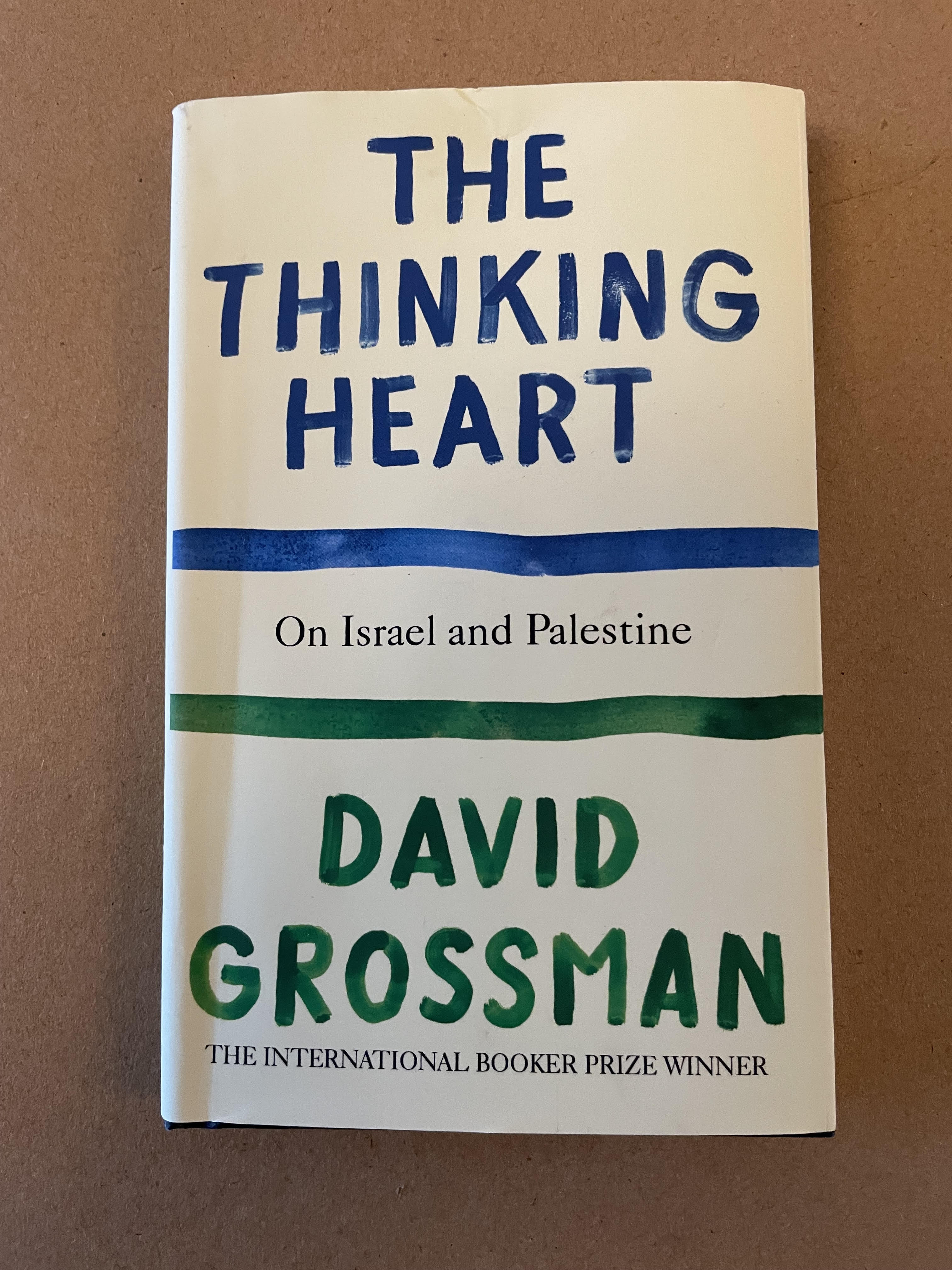
David Grossman: A Voice for Peace in Palestine

This is a collection of articles and speeches by novelist David Grossman, winner of the 2017 International Man Booker Prize. They span a period from July 2017 to June 2024, obviously taking in the barbaric attack of 7 October 2023. The book is a mere 87 pages long and exceptionally well written. It provides an intelligent and humane analysis of the problem of a just peace in Palestine, something Mr Grossman has spent decades campaigning for. It is a testament to his commitment that, despite the medeival horrors of 10/7 he remains convinced that “…it is impossible to begin resolving the Middle Eastern tragedy without offering a solution that alleviates the Palestinian’s suffering.”

His critique of Prime Minister Netanyahu is searing. He is equally critical of the ulta-Orthodox religious right who have a inappropriate and disproportionate say in the politics of the State of Israel. Promoting Eretz-Yisrael or Greater Israel, an area which has a number of definitions but certainly encompasses the current State of Israel, and the Palestinian Territories. It is this aspiration which “legitimises”, in their view, the settler movement in the West Bank and current demands for the same in Gaza.

Mr Grossman describes the Judaism he connects to as “…secular and humanist. It has faith in human beings. The only thing it holds sacred is human life.” You can imagine how acceptable this definition of Judaism is to those of the religious right who call for the State to go to War for a Greater Israel but “…refuse to send their own children to military service because, according to their faith, praying and studying Torah is what guarantees the continued existence of the Jewish people…”. Their single minded labours aim to preserve the purity of their contested view of the faith which sees God as being in the real estate business and having promised them the land of Palestine 2000 years ago.

What is interesting about the book is how it charts the growing stranglehold of PM Netanyahu and his actions to undermine, not just the rights of the Palestinians in the Occupied Territories, but also those of Arab citizens within the State of Israel. Mr Grossman sees all the actions of the Netanyahu government as being focussed on keeping alive and raw the wound that is the relationship between Israel and its Arab citizens and those in the occupied territories. He characterises the Nationality Law of 2018, which defines Israel as the nation state of the Jewish people and reserves the right of self determination to the Jewish people alone as a “…renunciation of the chance to ever end the conflict with the Palestinians.”

The articles in this collection remain optimistic and chart the growing internal opposition to Netanyahu. The demonstrations and marches against his attempts to consolidate his power and limit the rule of law were particularly vocal in the run up to 10/7. Despite the horrific terrorist atrocities of that day Grossman remains committed to negotiations and a move to a two state solution as the only viable route to a lasting peace.

Beyond this however Mr Grossman provides an insight into some of the psychological and other fears which shape Jewish thinking. Fears which certainly cannot be dismissed as irrational and which have an equal right to be addressed and must be part of any comprehensive solution in Palestine.

First among these fears is the pervasive view of the provisional nature of the State of Israel. Interestingly, this is not just seen as something driven by the hostile military objectives in the Hamas Charter of 1988 unabated in the eyes of Israel by the substantial revisions to that Charter in 2017, nor in chants about a Palestinian state from the Mountains to the Sea.

But more subtly than these attacks are the seemingly positive comments of supporters like the oft repeated formula by American Presidents that the US supports “Israel’s right to exist”. This phrase, although it challenges the opposite, subliminally concedes the possibility that such a right is not a given.

Another related but distinct issue is the attacks on Israel by its enemies. The objective of their campaigns against Israel is not simply to win a war against the Israeli state it is to abolish the state altogether. As Mr Grossman puts it “…Israel is the only country in the world whose elimination can be openly called for.” At the extreme end of this view is the antisemitic desire to eradicate the Jewish nation and people not just its state.

Mr Grossman asks the fundamental question, “Why is Israel – of the planet’s 195 countries – alone in being conditional, as if its existence depended on the goodwill of the other nations of the world.”

Mr Grossman also rejects the “intolerable”attempt to “…force the Israeli-Palestinian conflict into a colonialist discourse.” Arguing that colonialism can only be carried out by external nation states, and that as Israel does not have a state elsewhere it cannot be engaged in colonialism.

You can see why a people who have been persecuted and discriminated against in countries across Europe and beyond, and been subject to the most extreme attempt at industrial genocide the world has ever seen, would be extremely nervous about losing the safe haven of a nation state. This nervousness may at times become an existential panic resulting in a violent and disproportionate response to any form of challenge, perceived or real.

There are elements of Mr Grossman’s position that could be challenged. Being by far the most powerful military force in the region, the only one with a nuclear weapon capacity, and having the might of the United States foursquare behind it should allay some of the fears of its “provisional” nature. It is also the case that the vast majority of the nations on the planet recognise Israel as a legitimate member of the community of independent states.

Some of that sense of provisionality may stem from the manner in which the State was first established. One might argue this was by, “…the goodwill of the other nations of the world…” first in the actions of the League of Nations and secondly in the United Nations. Obviously, there were a range of other forces in play, not least the manouverings of declining imperial powers, notably France and Great Britain. Whatever its origins the world must, and in the vast majority do accept, the legitimacy of the State of Israel.

I fear the rejection of the colonialist model as applied to the actions of the Israeli State depends on an essentialist definition of colonialism relying on the preexistence of a colonialist state elsewhere as the aggressor. Whilst this might be a part of the definition there are key elements of the colonialist model, in the eviction of a preexisting peoples from their home lands and the repopulating of those lands by people from elsewhere which prima facie looks like it could be applied to the actions of the State of Israel.

Whilst there are parts of Mr Grossman’s argument which could be open to challenge, the tone and thrust of the book is exceptional. His analysis of the direction being followed by the current administration under PM Netanyahu is well-informed and trenchant. Despite the brutality of 10/7, Mr Grossman still argues for a negotiated settlement and a two state solution. In the end it is probably only this which will end the constant fear of the Israeli people about the provisional nature of the State of Israel. It is a book which everyone concerned about the current tragedy of Palestine should read.

The Thinking Heart. David Grossman. Johnathan Cape London 2024.

Lying with Statistics, is Just Lying

In these times of alternative facts Tim Harford’s quietly spoken commitment to the notion of truth is enormously welcome. His programme, More or Less, on BBC’s radio four is an enlightening analysis of statistical claims made on the news, often by politicians. Attempting and succeeding to distinguish the soundly based from the mildly misleading, the recklessly inaccurate and the straightforward propaganda lies.

For fans of the programme his book “How to Make the World Add Up” is a must read and for a much wider audience it is a should read. The first thing to say is that it is a book about statistics that those who did not even do O Level Maths can read with pleasure. There are no complex formula. On the contrary it is a limpid paean to the importance of statistics and its power to deepen and clarify our understanding of so many aspects of the world we live in.

Throughout there is a reassuring tone of common sense and inspiring presentation of how maths and statistics can be used to penetrate complex issues and abused to mislead and confuse. It is like being back in secondary school with that teacher who never raised his/her voice but never lost control of the class. Who maintained everyones interest through their enthusiastic mastery of their subject and ability to communicate in a manner accessible to all.

The book sets out eleven rules about how you should approach statistical claims. They all attempt to help you avoid confirmation bias which in the age of social media echo chambers leveraged by bots trolls is a vital skill. Asking you to think how you feel when you see a statistical claim. Does it give you a positive emotional boost as you find evidence to support your core beliefs/prejudices or does it make your hackles rise by contradicting them?

His advice is to treat those two imposters the same way and apply an objective set of challenges to both to try to discern the gold from the dross. This involves a deal of common sense and attempting to secure some kind of contextual framework. One which combines a birds eye view with a worms eye view. And one which understands what question any set of numbers is supposed to be answering. What are the definitions of the things that are counted. If it is gun deaths in the US is that about, mass killings, accidents, suicide or all the above?

it is important to avoid being enticed by the unusual nature of the findings in a report. Science progresses by findings exceptions to what is known. Scientific publications are would be tedious if all they ever published were results confirming what is already known. This means they look for the unusual. When combined with the academic imperative to publish or perish this can lead to the publication of findings which are unusual.

These may be a genuine step forward in scientific knowledge or they may be a result which is either unreplicable or designed in such a way as to provide eye catching if not knowledge enhancing results. Things like red wine prevents (yeay) or causes (boo) cancer. Along the way Hartford provides pointers to helpful tools which present a comprehensive picture of the state of peer reviewed research on medical matters, eg. the Cochraine Library.

Another target is the extravagant claims made for big data. The claim that google’s search engine was better at predicting flu epidemics than more traditional surveys, or that loyalty cards can predict your future shopping needs and that because such enormous data sets are being used the need for sample design was avoided, the facts would speak for themselves. At this point Harford quotes Professor Sir David Spiegalhalter of Cambridges University who said all this was “complete bollocks”.

This assessment may be of limited import when related to predictions about your need to buy nappies on the back of your previous purchase of follic acid. However, when such techniques are integrated into algorithms to guide recruitment or predict criminal behaviour or which teachers are failing to perform and need to be sacked, then they become of real concern. What they seem to end up doing is replicating and legitimating unfounded biased decisions.

The problem does not so much reside in the data sets or the use of algorithms in principle. Rather, it is the secrecy clothed in commercial confidentiality which means it is difficult to challenge results which seem to be producing bizarre outcomes. If big data is going to become a useful tool for analysing consumer preferences, criminal propensity, or professional competence it needs to be done in an open and transparent manner so that the logical steps in the chain of reasoning can be understood rather than hidden under a mountain of data.

If the misuses of statistics are of concern in civil society their manipulation by the state are a much greater concern. The book makes the point there are times when the bedrock statistics from national governments cannot be relied upon. This can never be right but is often ominous. Clear, reliable statistics about crime, health, the state of the national economy are fundamental elements of open government. They allow opposition parties, the media, academics and concerned citizens to question the government about the impact their policies are having. The book rightly draws attention to the geeks who try to protect the

Harford clearly articulates how critical reliable data is in modern democracies. Without a solid base to build knowledge all claims are equal. This is the realm of alternative facts. It is the logic of ex President Trump that if you don’t count the number of infections they go away.

The easy readability of this book belies the urgency, importance and contemporary relevance of it messages. One of which is the importance of sound maths and sound statistical techniques. But the other rather more profound one is the importance of bringing a critical mind to what the numbers purport to tell you. The need to understand what it is the numbers actually relate to and how accurate they can possibly be. What the standing of the authors is and the transparency of their sources, data and techniques.

Most important however is the need to examine your own motivations and biases. Carefully consider the extent to which your understanding of the numbers is guided more by your deep seated beliefs and prejudices than by what they actually say. In a world where some see evidence as a weapon to be tailored to promote a preconceived theory, or where dispassionate review of facts is dismissed as the tyranny of experts this book speaks to a key issue of our age, how we secure sound knowledge. Should be on the reading list of every first year University course in the country.

How to Make the World Add Up: Ten Rules for Thinking Differently About Numbers. The Bridge Street Press 2020. Tim Harford.

From Denial to Delay

Michael E Mann is one of the scientist who came up with the hockey stick graph which graphically displayed the increase in the earths temperature over the past century and in doing so sparked a rapid increase in the political temperature around the causes of that increase. He has personally felt the flames of the debate he helped trigger as the bots, trolls and pseudo academic mouthpieces, funded by those with a vested interest in fossil fuels, have challenged and denigrated his professional integrity, threatened his livelihood and indeed his life.

Given this, you can understand he is something of an impassioned advocate on the climate change crisis facing the world. His passion does not overwhelm his intellect however. He is profoundly committed to the scientific method embracing evidence based theories, peer review, replicability and open debate. His front line position in the debates over the reality of climate change has provided him with some unique insights into how that debate has been conducted by those who are not so keen on evidence and often prefer “alternative facts”.

His latest book”The New Climate War” is an interesting insight into the lessons he has learned and into how the nature of the debate has evolved over time. He believes the outright denial strategy is now very much a minority sport played on the fringes of society in the realms of places like the world of QAnon.

However, this does not mean those with enormous wealth and power invested in fossil fuel have given up. Denial has given way to deflection. Campaigns designed “…to divert attention from – and dampen enthusiasm for – calls for regulatory reform to reign in bad industry behaviour…” A key part of this strategy is to focus the debate on the role of individual as opposed to collective, government sponsored action.

To support this approach sophisticated social media campaigns focus on the individual’s responsibility for climate change and work to sow division within the groups advocating state action. Trying to undermine the credibility of leaders focusing on the “hypocrisy”of those flying around the world to attend conferences about the impact of international travel on C02 emissions.

The aim is to shift blame for the crisis to the level of the individual consumer, if they did not travel, eat meat, heat their homes excessively, demand infinite amounts of consumer goods, demand cheap food etc we would not be in the mess we are in.

Mann dissects the various deflection tactics and calls on fellow campaigners to avoid being drawn into divisions and debates which are promoted to undermine the effectiveness of collective actions. He considers a whole series of proffered non-solution solutions.

Geo engineering with sea algal blooms, and cloud seeding to counteract the effect to C02 warming. The use of bridge fuels like “clean coal” to manage the move away from the worse dirty coal. Various carbon capture strategies to suck the C02 out of the atmosphere. Variously these solutions rely on unproven technology and the hope it will emerge over the next few years and the risks they generate not proving more catastrophic than the climate based risks they allegedly solve.

The other strategy is that which focuses on adaptation and resilience. This is often underpinned by another deflective narrative, that of the doomsayers. The claims that things have already got beyond the point of no return or that the real politic of corporate vested interests or the complacency of the general public mean that action will not be taken until it is too late. Given this we need to prepare to live in a new, more hostile environment. One where food scarcity, coastal inundation, super storms, droughts and floods promote global migrations and international strife.

Against this Mann calls for balance. Recognition of the seriousness of the current situation but also recognising the progress that has been and continues to be made in terms of sources of renewable energy, changing farming practices, fossil fuel divestment campaigns and much more. Not least a growing popular awareness of the urgency of climate change and the political response to that. There remains much to be done but it is in our hands to change things and hold the increase in temperature to below 2 degrees centigrade of its pre industrial average.

Whilst throughout the book Mann warns of the divide and rule tactics of the opposition he is not averse to making clear the errors his colleagues are falling into. He certainly does not think the linking of climate change and the radical reform or overthrow of capitalism is helpful. He takes issue with those like Naomi Klein and Congresswoman Alexandria Ocasio-Cortez who have little faith in the role the market might play in addressing the use of fossil fuel via carbon pricing.

Mann on the contrary sees industry and market based solutions, including subsidising renewable energy sources and carbon pricing, as being helpful aides to bring about real change. He believes, when the market is properly structured it will naturally channel investment into new green investment bringing the innovation and entrepreneurship of the private sector to the battle.

In arguing climate change is a battle which requires a coalition of all the talents, Mann is probably right. The solutions of the current crisis do not lie in the hands of the captains of industry alone, not in the hands of the political elites. Rather, there has to be a partnership forged around a common aim of saving the planet. A partnership in which the wider population also needs to be actively engaged.

No one should be under any illusion about how difficult it will be to forge that alliance. It would be wrong to accuse Mann of that. The procrastinators, the delayers, the doomsayers generously funded and aided by corporate and state promoters will not dissolve in the face of overwhelming scientific evidence. The battle to overcome their misinformation and diversions will have to be relentless and multi faceted.

Whilst occasionally Mann seems to be a little too critical of those who are essentially on his side, but don’t sign up to all the elements of his battle plan, you have to respect someone who has been basically on the front line for the whole of his professional career.

The book is clear, informative and motivating. It also communicates an authentic passion to prevent the amazing planet we live on being turned into a far less beautiful and much less habitable home. Very much worth a read.

The New Climate War: the fight to take back our planet. Michael E Mann, Scribe Publications, 2021.