“Martial Aid”

Given the nature of their engagement in “diplomacy by other means” it is perhaps not surprising that the most sensible comments on what ought to be the direction of foreign policy in the Middle East has come from a retired United States General. John R Allen was President Obama’s Special Envoy to the Global Coalition to Counter ISIS. Before that he commended NATO and US forces in Afghanistan from 2011 to 2013.

His analysis of the current situation in Syria, and the wider Middle East, sees victory over ISIS as a necessary response to an immediate threat. However, he believes military success on the battlefield will yield no lasting peace. Battlefield war will simply evolve into terrorism, or “war carried on by other means”. Worse, for those in the West, is that this might mean more atrocities on the streets of London, Paris and New York.

At the moment the major part of the conflict is elsewhere and the vast bulk of the resources of ISIS and their backers is devoted to a military campaign for territory. If that territorial battle is decisively lost will the leaders and ideologues of militant Islam give up? Will they recognise defeat and accept the status quo ante?

General Allen’s view is this is highly unlikely. Much more likely is a terrorist diaspora. Battalions of soldiers will go home or to some other part of the world and become dispersed cells of terrorists along the Al-Qaeda model. What is happening in Syria at the moment is a battle, which ISIS may well be losing. If they do lose the battle however, we should not think we have won the war. The problem will not go away it will simply relocate. This might be in the west or it may be elsewhere in the region causing another round of death, destruction and dislocation. The result of this will be even more people fleeing the region creating greater tensions in Europe as they attempt to find a safe haven.

The citizens of Europe and the United States are fed up with the endless turmoil in the Middle East. More they do not want to expend blood and treasure trying to solve what looks like an insoluble problem when they are being told they must accept another half decade of austerity. This general opposition is reinforced by a wholly reasonable belief that when it comes to wars in the region our political leadership are incompetent or duplicitous, or both.

It is clear that the Bush/Blair invasion of Iraq had no thought to what needed to happen beyond a successful campaign on the battlefield. Similar criticisms were levelled at Mr Cameron’s unclear war aims when he proposed the intervention in Syria in 2013.

The reality the region remains one, which has strategic importance for the west and will continue to do so for years to come. Clearly the supply of oil is a major consideration with more than 25% of the world’s annual oil production coming out of the area. Significant disruption of this would have an impact on the global economy and the living standards of millions of people.

The populations of the region are unlikely to stop in their struggle for political freedoms and, perhaps more importantly, economic progress. This will result in more conflicts, population disruption and emigration to regions perceived as safer and offering more opportunity.

The option of ignoring the problem, therefore, is not a practical one. However, continuous forays into the region to shore up one regime or change another is not a viable long-term strategy either. General Allen made the point on the Today Programme on 22 October 2016 that what is needed is a radical, long-term plan of engagement with the region. He recognised the challenge of securing this. He felt however that until we “embrace the enormity of the newness of thinking” required we shall be condemned to “interminable conflict” in the region which we can neither ignore nor avoid being dragged into.

What new thinking was he proposing? In essence something like the Marshall Plan. This was the provision by the United States of something in excess of $12bn (circa $120bn in today’s money) to help rebuild Western European economies after the Second World War. The ambition of this is not lost on General Allen. However, you can see that without something along these lines, which helps establish a dynamic economy in the region benefiting the vast bulk of the population peace is likely to be a pipe dream.

Clearly progress needs to continue to be made on the military and diplomatic fronts however a prerequisite of effective democracy is social cohesion and that is only possible when people have a stake and a future in the society they live in. This can only happen if there is a functioning economy which provides gainful employment to the majority of the people.

Recent years have seen massive destruction of cities across the Middle East. They need to be rebuilt. As Lord Stern makes clear in his recent book “Why are we Waiting” the next twenty years of infrastructure development are going to be absolutely crucial to determining whether the world meets its targets of constraining global warming to less than 1.5 degrees C.

It would make sense for the West to work together to help fund the reconstruction of those cities and to treat it as a demonstration of what can be achieved in terms of low-carbon development, management and maintenance of urban centres.

All this may sound hopelessly idealistic but we should keep in mind that between 2003 and 2009 the Iraq war cost the UK alone £8.4bn. Whatever happens we and the rest of the West are going to be spending large amounts of money trying to stabilise recurrent conflicts in the region. Eventually we will either reconcile ourselves to perpetual war and the insecurity this generates or face the need to try a radically different approach. There is no doubt this would require political leadership in the West of the highest order and to be fair that doesn’t look likely to arise any time soon.
General Allen has pointed a way forward. He recognises this is a generational strategy not a tactical deployment between elections. Investing in this would support building the economies of the region, create employment and save millions of lives from the blight of war. It might also contribute to saving the planet. It must be worth a go.
Why is Trump so popular?

Ok maybe his star is waning. Maybe he has crossed one norm that alienates him from the majority in the United States, commitment to the democratic process. However it cannot be denied that, for a bombastic, demagogue who has cornered the market on phobes, (Zeno, Homo, Islama etc.) and has all the charm of a lounge iguana, Trump has tapped into a genuine and substantial vein of discontent.

The 2016 election may well come to be seen as a portent of things to come. Two years ago the idea that an avowed socialist would give Mrs Clinton such a run for her money in the Democratic primaries would have been laughed at. Similarly, who thought Donald Trump could become the Republican nominee, and what is more, run Mrs Clinton a tight race despite a whole number of increasingly outrageous comments.

I suspect after the race if Trump loses there will be analysis to demonstrate that he was never going to win given the basic demographics of the States. Even if this is true there is no denying his popularity amongst a large swath of the American public. More, his radical agenda might have got even more traction, including amongst traditional Democratic supporters, if he were not such a bafoon.

Mrs Clinton made the mistake of consigning half Trumps supporters to the “basket of deplorables”. This was not just a tactical, PR mistake it was a theoretical error. Whilst I have every confidence some of his followers are thoroughly objectionable people, his popularity goes well beyond that small substratum of society. There is genuine depth to his support, a depth which has been generated by tectonic shifts in America’s political economy that have been happening over decades, perhaps half a century. Each year, a small, almost imperceptible, but definitely detrimental, change in the position of the American Middle Class, and specifically, blue-collar workers.

It is a process which Ryan Avent claims began sometime in the 1970’s and is not about the periodic cycle of economic boom and bust. It is a secular decline in the relative position of labour in the distribution of income and wealth. The post war era was a boom time for the vast bulk of the American population. Between 1947 and 1972 real wages in the US rose by between 2.5% and 3% per annum.

From the 1970’s however, the rate of increase of real pay declined to an average of less than 1%. Up to the 1970’s workers pay rose broadly in line with the increase in productivity. From the 1970’s onwards however productivity growth slowed. Pay however, faired even less well, between 2005 and 2014 productivity increased by about 1.4% per annum, about twice the rate of real pay increases.

Avent goes onto make the point that even the poor performance of mean average real wages does not capture the reality for many Americans. “Median wage growth, or growth in wages for the American in the middle of the distribution, did far worse. Indeed, since 2000 the real wage for the typical American has not risen at all. Looking further back does not much improve the picture either; since 1980 the median real wage is up by only about 4%. Not per year, but over the whole period. And if you then focus in just on the real wage of the median male worker, the duration of the stagnation extends back into the 1960’s”. (1)

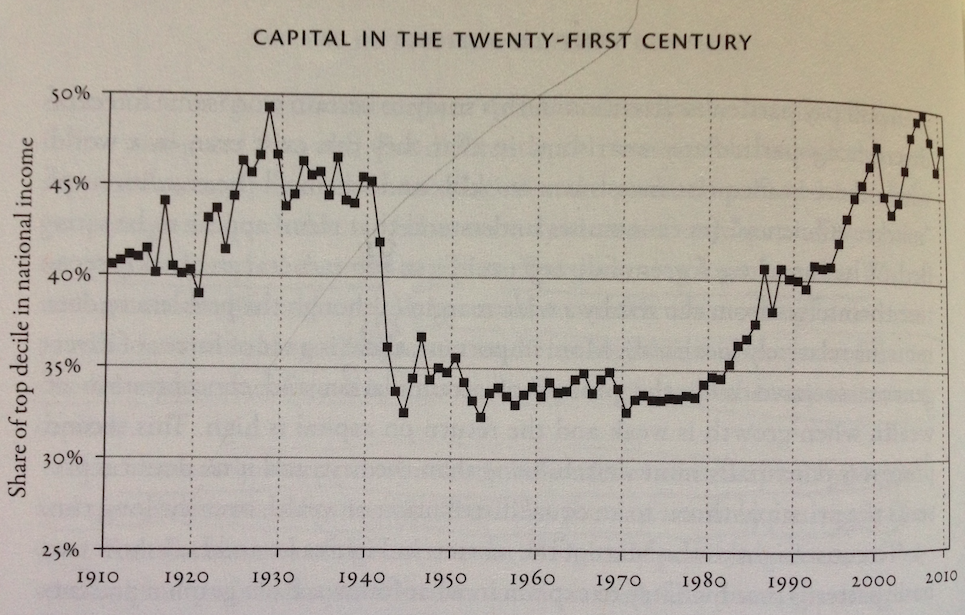
The picture painted by Avent of stagnating incomes for the majority of the population has been well documented in a range of book over the past few years. Robert Stiglitz(2) , Hacker and Pierson(3) and, of course, Thomas Picketty(4) have screen-shot-2016-10-23-at-14-58-44all pointed to this phenomenon and its role in increasing the levels of inequality in America. Typical is the “U” shaped graph showing Income inequality in the United States 1910 – 2010 in Thomas Picketty’s book Capital in the 21st Century. This charts the high levels of inequality in the first 40 years of the 20th Century followed by the dramatic reduction in inequality from the period after the second world war, then an accelerating growth in inequality since the 1970’s to levels not seen since the late 1920’s.

Given this gradual but enormous change in the position of middle class America it should be no surprise that people are frustrated and angry. The frustration arises out of the narrative that says this process is an inevitable result of progress. Opposing it is a luddite response to the course of history and in due course a whole load of new jobs will come along to take up the slack. The problem is the new jobs that have come so far are low skilled, low paid and very precarious.

At the same time people can see corporate and financial leaders taking enormous salaries, many multiples those of their predecessors at a time when GDP growth is lower than it used to be. Worse the people that take these enormous salaries seem to be able to secure them through location rather than performance. Whatever the results of the company the salaries of those in the C suite go up.

Worse yet when exceptionally highly paid people in the finance industry bring the economy to its knees, costing thousands of jobs and homes they are bailed out by the very people whose lives have been devastated, the tax payers. The people who arrange these bailouts as public officials later move on to work in the very institutions that have been saved. In these circumstances you can understand why the ordinary American is highly cynical about the ability of the existing political system to bring about change in their favour. This is why Mrs Clinton is struggling. She is perceived as too close to the traditional political machine and worse, Wall Street.

America may have averted a tragedy if they avoid the election of Donald Trump but they should not think they have avoided a crisis. It is not going to be politics as usual even if Mrs Clinton secures the White House. Radical change is needed in the States. There are a number of systemic problems that need to be addressed which would involve a real shift in the distribution of power. If Mrs Clinton can achieve this she will go down as one of the great US Presidents. If she cannot, and I am not optimistic, America, and therefore the rest of the world, are in for a very challenging time.


(1) Ryan Avent The Wealth of Humans: Work and its absence in the Twenty First Century. Penguin Random House 2016

(2) Joseph P Stiglitz The Price on Inequality Allen Lane 2012

(3) JacobS Hacker & Paul Pierson Winner Take All Politics Simon and Schuster Paperbacks 2011

(4) Thomas Piketty Capital in the 21st Century Harvard University Press 2014

Why Trump must stay in the race.

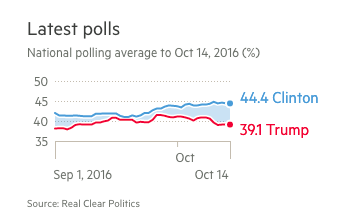
At first sight the suggestion it is important Donald Trump stay in the campaign to become the next President of the United States might seem crazy. Why might one want a bigoted, misogynistic, demagogue to remain a contender to become the most powerful person in the world. The first, and in truth the most important, reason is the fact that it looks now as if hscreen-shot-2016-10-15-at-12-54-25e will lose. The FT US Election 2016 graph of the latest polls shows Mrs Clinton with a 5% lead and describes support draining away from Trump as the revelations about his views on women continue to emerge. So it looks like a Clinton victory is becoming more and more likely which ought to be good news. However, I fear there is no good outcome for this election

It is clear that for many Mrs Clinton is just the  least worst candidate. Pew Research in the States  shows that for each candidate a third of those intending to vote for them are doing so  simply to stop the other candidate getting elected. If Mrs Clinton wins it is going to be difficult to claim a ringing endorsement when the main reason 32% of her supporters give for voting for her is because she is not Donald Trump. This cannot be a good outcome for a process to identify the most powerful person in the world.

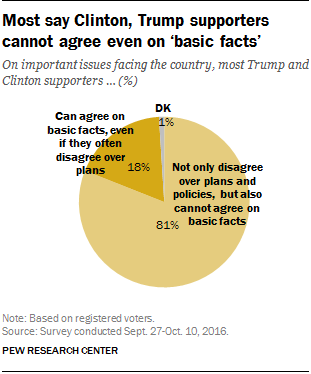
What has also become clear through the course of the campaign is the widening gulf between the supporters of the two main parties. Supporters for the two candidates not only disagree over screen-shot-2016-10-15-at-13-28-25policies, they cannot agree on basic facts. They appear to inhabit different worlds with little in common but everything contested. What is more, everything contested in  a very aggressive, not to say vicious, way. Compromise is not possible nor even thinkable. It is this which creates stalemate in the American system.

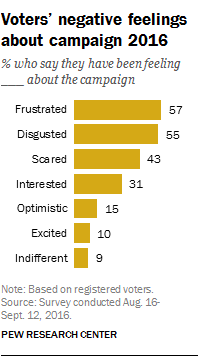
Worst of all is the fact that for a majority their overwhelming attitude to the whole Election is one of frustration or disgust. This is worrying in the extreme.screen-shot-2016-10-15-at-13-28-42 It is possible that people are going to start agreeing with the first part of Winston Churchill’s famous dictum on democracy being the worst form of government. Democracy can be remarkably robust when it rests upon  a foundation of internal social cohesion. Then the electoral process is a pragmatic way of conferring legitimate authority for a period of time. Take away the foundation of social cohesion and democracy becomes an arid arithmetic formula for arriving at a decision about who gains the levers of state power. To be a successful democratic nation its citizens need to have a common understanding of some foundational issues and a high degree of tolerance. At the moment tolerance is in short supply in  the States and the glue of the American dream seems to be dissolving.

All this brings me back to the issue of why I think Donald Trump needs to remain in the campaign. I fear that if he were to drop out then two things would happen. First, the die hard Trump supporters would develop a  rhetoric of the stolen election blaming the liberal media for giving credence to false accusations, there is evidence of this already and worse it is emanating from Trump himself. Second, those now saying they will vote for Mrs Clinton in order to prevent Trump getting elected might simply walk away. This may result in a President being elected on an historically low popular turnout. In circumstances like this the real loser will be democracy as some will believe their man has been swindled and others will have but tepid support for the victorious candidate.

Let me be clear I think that Hilary Clinton is by far the preferable candidate and she is focused on the kind of liberal issues which need to be addressed in the States.  However there are some more fundamental issues about growing inequality and the dominance of Wall Street over Main Street which are the issues which are exciting the citizens of the United States, her own supporters as much as those of Donald Trump. If these are not addressed it may be the US simply becomes ungovernable.

The grandees of the GOP seem to have calculated Trump is a lost cause and will lose the election they are therefore turning their attention to the race for the Senate, where 34 seats are up for grabs, aiming to increase their current majority. All this means 2017 may well be another year of paralysis on Capitol Hill further undermining support for the political system and by association democracy. Inequality will increase, the living standards of the majority will continue to stagnate and the grounds will be laid for a far more radical solution to be proposed by a demagogue with more traction. More Marine Le Penn than Nigel Farage. The fact that someone as obviously phoney and inappropriate as Donald Trump could get so far in the process is a clear sign that something fundamental is broken at the heart of American democracy. Radical change is needed which will mean a real shift in power. Those that have it are not likely to support this. They need to be careful however as the alternative may end up being worse, even for them.

We can only hope that some in the States remember the second part of Churchill’s dictum that democracy is the worst form of government… apart from all the others.


Trump lashes out at establishment over groping claims

Donald Trump painted himself as the victim of an establishment conspiracy as he rejected fresh allegations that he had made unwelcome sexual advances towards women, slamming the media for producing them in cahoots with Hillary Clinton.In a fiery campaign speech filled with sweeping indictments of his perceived enemies, Mr Trump sought to use the furore over his alleged conduct to make the case to supporters that he was being mistreated by the elite just as they had been.

Source: Trump lashes out at establishment over groping claims


Brass neck he lacks not! However, incredible though it is Mr Trump’s candidacy does have one area  of credibility. It speaks to the level of alienation from their political system of large numbers of Americans. It is a supreme irony that a billionaire has articulated the intuition of many citizens that America has the best democracy money can buy – and it has been bought from under them.

Whilst the election of Trump would have been a global disaster, the result of this election can only be, at best, least worst. Whilst the growing evidence of his lack of personal integrity may be pushing some supporters away it is only going to reinforce their frustration with a political system that does not seem capable of responding to their needs. The space remains for a more credible demagogue with all the risks that that entails. It is probably the case that western democracy is more at risk than it has been since before the second world war. These are frightening times.