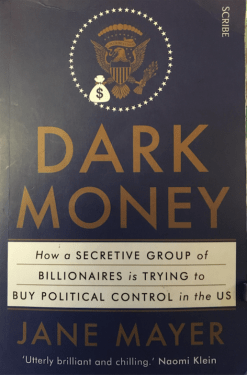
Dark Money by Jane Mayer covers a period from the early 1970’s to the run up to the Trump election. It documents in meticulous detail the amount of money spent over the period by super rich Americans, not just to secure the election of politicians supportive of their radical libertarian views but more insidiously to shift the terms of political debate to the right.
 The process begins in the late 1960’s early 70’s when a number of very wealthy Americans began to fear the US was about to succumb to socialism. It may seem unbelievable now but looking back it was a time of radical foment, the rights of black Americans were being fought for, a nascent women’s rights movement was emerging, young people’s opposition to the Vietnam war resulted in 4 students being shot and killed in a protest at Kent State University.
Whilst all this protest were real worries to many on the right there were other issues about the role of the state that were of perhaps of more profound concern. The Democratic President Lyndon Baines Johnson had initiated a War on Poverty. Worse however was a proposal by Republican President Richard Milhous Nixon to create a modest basic income, an idea about which there is currently renewed interest.
In 1970 the Family Assistance Plan passed through Congress with a healthy majority but was lost in the Senate to Democratic opposition that it was not radical enough. At the time it was said “This bill represents the most extensive, expensive and expansive welfare legislation ever handled.” Not only was their bipartisan support for this proposed legislation, but it was supported by 90% of the press and popular in the country.
For some, all of this represented an unwarranted intervention by the state in the operation of the market economy. An intervention that would expand the role of the state, require increased taxation and thus impact directly on the fortunes of the very wealthy. Some decided it was time time to act.
Ms Mayer’s book focuses primarily on the brothers Charles and David Koch. The brothers engaged in active politics in the 1970’s providing financial support to the Libertarian Party. In 1980 David Koch ran as the running mate to the party’s Presidential candidate, Ed Clark who was challenging Ronald Reagan, from the right. They got 1% of the vote. From this point on the Koch’s receded from public view and over the next three decades according to Ms Mayer gave well in excess of $100m “…to dozens of seemingly independent organisations aimed at advancing their radical ideas.”
The book charts how the brothers “weaponised philanthropy”, maximising the tax benefits of establishing charitable trusts, thus avoiding inheritance tax, and then using the money from the trusts to support a series of educational and social welfare groups to promote their libertarian viewpoint. Over the years a variety of think tanks were established or supported all with the aim of ensuring that conservative ideas were made respectable.
Over time the thinking evolved and there was a recognition that in order to change opinions the elite educational institutions of the US had to be “penetrated”. This led to the “beach head” theory which was about establishing conservative beach heads at “…the most influential schools in order to gain maximum leverage.” By 2015 the Charles Koch Foundation was “subsidising pro-business, anti-regulatory and anti-tax programmes in 307 different institutions of higher education in America.” Interestingly the book reports a comment about the Golden Rule of philanthropic giving – those with the gold, rule. This was taken to a higher level when a donation of $965,000 to West Virginia University by the Charles Koch foundation came with strings. The foundation was to have a say over the professors it funded, fundamentally undermining academic independence.
The Koch’s were not alone in this enterprise but they did, and continue, to play a major co-ordinating role such that at one point the sprawling breadth of their influence in right wing political promotion was described as Kochtopussy. Ms Mayer’s book makes clear that this was not the outcome of a series of more or less random individual initiatives. Rather it was an evolving, but very conscious, political strategy to move the political goal posts. It responded to a very clear cri de coeur set out in a memo by Lewis Powell in the late 1970’s urging American capitalists to wage “guerrilla warfare” against those he saw as trying to insidiously undermine them. Ms Mayer claims his call to arms inspired some of the super rich, “to weaponise their philanthropic giving in order to fight a multi-front war of influence over American political thought.”
You may wonder whether these people were driven by a bizarre but genuine belief in radical libertarianism, where the state, taxes and regulation were perceived as demeaning constraints on the freedom of the individual. In truth their idealism was always tempered by a strong regard for their personal advantage. When congress was considering the Troubled Assets Relief Progamme (TARP) the Koch’s and their radical caucus were opposed to the massive package of state support. This changed however when the stock market started to tank. Suddenly their wealth was at risk and opposition to the TARP was dropped.
Another fascinating insight into the motivation of the Koch brothers comes from a post mortem conducted into the right’s failure to prevent a second Obama term at one of their annual seminars. Arthur Brooks, President of the American Enterprise Institute funded generously by the Koch brothers, made the point that if the 1% want to win control of America, “… they needed to rebrand themselves as champions of the other 99%”. This theme was built on in 2014 in a paper that Richard Fink, Charles Koch’s “grand strategist”, gave to a meeting of one of their annual seminars of the libertarian super rich. The paper was entitled “The Long Term Strategy: Engaging the Middle Third”. In a perfectly candid way Fink asked the question, “We want to decrease regulations. Why?” he then answered his own question, “It’s because we can make more profit, okay?.”
One third of the electorate who were perceived as solidly on the side of the libertarians, another third never would be. This mean the battleground was about gaining the trust of the middle third. To do this it would be necessary to convince the them that libertarian intent was virtuous. “We’ve got to convince these people we mean well and that we are good people.”
Following a Supreme Court decision in 2010 known as Citizens United it was found that corporations had the same rights to freedom of speech as individuals. This overturned a century of restrictions banning corporations and unions from spending all they wanted on the election of candidates. This opened the floodgates to political spending to support congressmen and senators and the Koch Brothers took maximum advantage building a real power base which was in but not of the Republican Party.
In 2014 the Koch network invested $100m into House and Senate races for the GOP plus almost twice as much into other kinds of activism. The result was they won full control of both. Their aim was to spend $889m in the 2016 presidential race. Whilst they could not legislate for the Trump wildcard the first attempt to replace Obamacare was such a shambles because of the intransigence of the right wing caucus within the Republican Party largely made up of Koch supported Congressmen and Senators who thought the Trump proposal was too generous!
Dark Money is a sobering work which casts an unflinching light on the very private world of the super rich in America and specifically on the brothers David and Charles Koch estimated to be worth $41.6bn each. It raises all kinds of issue about the role of multi-billionaires in undermining democracy in America and reinforcing a process which is concentrating ever more power and wealth in the hands of a smaller and smaller group of super rich plutocrats.
The influence of the Koch brothers, and many others of the same ilk, is not confined to the States however. They have played a part in shifting the terms of political debate across the whole of the developed world, dragging the centre of politics so far to the right that people like Richard Nixon look like lefty softies. If one thinks about how a proposal to increase taxes on the rich in Britain today would be greeted it is a testament to how far the super rich have captured common sense and shaped it to their benefit.
This is a book that should be read widely. It’s scale will probably prevent this which is a real shame. It is a tremendous summary of a long and sustained process of the exercise of soft power through the expenditure of vast amounts of private money. If the process is not stopped it will ultimately undermine democracy.
Dark Money. Jane Mayer. Scribe Publications 2016
 northerncomment