
Freedom of Screech

In 1987 the US Federal Communications Commission abolished the “fairness doctrine”. This had been in place since the 1940’s and required broadcasters to provide a balanced hearing for different viewpoints on topics. It did not specify how this should be done, for example with equal amounts of time, however it meant that a broadcaster’s licence could be in jeopardy if they failed to allow different sides of an argument to be aired.

The repeal of the doctrine paved the way for talk radio to give birth to the shock jock. In 1988 Rush Limbaugh was recruited for a nationally syndicated radio show which by 2020 had become the the most listened to talk radio show in the US with just over 15m listeners every week. The next most popular radio show was that of Sean Hannity with 15 million listeners.

Both broadcasters espoused extreme right wing views on race, feminism, climate change and a range of other liberal causes. Like President Trump, for example, they claimed climate change was a hoax. Thus not only were they extreme, they were also wrong.

They are often portrayed as the leading edge of a process where the media began to divide into liberal and conservative channels with the distinction between them ever more stark. Cable TV networks and the advent of Fox News in 1996 reinforced this evolution. Donald Trump’s channel of choice it also drew some 87 million other older viewers (median age 68) providing a diet of climate change deniers, gun lobby supporters and anti-government groups of all sorts.

The rise of an increasingly militant right wing media has often been presented as one side of a process of increasing partisanship. A process where those on the right and those on the left retreat to their respective extremes and eschew any common ground in political debate.

Whilst it is clear what broad political stand point networks like CNN and MSNBC support there is a false equivalence to their partisanship. First, in terms of degree the right has moved much further to the right than the left has to the left. But worse, they have they have moved to the wrong right. The right which rejects trade, science and experts, (apart from brain surgeons and airline pilots when you are on a hospital bed or in an airplane!) not the right which promotes entrepreneurship, business, commerce, markets and an effective welfare state..

If we take climate change, the consensus scientific view on this has been in place for decades. The rejection of this science is not, inherently, a shift to the right, it is just wrong. That the Republican Party and the right in America have hitched their wagon to that… ass, is not only wrong but in the medium term politically risky. As the scientific reality of climate change becomes a physical reality pretending it is a hoax when it is taking peoples lives and homes must become an increasingly difficult sell.

When mainstream media turn their back on notions of impartiality, truth and scientific facts it is unsurprising the volume goes up and the quality down. Unless the Republican Party takes some serious action to distinguish itself from Donald Trump and connect with the issues the majority of Americans care about they are going to be trapped in a declining market of those who think the First Amendment is really a license to lie.

On this side of the Atlantic we need to be wary of moves which seem to be testing our desire to travel the same road. We have in the BBC a global brand which is highly respected and indeed revered in some countries. It is an important part of our soft power and that may become the only power we have over time so we lose it at our peril. No one would say the BBC is perfect, far from. However, it may be that it is like democracy, the worst broadcaster in the world, apart from all the others. And also like democracy something you really regret losing when it is too late.

Abolishing the fairness doctrine probably seemed like a minor change when it occurred. Its effects have, however, cast a long shadow over US and consequentially global politics. Perhaps it is time to restore it.
Age Inflation

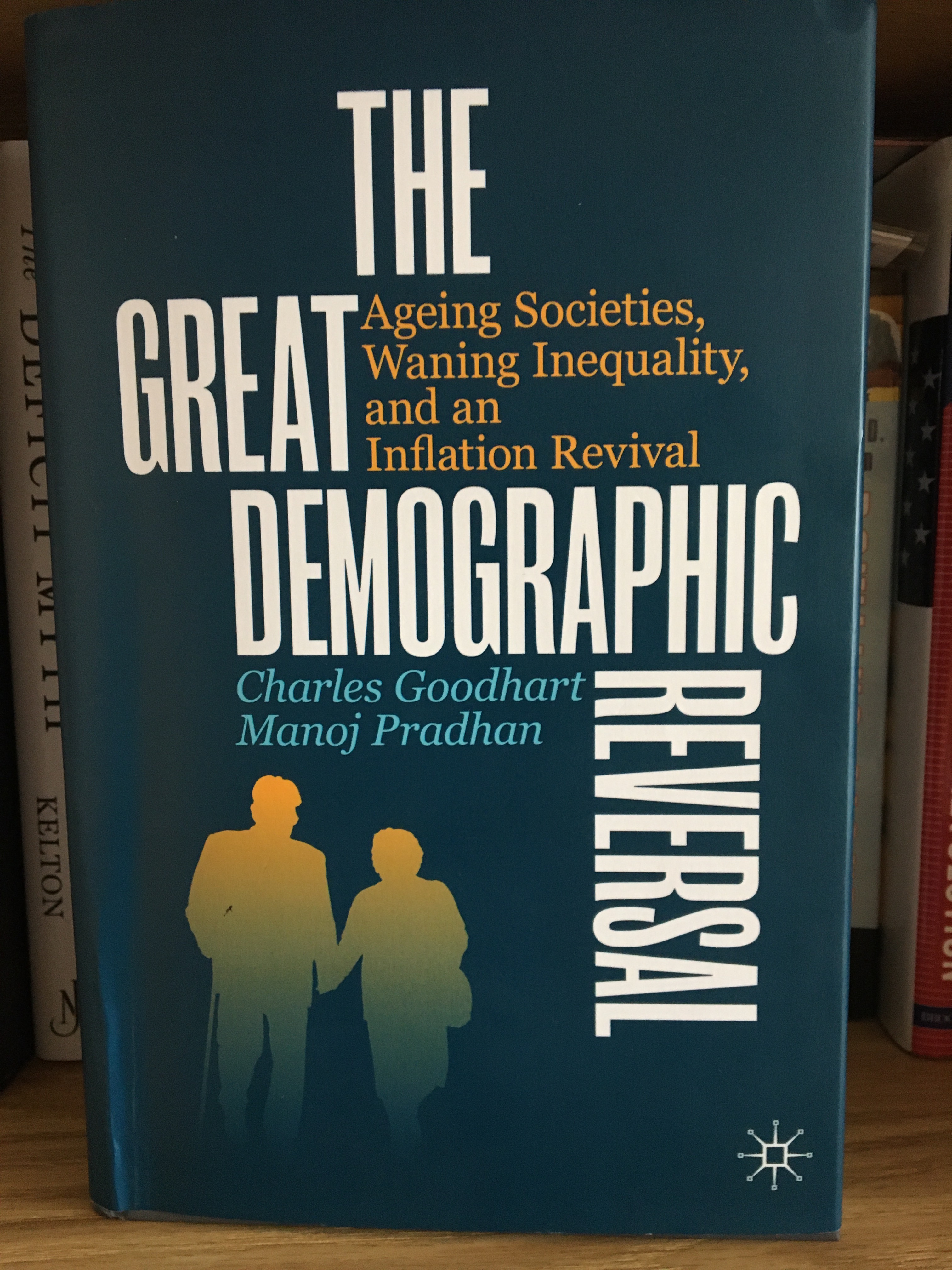
“The Great Demographic Reversal” is an immensely stimulating book by Goodhart and Pradham which amongst other things predicts a shift in the balance of power between capital and labour, reductions in levels of intra-state inequality and, worryingly for highly indebted nations, the return of higher nominal interest rates and higher inflation.

The predictions run counter to what seems to have become a prevailing view about the state of the world economy distilled into the concept of “secular stagnation”. This model, discussed elsewhere on this site, focusses on many of the same drivers as Goodhart and Pradham. An ageing population, increasing dependency ratios, a glut of savings, changes in the capital intensity of growth industries all leading to a paucity of demand for capital for investment. The demand for money is thus reduced pushing down its cost ie. interest rates. These things are also presented as part of the explanation for the aneamic productivity growth rates in advanced economies and a whole lot of other ills.

Goodhart and Pradham have a different take on these issues. They share the view that a demographic sweet spot in critical economies around the world has combined to create a benign low inflation and low interest environment. But looking forward they analyse how that national sweet spot is turning sour and is set to impact the evolution of the global economy.

In essence, they see that over the past thirty years China has proved to be a massive engine of deflation which it has exported around the world. Its insertion into the global economy through its membership of the World Trade Organisation in 2001 effectively increased the supply of cheap labour into an increasingly integrated globalised capitalism. This sucked in jobs from the advanced, relatively high wage, economies of the world and pumped out cheap manufactured products.

This meant a decline in demand for workers in manufacturing jobs in the West, a consequent reduction in their bargaining power leading to wage stagnation and or unemployment. This reinforced a shift towards service industries with a generation of baristas and deliveroo employees on minimum wages only able to remain fashionable because of the rock bottom prices provided by the House of Primarnia with its Asian manufactured clothing.

However, the positive demographic is being replaced by negative trends in both the East and the West. In China and many parts of the West population structures are shifting towards the elderly end of the bell curve. What is more the tail on the elderly end is being pushed out as people are living longer. This has a number of interacting consequences on society and the economy.

Firstly, there is the increasing demand on health and social services as the old and very old members of the population create increasing levels of demand for support. Goodhart and Pradhan have an excellent chapter on the health and care challenges of an ageing society.

Second, their living longer puts increasing strain in terms of national and private pension requirements. Responses to these may including raising the retirement age, reducing levels and or benefits, and closing final salary schemes. Whilst some element of all these have occurred in the UK there is a limit how far these things can be taken if not for moral, then for reasons of electoral arithmetic. Old people vote.

In summary both of these factors create significant levels of demand on public finances just at a time when the dependancy ratio, ie. the ratio of those who are economically inactive to those working and paying taxes is getting worse.

Not only is this happening in many advanced economies it is also happening in China. The dependency ratio there is moving in the same direction and labour availability is set to reduce over the coming decades. This will, over time switch off the deflation machine.

In parallel with all this is the shift in political sentiment away from globalisation linked to an increasingly populist rhetoric. Goodhart and Pradham make the point that this will have a doubly negative effect. Controls on immigration will exclude the labour required by the economy to improve the dependency ratio. It will also limit the importation of inflation reducing cheap imports.

Watchers of the Global economy may respond to the predictions of this book by pointing to Japan. A nation which has gone further along the demographic ageing curve than any other advanced economy. There is little sign of inflation or increasing nominal interest rates after the best part of three decades of economic stagnation and a national debt which, as a percentage of GDP, is 1.6 times worse than the current UK position, c260% plays c100%.

Goodhart and Pradham have a chapter on this and provide, to a laypersons point of view, a convincing explanation of why Japan’s experience cannot be seen as a prediction of the future impact of demographic changes globally. Not least because they were able, and did, take maximum advantage of the demographic sweet spot of their neighbour to import deflation.

The book does not simply explain the likely trajectory of the world economy based sole on demographics. They outline what significant challenges this creates but they look at a whole host of other factors as well including the rise of indebtedness in the non-financial corporate, household and public sectors. They also talk about the misalignment of management incentives with investment needs negatively impacting productivity growth. Goodhart and Padhan are clear that, whilst, ageing is inevitable its economic and social consequences are not. They depend on policy actions.

The final chapter of the book points to a number of actions that might be taken to start to address the issues of indebtedness, productivity and inequality. They see tax increases as inevitable but have interesting proposals about how they might be structured in the most equitable and effective way possible.

They explore the benefits of a land tax and a carbon tax . They also look at ways to reduce the differential tax benefits of debt over equity through an Allowance for Corporate Equity or a Destination-based Cash Flow Taxation (DBCFT). Both of these are mechanisms to push corporates to rely more on equity than debt which may be critical if the authors are correct about the likely direction of interest rates. They also talk about reforming the incentive structure for corporate managers which, currently, positively promotes the loading on of debt, excessive cost reductions particularly in relation to R&D, and the buy back of equity in order to push up the Return on Equity (ROE), all of which increase the benefit corporate managers derive from share incentive schemes.

At 218 pages this book deals with an enormous topic with a mix of close technical discussion of things like the Philips curve and the Non Accelerating Inflation Rate of Unemployment (NAIRU) and very easy to follow logic. It is definitely swimming against the tide of much current thought about the prospects for inflation and interest rates. However, much of what it has to say makes sense as a strategy for addressing some of our current problems of productivity whether or not the demographic time bomb is as powerful or as pervasive in its impact as they predict.

In the interests of full disclosure, as a pensioner the issue of inflation is close to my heart, and wallet, however, I recommend this book for anyone who wants to read an accessible and interesting analysis of the possible evolution of the global economy over the next few decades.

The Great Demographic Reversal: Ageing Societies, Waning Inequality, and an Inflation Revival. C Goodhart, M Pradham. Palgrave Macmillan. 2020

Republican Values

Despite his rejection by a clear majority of the American people, and despite having lost the House and then the Senate to the Democrats, Donald Trump seems to have an incredible hold over the Republican Party. Whilst it is clear the leadership can’t wish him far enough, and criticise his role in the events of 6 January, they are still circumspect in their actions and words. Many members of the party have still failed to say a word against him.

The willingness to call out the ex-presidents behaviour seems to be closely correlated to the distance from re-election. For members of the House that is very soon and they are loath to risk the ire of a man renown for his commitment to revenge. The threat of being primaried or having some of the Trump war chest deployed against them retains their public if not private loyalty.

Some, of course, may be believers in Trumpism. They genuinely think the policies and practices of the past four years are consistent with the constitution and the principles of liberal democracy. In which case one cannot question their integrity though you might their judgement.

It is the ones that know Trump is definitely in the running for the worst American president of all time that are really difficult to fathom. They know the scale of the threat he has been to American Democracy but cannot bring themselves to stand up and be counted.

The job of an American Congressman, is reasonably well paid. The salary is $174,000 per annum for all members of the House and the Senate. There are no additional amounts for being the Chair of a Committee, however, the majority and minority leader in both houses receive $193k and the Speaker of the House receives $223,500.

On top of their base salary they can earn up to a maximum of 15% of a separately based figure with a current maximum allowance of $28,440 giving a potential total earnings from all employments of $202,440, approximately equivalent to £144k.

One cannot believe the concern Republican members have for the Constitution and their nations democracy is exceeded by their salary. There must be some other values which they hold so dear as to be willing to stand silent in the face of incitement to insurrection.

What can those values be?

Which McConnell?

Yesterday the leader of the Republicans in the Senate, Mitch McConnell, provided a startling example of decisive leadership in the Impeachment trial of Donald J Trump. He made clear that all charges have been proven so obviously he had to vote to find him… not guilty!

Like much in the Impeachment trial nothing was what it seemed to be. The lawyers for the defence did their best to secure an indictment. The jury were also the judges and, uniquely in this Impeachment, the victims. Having voted on and secured a bipartisan majority in favour of the constitutionality of the Impeachment procedure, most of the GOP of law and order, acquitted the accused on the grounds that the procedure was unconstitutional. It was trial in Wonderland.

But one has to wonder what “hare and hounds” strategy Mitch McConnells thinks he is pursuing? He starts by voting against Impeachment. “Hurrah!” shout 43 Republican Senators and 74m Trump voters. “Boo!” shout 50 Democratic and 7 Republican Senators, and 81m Biden voters.

But no sooner has he voted to prevent Trump’s indictment than he gets up, decries the appalling acts of mob violence on 6 January and is crystal clear about the cause: “There is no question that President Trump is practically and morally responsible for provoking the events of that day.”

“What!” shout 99 Senators and 155m voters?

Clearly this is an attempt by Senator McConnell to support Joe Biden’s calls for unity. In the twinkling of an eye he unites both bases and both parties representatives against him.

What is he thinking?

I struggle with this given he is one of the most experienced senators in Congress having been first elected in 1984 and then chosen as leader of the Republicans in the Senate in 2004. He must have a clear eyed view of what he wants to achieve, but what is it. Is he for or against Trump?

Could it be that after 4 years of unqualified support for the worst president in American history, and that is not a low bar, he has seen the light and recognises the threat Donald J Trump represents to US democracy? Have the scales dropped from his eyes? Is he now a convert to bi-partisan unity?

Or, alternatively, does he have some Machiavellian plan to steal the base?

If the latter he must be playing a long game. He cannot think the joy of the acquittal experienced by the Trump base will override their anger at his attack on their hero! If those storming the Capitol are anything to go by that judgement call would look doubtful.

But maybe he has taken a more sophisticated view about the Trump base and its stability. Perhaps he thinks, whatever the hype of the moment, Trump is likely to be a decreasing force in American politics. One which might be loud on the fringe but unlikely to gain centre stage again.

No longer with access to the most powerful pulpit in the world, nor able to use social media the ex-presidents voice will never be what he was as president. There will be no publicly funded PR machine making sense of, and reinforcing, what he says. Indeed he may find himself having to go to court to answer questions on accusations of sexual assault, business and taxation matters, campaign funding offences and much more.

As a defendant he will have to plead the 5th if he wants to stay out of prison. He will also have to take care of what he says outside of the courtroom if he wants to avoid contempt charges. But being respectfully silent is not his strong suit.

As these cases grind along they will feed deep state conspiracy theories amongst his base, base supporters but for many ordinary Republicans the drip, drip on his credibility will start to wear it down.

As more and more evidence comes to light about the actions of those invading the Capitol, and the precise role of Mr Trump, that too is unlikely to strengthen his position. Whilst a recent poll showed a disturbing 55% of Republicans in favour of violence to defend the American way of life, it also confirmed that 43% were opposed to the use of violence for that purpose. So a lot of Mr Trump’s base may well feel increasingly uncomfortable if they feel his leadership is promoting violence.

But even the base, base may start to have doubts. As insurrectionists come to trial and use Mr Trump as part of their defence and perhaps call him as witness to their patriotism, will he turn up in court to defend them under oath? Will he use some of his war chest to fund their defence? You only have to write it down to know it wont happen.

If he does refuse to support them, or denies their claims they were doing his bidding will he become part of the deep state conspiracy? That would be a delicious irony but history is rarely that kind.

How he uses his quarter of a billion dollar war chest may also start to ring alarm bells. Will he fund the defence costs of any of the invaders? No. Will he fund pimarying? Maybe. Will he fund the mid-term campaigns of those who flatter him most? Maybe. Will he fund the 2024 campaigns of those who go large and long on flatter? Maybe.

But, Mr Trump is notoriously difficult to get cash out of, ask his lawyers. The multi-billionaire Donald J Trump did not make the top 35 list of self funding candidates which goes down to a total of $1m of own funds.

Mitch McConnell is the latest of an increasingly partisan line of leaders of the Republicans in the Senate. It would be a mistake to assume he has changed his spot in that regard. He is also one of the most wily and politically savvy and it would be an even bigger mistake to think that has changed. He may be presenting a Janus faced strategy to the world but it is difficult to not think he sees Trump as a dying star. One which may explode rather than fade but one whose time is limited.

The mid-term are only 23 months away, however, a week is a long time in politics and Senator McConnell has lived through a lot of them. He may well have judged he will be able to pull the majority of Republican supporters away from Mr Trump. Those who do not support insurrection.

However, he will still have to figure out how to address the base, base which Mr Trump has fired up. Their actions are a stain on American democracy incited by Mr Trump who claims he is now the Republican party. His response to Senator McConnell’s comments will not be judged to pour oil on troubled waters. Going forward the good Senator may well need eyes in the back of his head.

The Republicans are in a hole and as yet no sign they have stopped digging.