
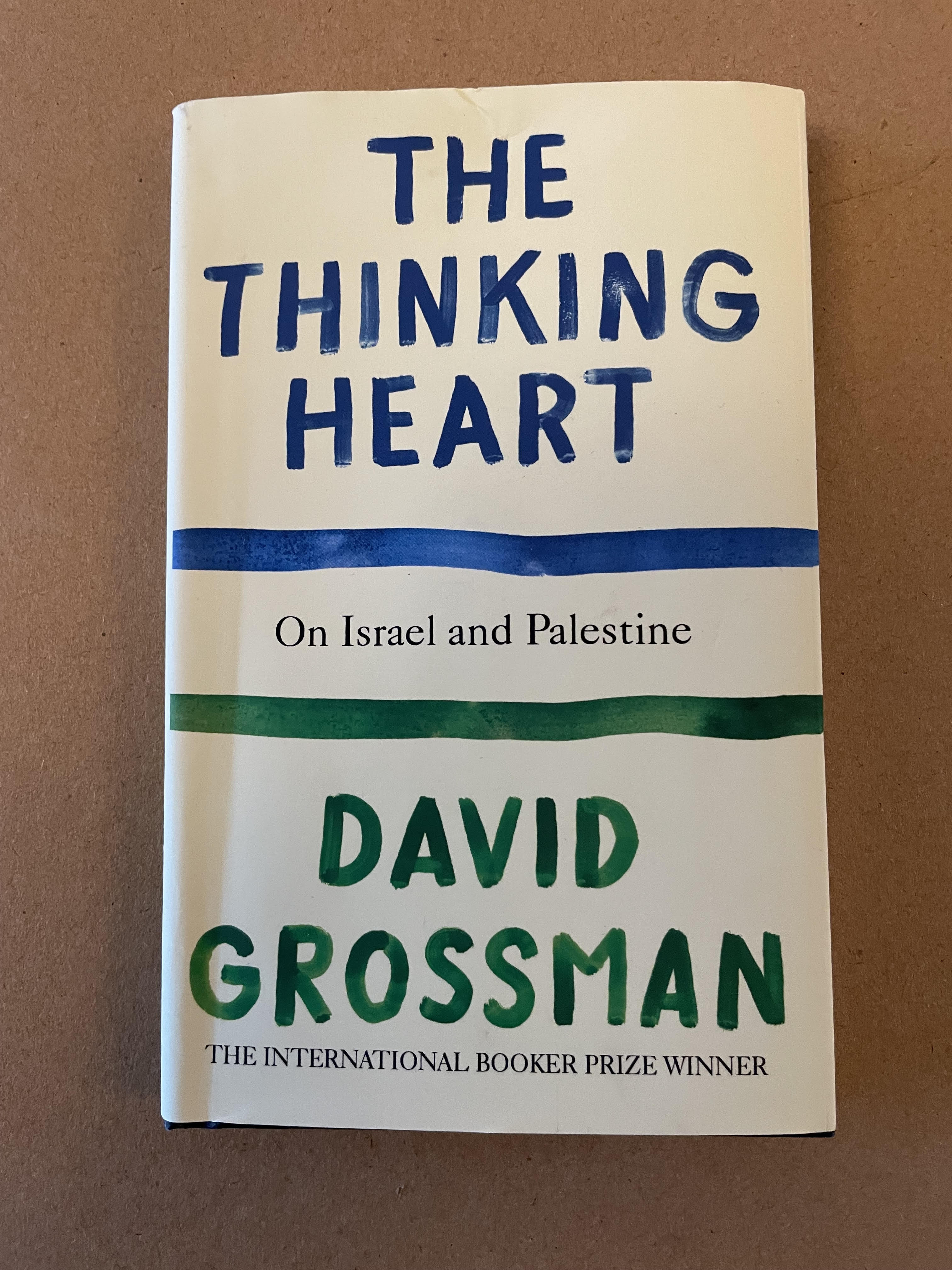
This is a collection of articles and speeches by novelist David Grossman, winner of the 2017 International Man Booker Prize. They span a period from July 2017 to June 2024, obviously taking in the barbaric attack of 7 October 2023. The book is a mere 87 pages long and exceptionally well written. It provides an intelligent and humane analysis of the problem of a just peace in Palestine, something Mr Grossman has spent decades campaigning for. It is a testament to his commitment that, despite the medeival horrors of 10/7 he remains convinced that “…it is impossible to begin resolving the Middle Eastern tragedy without offering a solution that alleviates the Palestinian’s suffering.”
His critique of Prime Minister Netanyahu is searing. He is equally critical of the ulta-Orthodox religious right who have a inappropriate and disproportionate say in the politics of the State of Israel. Promoting Eretz-Yisrael or Greater Israel, an area which has a number of definitions but certainly encompasses the current State of Israel, and the Palestinian Territories. It is this aspiration which “legitimises”, in their view, the settler movement in the West Bank and current demands for the same in Gaza.
Mr Grossman describes the Judaism he connects to as “…secular and humanist. It has faith in human beings. The only thing it holds sacred is human life.” You can imagine how acceptable this definition of Judaism is to those of the religious right who call for the State to go to War for a Greater Israel but “…refuse to send their own children to military service because, according to their faith, praying and studying Torah is what guarantees the continued existence of the Jewish people…”. Their single minded labours aim to preserve the purity of their contested view of the faith which sees God as being in the real estate business and having promised them the land of Palestine 2000 years ago.
What is interesting about the book is how it charts the growing stranglehold of PM Netanyahu and his actions to undermine, not just the rights of the Palestinians in the Occupied Territories, but also those of Arab citizens within the State of Israel. Mr Grossman sees all the actions of the Netanyahu government as being focussed on keeping alive and raw the wound that is the relationship between Israel and its Arab citizens and those in the occupied territories. He characterises the Nationality Law of 2018, which defines Israel as the nation state of the Jewish people and reserves the right of self determination to the Jewish people alone as a “…renunciation of the chance to ever end the conflict with the Palestinians.”
The articles in this collection remain optimistic and chart the growing internal opposition to Netanyahu. The demonstrations and marches against his attempts to consolidate his power and limit the rule of law were particularly vocal in the run up to 10/7. Despite the horrific terrorist atrocities of that day Grossman remains committed to negotiations and a move to a two state solution as the only viable route to a lasting peace.
Beyond this however Mr Grossman provides an insight into some of the psychological and other fears which shape Jewish thinking. Fears which certainly cannot be dismissed as irrational and which have an equal right to be addressed and must be part of any comprehensive solution in Palestine.
First among these fears is the pervasive view of the provisional nature of the State of Israel. Interestingly, this is not just seen as something driven by the hostile military objectives in the Hamas Charter of 1988 unabated in the eyes of Israel by the substantial revisions to that Charter in 2017, nor in chants about a Palestinian state from the Mountains to the Sea.
But more subtly than these attacks are the seemingly positive comments of supporters like the oft repeated formula by American Presidents that the US supports “Israel’s right to exist”. This phrase, although it challenges the opposite, subliminally concedes the possibility that such a right is not a given.
Another related but distinct issue is the attacks on Israel by its enemies. The objective of their campaigns against Israel is not simply to win a war against the Israeli state it is to abolish the state altogether. As Mr Grossman puts it “…Israel is the only country in the world whose elimination can be openly called for.” At the extreme end of this view is the antisemitic desire to eradicate the Jewish nation and people not just its state.
Mr Grossman asks the fundamental question, “Why is Israel – of the planet’s 195 countries – alone in being conditional, as if its existence depended on the goodwill of the other nations of the world.”
Mr Grossman also rejects the “intolerable”attempt to “…force the Israeli-Palestinian conflict into a colonialist discourse.” Arguing that colonialism can only be carried out by external nation states, and that as Israel does not have a state elsewhere it cannot be engaged in colonialism.
You can see why a people who have been persecuted and discriminated against in countries across Europe and beyond, and been subject to the most extreme attempt at industrial genocide the world has ever seen, would be extremely nervous about losing the safe haven of a nation state. This nervousness may at times become an existential panic resulting in a violent and disproportionate response to any form of challenge, perceived or real.
There are elements of Mr Grossman’s position that could be challenged. Being by far the most powerful military force in the region, the only one with a nuclear weapon capacity, and having the might of the United States foursquare behind it should allay some of the fears of its “provisional” nature. It is also the case that the vast majority of the nations on the planet recognise Israel as a legitimate member of the community of independent states.
Some of that sense of provisionality may stem from the manner in which the State was first established. One might argue this was by, “…the goodwill of the other nations of the world…” first in the actions of the League of Nations and secondly in the United Nations. Obviously, there were a range of other forces in play, not least the manouverings of declining imperial powers, notably France and Great Britain. Whatever its origins the world must, and in the vast majority do accept, the legitimacy of the State of Israel.
I fear the rejection of the colonialist model as applied to the actions of the Israeli State depends on an essentialist definition of colonialism relying on the preexistence of a colonialist state elsewhere as the aggressor. Whilst this might be a part of the definition there are key elements of the colonialist model, in the eviction of a preexisting peoples from their home lands and the repopulating of those lands by people from elsewhere which prima facie looks like it could be applied to the actions of the State of Israel.
Whilst there are parts of Mr Grossman’s argument which could be open to challenge, the tone and thrust of the book is exceptional. His analysis of the direction being followed by the current administration under PM Netanyahu is well-informed and trenchant. Despite the brutality of 10/7, Mr Grossman still argues for a negotiated settlement and a two state solution. In the end it is probably only this which will end the constant fear of the Israeli people about the provisional nature of the State of Israel. It is a book which everyone concerned about the current tragedy of Palestine should read.
The Thinking Heart. David Grossman. Johnathan Cape London 2024.
 northerncomment