
On the 9th August 1974 president Richard Nixon resigned from office in the face of almost certain impeachment. As president he broke a number of political, constitutional and moral norms.
He attempted to use Departments of state to “get dirt” on his opponents; he had a list of “enemies”; he hated the press; he expected loyalty to himself not the Constitution; he instigated the Saturday night massacre, his Attorney General and Deputy Attorney General resigning in succession when he ordered them to fire Archibald Cox the Special Prosecutor investigating the Watergate affair. He was a bad man. And he swore a lot.
Not since then has the US faced such a norm challenging president. Someone who threatens not just to do a bad job or make awful policy decisions but who actively undermines the foundations of the democratic system of government.
The parallels between Nixon and Trump are many and close however in the pantheon of awfulness Trump stands head and shoulders above even Nixon. He has been a far greater threat to US democracy and liberal democracy worldwide than Nixon ever was. There are two reasons for this.
Firstly, the character of the person. Neither Nixon or Trump could be said to be overly worried about questions of conscience or moral scruple. The difference is Nixon knew there was an issue, Trump doesn’t understand the question.
The second difference, is the the moral character of those about them. Nixon had loyal supporters, some of whom went to jail for him. However within the Republican Party and within Departments of State, most importantly Justice, individuals knew there were lines that must not be crossed.
They knew when partisan political focus strayed into an obsessive demand for control at the expense of Constitutional government. Not only did they know when something was wrong they did something about it. His political colleagues in the Republican party withdrew support from the president making the success of impeachment certain, lifetime public servants resigned rather than implement the actions of an increasingly irrational leader.
The threads connecting Nixon who was enraged by what he saw as the radical trends of the 1960’s in relation to issues like race, gender, youth, and Trump who has many of the same prejudices are fascinating.
Part of the Nixon legacy may be his support for a counter revolution taken up by libertarian oligarchs determined to overturn what they saw as a strengthening progressive agenda. The investment of hundreds of millions of dollars to change the intellectual landscape and build an alternative neoliberal agenda as promoted by groups like the Mont Pelerin Society.
An agenda of small government and privatisation, unregulated free markets, low taxation, a Washington consensus about the benefits of free trade Their activities contributed to a period where market-determined price became the measure of worth of all things to the exclusion of value. Government was portrayed as the problem, supply side economics with its tax cuts and de-regulation the norm with a Washington consensus about trickle down wealth distribution.
Over the years what may arguably have been a reasonable recognition of the importance of entrepreneurial dynamism became an ossified dogma incapable of addressing the problems of an increasingly integrated world with a dramatically different economic structure.
A weightless world of digital goods and instant communications facilitating global supply chains supporting just-in-time assembly processes. A world where offshoring, and mechanisation was destroying some jobs and shifting others to the other side of the world.
The impact of all this on, initially, non-graduate labour but as countries expanded their higher education, graduate labour was remorseless. Further, the deregulation agenda meant the ability of labour to defend itself was diminished if not removed.
The outcome in terms of growing inequality, an uncertain “gig”economy, loss of employment rights and benefits, and in the States the loss of health insurance created a sense of despair. Despair which had devastating consequence for the health and well being of many as described by Anne Case and Angus Deaton in their work “Deaths of Despair”.
These trends have meant the majority of the populations of many western democracies have seen their standard of living stagnate or decline. The political elites of these nations have seen this decline as an unfortunate consequence of economic progress.
Labour and Conservative, Democrat and Republican have argued, more or less forcefully the market economy is a self regulating machine which human interference can only damage. Ultimately it will make things better. Ultimately of course we are all dead. For those living, and possibly dying, through the transition, ultimately better days are of little consolation.
It is this context in which Donald Trump came to power. For Millions of Americans, no one was listening to them. It is a sign of the level of desperation they felt that a billionaire, foul mouthed, misogynist, racist could be seen as someone able to address their concerns.
What Trump did do was articulate their fears. He gave them a voice. He took the crisis of identity which unemployment, underemployment and marginal employment foster and gave it a series of targets which he claimed would “Make America Great Again”.
After four years the Trump record on the issues he said were his priorities is clear. He “loves” coal but coal production is lower as he leaves office than when he arrived, the balance of trade with China (ignoring the question of whether a deficit is necessarily a bad thing) in 2016 was negative $346bn in 2019 it was negative $345bn. (It is much lower in 2020 but there are reasons for that.) The $1bn reduction in the deficit has come at significant cost to the US economy. The New York Federal reserve has estimated that the trade war has wiped $1.7tn off the value of US companies.
In January 2016 US unemployment was at 4.9%. This was after six straight years of decline from a high of 10% in October 2009. In October 2020 the rate is 6.9%. The wall with Mexico remains to be built and Mexico have made clear their views on paying for it. Worst of all, close to a quarter of a million US citizens have died from Covid-19. A significant proportion of those would still be alive if the president had chosen to address the issue.
President Trump’s record is disastrous in his own terms which in the main are wrong anyway. This is before you address the issues of nepotism, self dealing, global security, national standing. I could go on.
However, the issues which created the space for a Trump presidency have not gone away. A radical agenda of change is needed and those that Hilary Clinton dismissed as in the “basket of deplorables” need to be reached out to and tangible support provided.
A president Biden has a massive task ahead. Despite appearances to the opposite winning the presidency is the easy bit. Crafting a consensus which secures real change in the balance of economic power to ensure areas like the rustbelt experience economic transition as benefit not just pain will be a massive challenge.
The agenda and the process of reconciliation is more than a one term exercise.and will mean hitting the ground running. There are those that doubt whether Joe Biden is up to the job. We will see, however, whatever his failings he is infinitely better than his predecessor. Democracy has rescued itself as it has done before. The political elites of all democratic parties must learn the lesson of how fragile it is and stand up for it against all who attempt to undermine it whichever side of the aisle they stand.
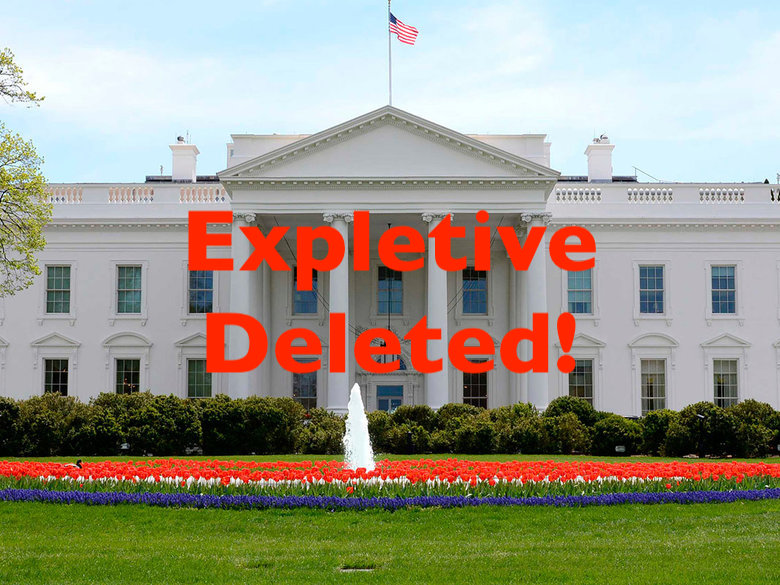
When he was forced to release the transcripts of the tapes of the conversations in the Oval office President Nixon insisted that the obscenities be deleted. This led to a huge number of text replacements with the term “expletive deleted”. Democracy has just ensured that an expletive has been deleted from the White House. It is a massive triumph for democracy.
 northerncomment
Pingback: Expletive Deleted | Native_Son