
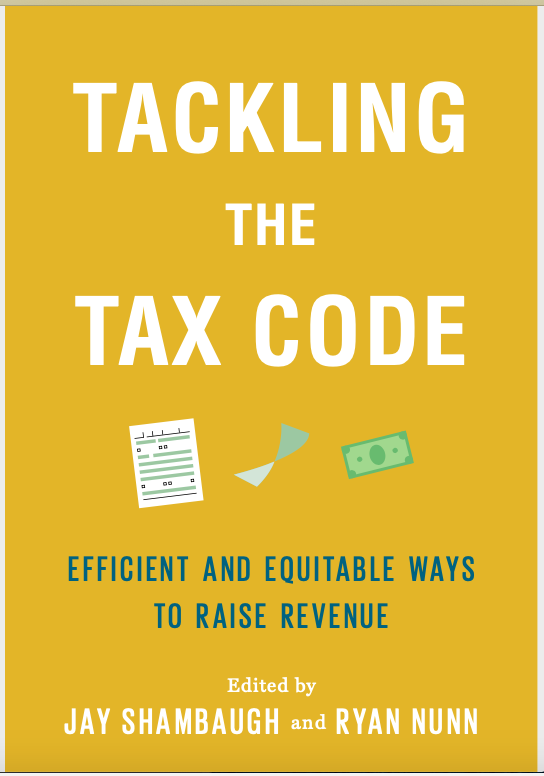
A new book on taxation, Tackling the Tax Code, published, (free) in the United States by the Brookings Institution has things much needed to inform debate on this side of the Atlantic. As we emerge from lock down its economic consequences are beginning to become apparent, and they are vast. Enormous sums have been pumped into the economy by the government to prop up employment, sustain the health service and fight the Covid-19 virus.
An enormous bill has been accumulating on the balance sheet of the government and the Bank of England one which will have to be paid at some point. When and how are questions which will soon dominate political debate.
There are two ways in which you can reduce debt. First, you can cut your expenditure so that more of your income can be devoted to reducing the debt. This is what we tried in relation to the debt arising out of the 2008 credit crunch. A decade of Austerity. Easy to understand because of analogies with household debt even if some believe the analogy involves a category error between national and household debt.
Whether another decade of Austerity is politically acceptable or even possible is a moot question. At the moment politicians do not seem to be promoting that line. Of course if they do not it rather calls into question the TINA argument about the need for the first decade. However, the expenditure side of the debate is for another time.
An alternative to reducing expenditure is increasing your income. How does the Government do this? Through taxation. Over the past few decades the direction of taxation policy has been remorselessly down, particularly for those on the highest incomes. C-19 and the subsequent recession is going to challenge that trend. If it is to change then there are a number of issues which need to be addressed. These need to be debated publicly for they have enormous consequences for all of us.
Which brings me back to the book. This is firmly focused on the US tax system but many of the issues and opportunities identified could equally be applied in the UK in fact some of the issues require multi-national responses in a global economy.
The book looks at the existing taxation system in the US and how it has evolved in recent years and particularly how income from taxation has gone down following tax cuts by GW Bush and D Trump. It then looks at how taxation should be raised in a fair and progressive manner.
One of the key principles the authors of the book promote is that taxation should be distributed fairly and progressively. Those with the broadest shoulders should take the heaviest load. Given the enormous concentrations of wealth allowed to build up over recent decades there is consideration of how this might be taxed including proposals for a much more effective inheritance tax for the wealthiest in the country. This would have the double benefit of raising revenue and reducing inequality which some believe is becoming a genuine drag on the economy.
In a similar vein there is also a proposal for a tax on financial transactions. This would mean that every time shares, bonds or fancy derivatives were sold they would be subject to a small charge. The proposal is 10 basis points or 1 tenth of 1 percent. Sounds like a small number but they estimate it could generate $60bn per annum when fully operational. Given that most of the wealth of very wealthy people is stored in financial instruments the costs of this would be mainly on the broadest shoulders.
More specifically the book looks at adopting a Value Added Tax (VAT). Clearly this is something we have already. What is interesting however is the discussion about how that should be adjusted through transfers to low income households to reduce the regressive impact of such a tax.
More effective taxation of multinational companies (MNC’s) is also called for. This to ensure that under current laws they pay what they are supposed to and that incentives to off-shore production and relocate profit centres are eliminated. This is combined with proposals to promote a global approach to MNC’s which will address the race to the bottom of tax reductions to attract corporate HQ’s. Changing accounting principles to tax according to location of turnover as opposed to HQ would transform the behaviour of corporates and enable all sovereign governments to more effectively ensure corporates pay their fair share.
Resourcing the revenue authorities appropriately is also something called for. Interestingly in countries around the world where there have been homilies about the need to act prudently they have almost all reduced the resources of the organisations whose job it is to raise the revenues that have been publicly approved. Given they raise much more than they cost there is clearly no prudential reason to do this.
Taxation is complex and in the main very dry, however it is the engine of civilisation. It provides the resources to educate, heal, protect, support and sustain civilised society. It is something we should not leave to the politicians or the technicians. There are basic issues of equity which need to be addressed in order to create a fair, transparent and progressive taxation system. If we do not militate for that you can be sure something much worse will be put in place. Something that reinforces inequality rather than reducing it.
The Tax Code: Efficient and Equitable Ways to Raise Revenue. Ed J Shambaugh and R Nunn. Brookings 2020.
 northerncomment