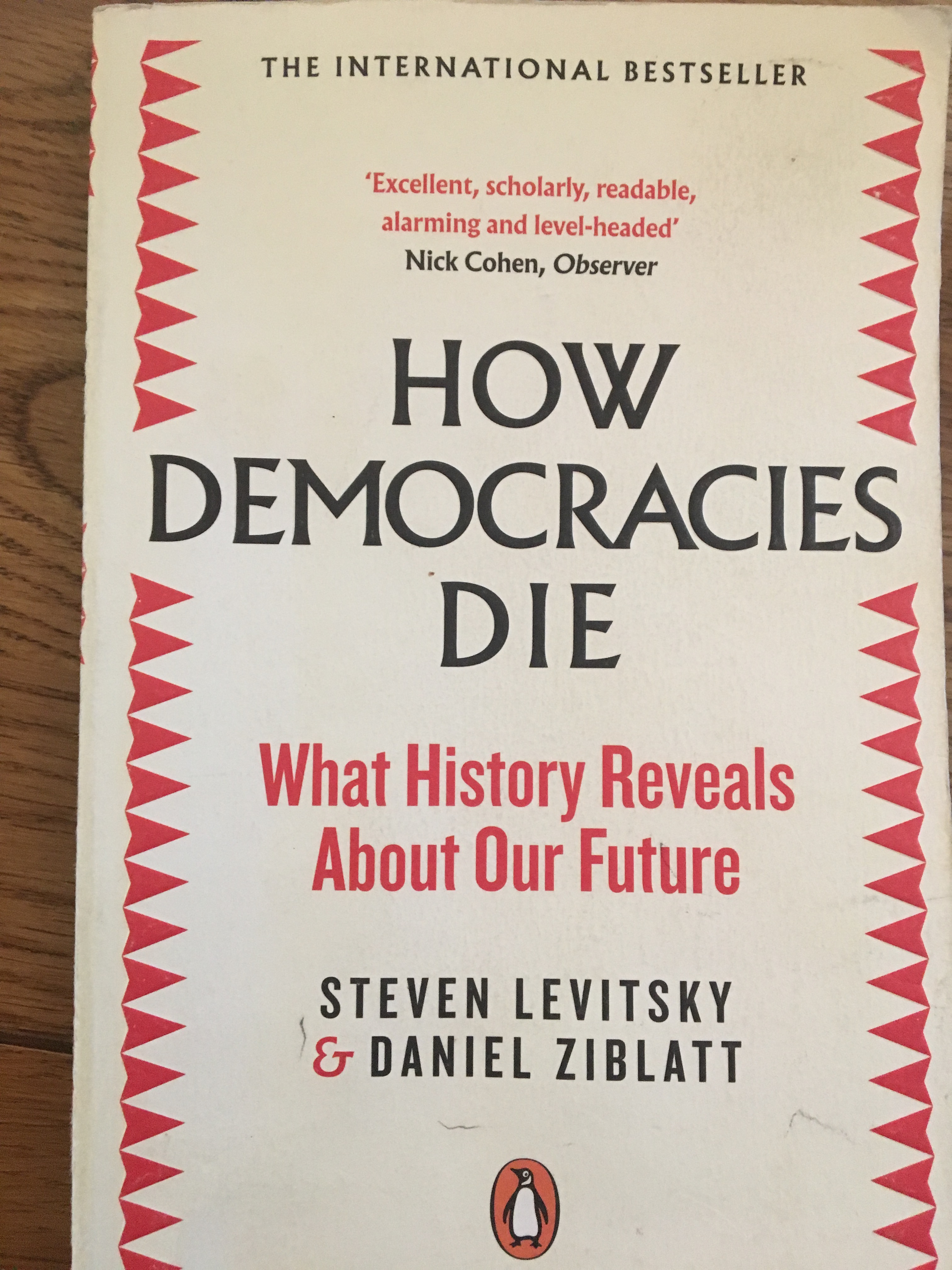
In their book, “How Democracies Die”, Steven Levitsky and Daniel Zitblatt draw on 15 years research and teaching together about how democracies fail. They distinguish between circumstances where agents external to the domestic political system use force to overthrow elected governments, Allende’s Chile being a classic example of this.
 A more insidious, but no less effective and dangerous, mechanism they identify is when a democracy is destroyed from within. Destroyed by leaders who have come to power through the very democratic process which they ultimately debase and destroy. A variety of examples are drawn upon to illustrate their case. In some instances it was clear from early on the individual concerned had no respect for, or interest in, democracy, others drifted to a more authoritarian position in a tit for tat escalation of power plays with opposition parties.
Based on their research they identify four key indicators of authoritarian behaviour. First, a rejection of, or weak commitment to, the democratic rules of the game. An example might be a candidate saying they may not accept the outcome of the election if they don’t win. Second, a denial of the legitimacy of political opponents, for example questioning whether they were legally entitled to hold office. Third, the toleration or encouragement of violence. Finally, readiness to curtail civil liberties of opponents, including the media.
Interestingly, Levitsky and Zitblatt see political parties as having a key role to play as gatekeepers for democracies. Ensuring only those committed to the rules of the game get to play. Or at least exercising appropriate control when errant leaders go off-piste.
Whilst one should never fail to hold to personal account leaders who undermine democracy there is real force in the wider level of responsibility amongst political parties to shore up democratic values and call out transgressors. It is particularly incumbent on a problematic leaders’ own party to accept this responsibility, not least as it has the greatest power to enforce acceptable standards of behaviour.
The Republican Party in the United States will, in the fullness of time, be seen to have been derelict in their duty to democracy from its actions to date in relation to their President. They have a President who, even given the leeway appropriate to an incumbent and a member of their Party, has demonstrated time and again a disdain for democratic conventions and an ignorance of the fundamental principles of the Constitution.
There are some things which should override partisan loyalty and access to Presidential power. Democracy needs to be cultivated and supported if the concentration of power and the inevitable abuse that accompanies this is to be avoided.
No one should underestimate the scale of the threat that President Trump represents. Every congressman and senator in the US needs to look to their conscience and answer whether President Trump represents the values they want to shape the country their children live in.
“How Democracies Die” does not see President Trump as the single aberrant cause of the current dysfunctional politics in the States. They believe the “process of norm erosion started decades ago…” A key personality they identify is Newt Gingrich and his election in 1978. This turning point ushered in a period when the language of politics was increasingly coarsened. Gingrich took combative politics to a new level, questioning the patriotism of Democrats, comparing them to Mussolini and accusing them of trying to destroy the country. Initial concern amongst traditional Republicans was overcome and bipartisan compromise and progress gave way to legislative deadlock and government shutdowns.
By the time President Obama was elected in 2008 many of the conventions and norms essential to the effective running of governments had been abandoned. Three norm breaches pointed to by Levitsky and Zitblatt show how far apart the sides had become. Firstly, the refusal by the Republicans, propelled by the Tea Party, to raise the Federal debt limit. In passing, it is something of a mystery what has happened to the enormous Republican concern with the Federal debt now that President Trump has added a significant amount to it with tax cuts.
Secondly, in March 2015 forty six Republican Senators wrote an open letter to Iran’s leaders claiming President Obama had no authority to negotiate a deal over Iran’s nuclear programme. Seeking to undermine the authority of a sitting president was previously unthinkable.
But possibly the most outrageous and significant in the long term was the blocking of President Obama’s nomination to the Supreme Court in 2016. In 150 years from 1866 to 2016 the Senate has always accepted the right of the sitting President to fill a Supreme Court seat. The Republicans did not just refuse the proposed candidate of President Obama they said they would not consider any nominee from him in his last year in office.
When politicians turn democracy into a zero sum power game they play with fire. They transform opponents into enemies and divide communities. In a context of massive and growing inequality, continuing stagnation of wage levels, the automation of more and more jobs, and the rising impact of climate change this has the potential to be cataclysmic.
Changes over the past 40 years have created an environment where someone like Donald Trump can get elected to the Presidency of the United States and be supported by the vast majority of Republican senators and congressmen. It would be wrong however to see President Trump as simply another step along a path of the debasement of political currency. He is a step change in the degradation of the body politic. The need for him to be rejected by voters in the United States is vital. Democrats must ensure they do not allow him to divide them. If they do the very term United States may be in danger and democracy may indeed die.
 northerncomment